Trump’s Personal Lawyer Boasted That He Got Preet Bharara Fired

And a Kasowitz partner is a leading candidate to replace Bharara!

Marc Kasowitz, President Trump’s lawyer in the Russia investigation, has bragged he was behind the firing of U.S. Attorney Preet Bharara.


Marc Kasowitz, President Donald Trump’s attorney, makes a statement to the media on June 8, 2017, in Washington, D.C. (Ricky Carioti/The Washington Post via Getty Images)

Marc Kasowitz, President Donald Trump’s personal lawyer in the Russia investigation, has boasted to friends and colleagues that he played a central role in the firing of Preet Bharara, the United States Attorney for the Southern District of New York, according to four people familiar with the conversations.

Kasowitz told Trump, “This guy is going to get you,” according to a person familiar with Kasowitz’s account.

Those who know Kasowitz say he is sometimes prone to exaggerating when regaling them with his exploits. But if true, his assertion adds to the mystery surrounding the motive and timing of Bharara’s firing.

New presidents typically ask U.S. attorneys to resign and have the power to fire them. But Trump asked Bharara to stay in his job when they met in November at Trump Tower, as Bharara announced after the meeting.

In early March, Trump reversed himself. He asked all the remaining U.S. attorneys to resign, including Bharara. Bharara, a telegenic prosecutor with a history of taking on powerful politicians, refused and was fired March 11.

As ProPublica previously reported, at the time of Bharara’s firing the Southern District was conducting an investigation into Trump’s secretary of health and human services, Tom Price.

Kasowitz and the White House did not respond to requests for comment.

Kasowitz became a nationally recognized figure last week, after he acted as Trump’s designated spokesman to respond to former FBI Director James Comey’s landmark Senate testimony.

Kasowitz’s claimed role in the Bharara firing appears to be a sign that the New York lawyer has been inserting himself into matters of governance and not just advising the president on personal legal matters.

Kasowitz has also said in private conversations that Trump asked him to be attorney general, according to four people familiar with the matter. Kasowitz said he turned down the role. Ultimately, Trump decided to give the position to then-Alabama Sen. Jeff Sessions.

The Southern District of New York conducts some of the highest profile corporate investigations in the country. According to news reports, it is currently probing Fox News over payments made to settle sexual harassment charges against the network’s former chairman, the late Roger Ailes. The office is also looking into Russian money-laundering allegations at Deutsche Bank, Trump’s principal private lender.

Kasowitz has represented Trump over the years on matters including his failed libel lawsuit against a journalist, the Trump University case, and then-candidate Trump’s response to allegations of sexual assault by multiple women last year. Trump retained him to be his personal attorney in the Russia investigation last month.

The New York Times reported Sunday that Kasowitz has advised White House staffers about whether they need personal attorneys, raising conflict of interest questions.

Trump has also turned to Kasowitz’s firm to fill jobs in the administration. David Friedman, a former name partner of the firm, is now ambassador to Israel. Trump considered former senator and Kasowitz Senior Counsel Joseph Lieberman to replace Comey.

One of the names floated to replace Bharara is Edward McNally, a partner at Kasowitz’s law firm. More than three months after Bharara was fired, Trump has not nominated anyone to fill the Southern District job or most of the other U.S. attorney positions.

Bharara’s firing on March 11 came two months before the firing of Comey, head of the FBI. Critics charge that Trump obstructed justice in forcing Comey out.

Comey testified last week that Trump had tried to “create some sort of patronage relationship.” Bharara said in a television interview Sunday that Trump had attempted something similar with him: Comey’s testimony “felt a little bit like déjà vu.”

Posted in Congress, GOP, Trump | Tagged , | Comments Off on Trump’s Personal Lawyer Boasted That He Got Preet Bharara Fired

Smirnoff mocks Trump’s Russia scandals in new ad

Dive Brief:

  • Vodka maker Smirnoff released an outdoor ad campaign that mocks the Trump administration’s alleged collusion with the Russian government, according to Adweek. The ad, which sparked a wave of social media buzz, features an image of the iconic Smirnoff bottle with the text: “Made in America. But we’d be happy to talk about our ties to Russia under oath.”
  • The ad alludes to President Trump’s recent claims that he will testify to Congress under oath about a special prosecutor’s probe into accusations that Russia influenced the 2016 election in his favor.
  • Smirnoff vodka dates back to an 1860s Moscow distillery, but is now part of British-based global beverage maker Diageo. Today’s Smirnoff vodka is distilled at a Diageo facility in Plainfield, Illinois.

Dive Insight:

In the aftermath of a divisive election and in the midst of a controversial, scandal-ridden presidency, brands may be tempted to distance themselves from the political sphere for fear of alienating valuable consumers. Ignoring consumers’ feelings toward today’s politics could be a risky move, however, as this could cause people to view some brands as out of touch.

Russell Zack, senior vice president of products and solutions at HelloWorld, told Food Dive that in today’s marketplace, brands can’t afford to be completely apolitical.

“Brands who have a global audience really do need to make a statement about where they stand politically, and you’re seeing those big global brands like Anheuser-Busch and Coca-Cola make those statements  — most of which are about inclusion,” Zack said. “There’s also so much consumer choice out there, so brands need to be very clear about their position in the world.”

Smirnoff’s ad campaign deftly makes light of an issue that is plaguing both sides of the political spectrum, though it will likely be interpreted as anti-Trump by some consumers. It’s important for brands to have a deep understanding of the behavior of their consumer base before launching a political marketing blitz. Companies want to avoid having to backpedal after launching an ad that toes the line as Smirnoff’s does. Businesses that decide to try such a campaign should have a response and game plan ready in case of backlash.

“Anything can be misrepresented, anything can be possibly misconstrued, and if brands are making these statements, they need to be prepared for any type of response  — good or bad  — that consumers will have in response to those comments,” Zack said.

It will be interesting to see how consumers react to the ad in the coming days, and if Smirnoff will experience any sales hits as a result. So far, social media users have been commending the poster as a “good burn”, driving the ad to Reddit’s front page during the weekend.

When Anheuser-Busch aired its “Born The Hard Way” Super Bowl commercial, which depicts the immigration of co-founder Adolphus Busch from Germany to the U.S. in the 1800s, the ad garnered both praise and criticism. Some consumers called for a boycott of Budweiser products, claiming the commercial was made in response to President Trump’s immigration ban. Smirnoff’s ad doesn’t seem to have inspired the same vitriol, but only time will tell if the politically charged campaign will help or hurt the company’s sales and brand image.

Copyright © Industry Dive (or its licensors)
Posted in Trump | Tagged , , | 1 Comment

Do or Die on Trumpcare

Senate Republicans want to rush a vote on Trumpcare in JUNE, whether they have the votes or not. The deciding moment may be near.   Since much of this is behind closed doors and interest groups such as doctor associations, hospital associations, patients advocates, apparently represent a “half hearted opposition“….well it is up to us, the public, to raise all hell.

here are some breaking stories:

Nationwide blitz launched,  in Forbes

The Senate Trumpcare bill

Senate Trumpcare behind closed doors

Sen. Tom Cotton, Sen. Mike Lee and Sen. Rand Paul, all Republicans, have said in the past that they oppose the American Health Care Act and will vote against it.

AARP is targeting Sens. Lisa Murkowski and Dan Sullivan of Alaska, Jeff Flake of Arizona, Cory Gardner of Colorado, Joni Ernest and Chuck Grassley of Iowa, Dean Heller of Nevada, Rob Portman of Ohio, Lamar Alexander and Bob Corker of Tennessee, and Shelley Moore Capito of West Virginia, with aggressive TV advertizing.

Kaiser Family Foundation lists 6 senators that could kill the Senate bill:

SENATOR STATE STATE TRUMP MARGIN STATE EXPANDED MEDICAID
Shelley Moore Capito West Virginia +42
Bill Cassidy Louisiana +20
Susan Collins Maine -3
Dean Heller Nevada -2
Lisa Murkowski Alaska +15
Rob Portman Ohio +8
Senate Republicans who could stop the Obamacare repeal

Sources: Kaiser Family Foundation, The New York Times


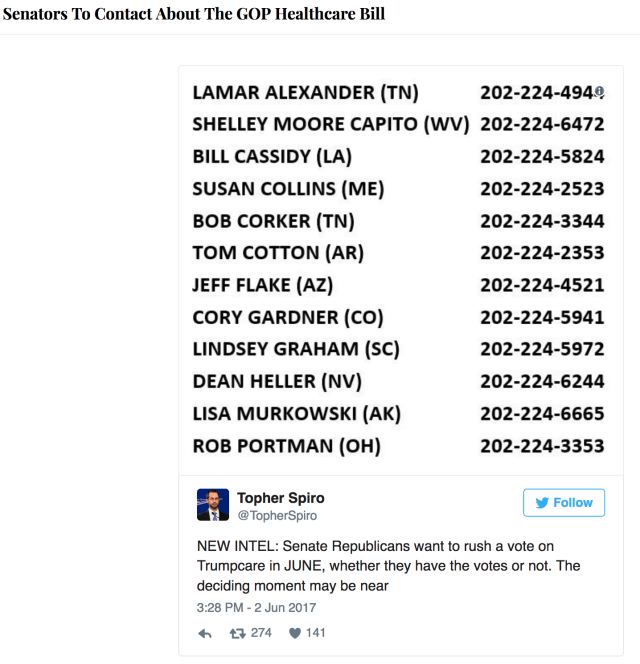
Here is a useful list with phone numbers:

Screen Shot 2017-06-13 at 5.29.23 PM.png


Posted in AHCA, GOP, Health Care, Medicaid, Pre-existing Conditions, Trump, trumpcare, Uncategorized, Zeldin | Tagged , , , | Comments Off on Do or Die on Trumpcare

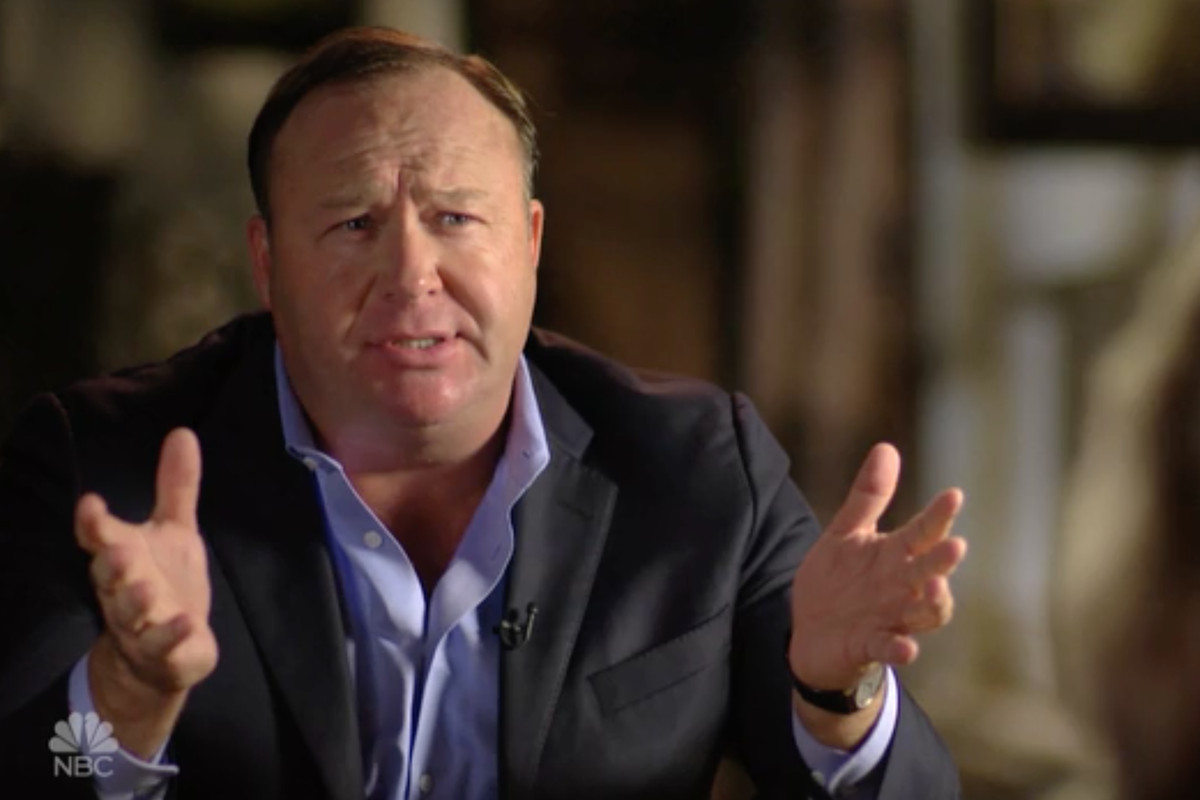
NBC’s Megyn Kelly’s interview with Alex Jones is shaping up to be a disaster

The sit-down format was a poor choice for a segment on the Infowars conspiracy theorist.

Posted in Fake News, Uncategorized | Tagged , , , | Comments Off on NBC’s Megyn Kelly’s interview with Alex Jones is shaping up to be a disaster

U.S. Refuses to Sign G7 Climate Pledge

Trump’s Chief Climate Denier Delivers the Coup de Grace on US Leadership on Climate Issues

The U.S. refused to sign on to the full Group of Seven environment ministers statement Monday, abstaining from large sections of the final communique on climate change and development banks funding climate initiatives.

“The United States will continue to engage with key international partners in a manner that is consistent with our domestic priorities, preserving both a strong economy and a healthy environment,” a footnote to the final text reads. “Accordingly, we the United States do not join those sections of the communiqué on climate and MDBs, reflecting our recent announcement to withdraw and immediately cease implementation of the Paris agreementand associated financial commitments.”

The section on climate change in the final communique affirmed Paris as “irreversible,” voiced support for international efforts to limit hydrofluorocarbons and airline emissions and reaffirmed the necessity of “an interactive evidence-based dialogue drawing on the best available science, including reports of the Intergovernmental Panel on Climate Change.”

German environment minister Barbara Hendricks said in an interview that U.S. Environmental Protection Agency administrator Scott Pruitt, who attended the meeting for only a few hours Sunday, blamed President Obama for moving ahead with the Paris agreement, which Pruitt told other ministers is a bad deal for the U.S.

“Trump sending Scott Pruitt to the environmental ministers meeting for only one day was a pathetic and failed attempt to save face following his historic mistake of withdrawing the U.S. from the Paris agreement,” John Coequyt, Sierra Club global climate policy director, said.

“Sending a notorious climate denier like Scott Pruitt to discuss anything related to the environment is nothing short of an insult to the other countries of the world who are acting on climate.”

Posted in Air Pollution, climate change, Environment, EPA, Trump | Comments Off on U.S. Refuses to Sign G7 Climate Pledge

You’re Probably Going to Need Medicaid

Photo Credit Niko J. Kallianiotis for The New York Times

Imagine your mother needs to move into a nursing home. It’s going to cost her almost $100,000 a year. Very few people have private insurance to cover this. Your mother will most likely run out her savings until she qualifies for Medicaid.This is not a rare event. Roughly one in three people now turning 65 will require nursing home care at some point during his or her life. Over three-quarters of long-stay nursing home residents will eventually be covered by Medicaid. Many American voters think Medicaid is only for low-income adults and their children — for people who aren’t “like them.” But Medicaid is not “somebody else’s” insurance. It is insurance for all of our mothers and fathers and, eventually, for ourselves.The American Health Care Act that passed the House and is now being debated by the Senate would reduce spending on Medicaid by over $800 billion, the largest single reduction in a social insurance program in our nation’s history. The budget released by President Trump last month would up the ante by slashing another $600 billion over 10 years from the program. Whether the Senate adopts cuts of quite this magnitude or not, any legislation that passes the Republican Congress is likely to include the largest cuts to the Medicaid program since its inception.Much focus has rightly been placed on the enormous damage this would do to lower-income families and youth. But what has been largely missing from public discussion is the radical implications that such cuts would have for older and disabled Americans.

Medicaid is our nation’s largest safety net for low-income people, accounting for one-sixth of all health care spending in the United States. But few people seem to know that nearly two-thirds of that spending is focused on older and disabled adults — primarily through spending on long-term care services such as nursing homes.

Indeed, Medicaid pays nearly half of nursing home costs for those who need assistance because of medical conditions like Alzheimer’s or stroke. In some states, overall spending on older and disabled adults amounts to as much as three-quarters of Medicaid spending. As a result, there is no way that the program can shrink by 25 percent (as under the A.H.C.A.) or almost 50 percent (as under the Trump budget), without hurting these people.

A large body of research, some of it by us, has shown that cuts to nursing home reimbursement can have devastating effects on vulnerable patients. Many nursing homes would stop admitting Medicaid recipients and those who don’t have enough assets to ensure that they won’t eventually end up on Medicaid. Older and disabled Medicaid beneficiaries can’t pay out of pocket for services and they do not typically have family members able to care for them. The nursing home is a last resort. Where will they go instead?

Those who are admitted to a nursing home may not fare much better. Lowering Medicaid reimbursement rates lead to reductions in staffing, particularly of nurses. Research by one of us shows that a cut in the reimbursement rate of around 10 percent leads to a functional decline of nursing home residents (that is, a decline in their ability to walk or use the bathroom by themselves) of almost 10 percent. It also raises the odds that they will be in persistent pain by 5 % and the odds of getting a bedsore by 2 %.

Finally, these cuts would just shift costs to the rest of the government. Lower-quality nursing home care leads to more hospitalizations, and for Americans over 65, these are paid for by another government program, Medicare. One-quarter of nursing home residents are hospitalized each year, and the daily cost of caring for them more than quadruples when they move to the hospital. Research shows that a reduction in nursing home reimbursements of around 10 percent leads to a 5 percent rise in the odds that residents will be hospitalized. So care for seniors suffers, and the taxpayer pays.

Mr. Trump and the Republicans would lower spending on the frailest and most vulnerable people in our health care system. They would like most Americans to believe that these cuts will not affect them, only their “undeserving” neighbors. But that hides the truth that draconian cuts to Medicaid affect all of our families. They are a direct attack on our elderly, our disabled and our dignity.

Posted in AHCA, American Health Care Act, Health Care, Medicaid, Seniors, Uncategorized, Zeldin | Tagged , , , | Comments Off on You’re Probably Going to Need Medicaid

Trump backs permanent snooping powers he once criticized as abusive

We Have Good Reasons to Be Concerned About the Impact of Section 702 on the Criminal Justice System

Posted on Just Security


In a recent analysis for Just Security, I explored some concerns about how warrantless surveillance under Section 702 of the Foreign Intelligence Surveillance Act (“FISA”) may be undermining the U.S. criminal justice system. While many of those concerns would apply to the government’s potential reliance on warrantless Section 702 data as part of any criminal probe, I expressed a worry that such data might conceivably be making its way into investigations of relatively low-level suspected offenses (for example, suspected drug-related violations).

Partly in reply to Dean Asha Rangappa’s letter to the editor, I would like to expand on a few of the problematic practices I had mentioned—all of which should be at the forefront of legislators’ minds during the upcoming debate about whether Section 702 should be renewed before its scheduled sunset at the end of this year. These include “incidental”collection, warrantless querying of Section 702 data by the FBI, and parallel construction.

“Incidental” collection: A “subset” can still be a large pool of private information—including on U.S. persons

Under the law, the executive branch must “target” non-U.S. persons outside the United States when it carries out warrantless monitoring of Internet or telephone communications under Section 702. These targets need not be suspected of any wrongdoing: as long as “a significant purpose” of the surveillance is to obtain “foreign intelligence information,” a term FISA defines broadly, any non-U.S. person outside the country’s borders is fair game. In 2016, the government had an estimated 106,469 such targets—a number that had steadily increased for several years. Foreign Intelligence Surveillance Court (“FISC”) amicus, Amy Jeffress, who served as an impartial adviser, has confirmed that “not all Section 702 targets are international terrorists,” and the executive branch has yet to explain who else might be singled out. Then-chair of the Privacy and Civil Liberties Oversight Board (“PCLOB”) David Medine told Congress in 2016 that a Section 702 target could be “anyone with foreign intelligence value,” including, for example, “a completely innocent businessman.” 

While this monitoring has considerable human rights implications for the foreigners who are targeted, it is likely that the dragnet is also capturing large numbers of U.S. persons’ communications. The government likes to describe this seizure of Americans’ private correspondence under Section 702 as “incidental.” However, as PCLOB has pointed out, “[s]uch ‘incidental’ collection … is not accidental, nor is it inadvertent.” FISA requires that Section 702 surveillance be “reasonably designed” to minimize such collection, but it happens anyway. The President’s Review Group on Intelligence and Communications Technologies even suggested in 2013 that the executive branch may have an incentive “to use section 702 in an effort to gather evidence against United States persons in a way that would circumvent the underlying values of both FISA and the Fourth Amendment.”

This pool of warrantless Section 702 information on U.S. persons is probably sizeable. Medine testified explicitly that “the government is collecting large quantities of Americans’ communications” under the law. In her FISC amicus brief, Jeffress referred to “a potentially very large … scope of incidental collection of communications between lawful targets and U.S. persons that are not the type of communications Section 702 was designed to collect”—including communications with “no foreign intelligence value.” These statements indicate that while it is probably literally true that U.S.-person information is a “subset” of the data gathered under Section 702, this subset may be substantial and may include such troublingly private content as—in Medine’s words—“family photographs, love letters, personal financial matters, discussions of physical and mental health, and political and religious exchanges.”

Therefore, I do not share Dean Rangappa’s confidence that warrantless Section 702 data is unlikely to include information on “[w]holly domestic” U.S. crimes—let alone crimes (such as drug-related offenses) that the government may regard as having some kind of foreign nexus, however remote. The fact is that when a government grabs untold reams of private communications belonging to thousands or millions of people, there is simply no knowing what kind of information might be in there, available to be searched.

Once the National Security Agency (“NSA”) has obtained data through Section 702, including on U.S. persons, it may distribute or report on that data in several ways that may ultimately have implications for criminal cases—including by sharing data it “reasonably believe[s] to contain evidence of a crime” with the FBI or other law enforcement bodies. While it has not been publicly confirmed that such knowing NSA sharing of Section 702 data believed to contain evidence of a crime is feeding into non-terrorism prosecutions, in my view the risk is real.

FBI querying: “Fishing” in the pool is probably not so unusual

The current Section 702 regime allows the FBI to obtain unknown amounts of raw Section 702 data without a warrant. PCLOB has said it does not obtain all such data, but the actual amount remains unclear; the Office of the Director of National Intelligence’s statementthree years ago that the data constitutes “a small percentage of NSA’s total Section 702 collection” did little to illuminate this.

The Bureau then has the power to carry out warrantless searches—or “queries”—of these communications, a practice that has prompted strong expressions of concern from independent evaluators. Medine testified that the FBI “routinely looks into 702 databases, and not just in investigations, but even in assessments where the FBI has absolutely no suspicion of wrongdoing … they’re just sort of entitled to poke around and see if something is going on.” Jeffress, too, flagged that the FISC has described these FBI queries as “routine and encouraged,” that the Bureau may conduct them even at the pre-investigation “assessment” stage, and that “there is no requirement that the matter be a serious one, nor that it have any relation to national security.”

It is difficult to reconcile the claim that it is “extremely unlikely” that FBI agents would “fish” in Section 702 data for evidence of crimes with Medine’s and Jeffress’ statements, which suggest the Bureau has the power to do just that. As Dean Rangappa emphasizes, FBI procedures require that “[t]o the extent reasonably feasible,” queries of raw Section 702 data must be designed to “find and extract foreign intelligence information or evidence of a crime.” That latter phrase, however, essentially captures the problem: Agents may carry out warrantless searches of warrantlessly seized communications in order to find something the government could use to put someone in jail.

A recent FISC opinion indicates that the executive branch has reported only one instance to the Court in which the FBI, using a query that was not designed to find “foreign intelligence information,” found Section 702 information on an American. As highly unsympathetic as that case is (it involved an e-mail containing a description of child abuse), the fact that the government did use Section 702 to find such information without a warrant should give us all pause. Footnote 53 in the opinion also gives rise to concern that the FBI’s self-reporting processes for such cases may not be fully reliable—and one wonders how expansive queries that are seeking “foreign intelligence information,” which would not even result in such reporting, may be.

The FBI’s adoption of internal procedures that, in some ways, regulate access to this pool of warrantlessly collected data (for example, by requiring agents to have authorization before they can view Section 702 data they have found) does not take these concerns off the table. First, as Chief Justice Roberts observed in Riley v. California, law enforcement’s development of internal rules to assuage concerns about warrantless searches is “[p]robably a good idea, but the Founders did not fight a revolution to gain the right to government agency protocols.” In other words, even the best and strictest FBI procedures cannot undo any constitutional or other violations inherent in these programs.

Second, the FISC expressed a stark concern in its recent opinion about the FBI’s “apparent disregard” of rules the FISC had approved, and recorded at least three serious episodes in which the Bureau improperly provided access to raw Section 702 data to its own employees or to groups of private contractors. The Court also raised fears that “the FBI may be engaging in similar disclosures of raw Section 702 information that have not been reported.”

Parallel construction means the use of this data in criminal investigations may never come to light

If the NSA, FBI, or other entities are employing warrantless Section 702 data in non-terrorism criminal investigations, this practice might never come to light. Historical documents suggest that the government may have devoted a significant amount of time over the years to pondering the question of how to use intelligence information in investigations without disclosing this fact at trial. Among other things, a declassified document from 1983 shows the executive branch seeming to embrace the idea of deliberately “build[ing] a firebreak” in evidentiary trails by encouraging law enforcement to develop independent evidence in a way that would prevent defendants from discovering that information originally came from intelligence activities. Thirty years later, Reuters reported that the DEA was engaging in just such an activity, known as “parallel construction,” to avoid disclosing its use of tips from intelligence.

The government’s decidedly belated notice of Section 702 surveillance in at least a few known criminal cases provide reason to be concerned about the use of parallel construction to conceal such monitoring; it is also worrying that even defense attorneys who fight determinedly to find out if Section 702 or other intelligence monitoring was employed in their clients’ cases may face stiff resistance. (For civil rights defenders, it is worth reading the hearing transcript and related motion in an unusual 2013 Texas drug case to see some of the challenges confronting such attorneys.) It also seems possible, as at least one declassified record as well as the Reuters article suggest, that the prosecution could simply drop cases if defendants appeared likely to succeed in forcing the disclosure of Section 702 surveillance.

* * *

Particularly since the discussion above draws on some materials that had not yet been released at the time of our original exchange, I hope Dean Rangappa will take this as an invitation to a continuing dialogue.

This analysis of how Section 702 data may be quietly making its way into criminal investigations is one aspect of a larger story: I am just as concerned about information the U.S. has warrantlessly obtained under Executive Order 12333 or intelligence-sharing agreements with foreign governments and hope to write further on those topics in the future. However, Section 702 presents an immediate opportunity to restore civil liberties in this area—something Congress should not pass up.

Image: Getty/Chip Somodevilla 

Tags: , , , , ,


ABOUT THE AUTHOR

is a researcher and advocate on national security, surveillance, and domestic law enforcement for the US Program at Human Rights Watch. You can follow her on Twitter (@SarahStV_HRW)

Posted in FBI, FISA, National Security, Trump | Tagged , , , , , | Comments Off on Trump backs permanent snooping powers he once criticized as abusive

Net Neutrality — Don’t Be Fooled by the Comcast PR Machine: It Has Always Opposed Internet Freedom

Electronic Frontier Foundation
JUNE 5, 2017

Years of lobbying and litigation has made it clear Comcast wants to turn the Internet into a toll road and run the booth

If you have signed onto Twitter and have been following the network neutrality debate, you’ve probably seen Comcast’s campaign to rewrite its history of opposition to the Open Internet. But the company’s own statements to Congress, the FCC, and to the courts make Comcast’s true goal abundantly clear: free rein to use its market power to become an Internet gatekeeper.

Converting the Internet into a Pay to Win System

In the early legal battles over network neutrality, Comcast challenged a Republican FCC’s ability to enforce open Internet principles. In repeated legal filings, the company made clear that it did not believe the FCC could prevent providers from data discrimination unless it reclassified them as common carriers. After all, Comcast itself said in court that “nondiscrimination obligations are the hallmark of common carrier regulation (page 12).” In other words, Comcast was saying that the FCC couldn’t impose nondiscrimination rules unless it reclassified Comcast as a common carrier – which is exactly what the FCC did in 2015 and exactly what Comcast is fighting now. “Common carrier regulation” is code for Title II of the Communications Act. “nondiscrimination obligations are the hallmark of common carrier regulation” -Comcast’s 2009 court filing in Comcast vs FCC

The Comcast Plan If Network Neutrality Is Repealed

At the FCC, Comcast doubled down. In 2010, Comcast told the agency that one of the “benefits” that would be lost under an Open Internet Order would be the ability for cable and telephone to strike exclusive deals with Internet companies – in other words, paid prioritization, or “fast lanes” for those who can afford them.

“The proposed rule could prohibit Internet content, application, and service providers from improving their existing offerings with the assistance of a broadband ISP, regardless of whether doing so would be pro-competitive and beneficial to consumers.” –Comcast FCC filing, Jan 14, 2010 (page 40).

While Comcast attempted to make paid prioritization sound like something that would be good for online service competition, it is pretty obvious how these types of exclusives and priority access deals will play out in reality. In practice, what we will see is the biggest Internet companies getting premium access to bandwidth while every mom-and-pop business and tech startup will get relegated to inferior infrastructure because they do not have the excess capital to pay for access. For example, even as the FCC was actively pushing a new Open Internet Order in 2014, Comcast started rerouting and degrading Netflix traffic despite the demand coming from Comcast’s customers. Today, Netflix says it can pay for fast lanes – but the next Netflix won’t be able to survive in that world.

Setting up the FCC to Fail

In its PR campaign, Comcast claims that its decision not to challenge the 2010 Open Internet Order is evidence of its support for network neutrality. In reality, it’s likely the company stayed quiet because shortly after the Open Internet Order was approved Comcast was required to operate neutrally as a condition of its merger with NBC Universal. It had little to gain from publicly opposing the 2010 Order because they could not lift network neutrality obligations over their network even if they won in court due to merger conditions. Those Comcast NBCU merger conditions will expire in 2018. Here is what they said following the merger during consideration of the FCC’s second defeat under Verizon vs. Comcast as they were asking for approval of yet another merger (this time with Time Warner Cable).

“Comcast agreed to be bound by the FCC’s Open Internet rules until 2018. These protections will now extend to the acquired TWC systems, giving the FCC ample time to adopt (and, if necessary, to defend) legally enforcement Open Internet rules applicable to the entire industry.” -Joint statement by David L. Cohen (Comcast) and Arthur T. Minson (Time Warner Cable) to the Senate Judiciary Committee regarding the Comcast-Time Warner Cable merger

Translation: Don’t worry about our merger because we are bound to respect the Open Internet Rules for now, and by the time the agreement expires, the FCC will have found a legally enforceable basis for net neutrality protections. As Comcast indicated way back in 2009, that path required the FCC to do exactly what it did in 2015: reclassify broadband as a common carrier service. So Comcast’s record is pretty clear: the cable behemoth has known for years what the FCC had to go to get legally sound neutrality rules. Now the FCC has done it, Comcast is fighting tooth and nail to reverse it.

If we want to stop the Comcast plan to repeal network neutrality and convert the Internet into a pay-to-win system where only the largest players can compete for access to subscribers, squeezing out innovative and competing services (not to mention libraries, hospitals, schools, and political organizations), then we must act now.

Tell the FCC your story and contact your two Senators and House Representative today.

Posted in Congress, FCC, Internet, Net Neutrality | Comments Off on Net Neutrality — Don’t Be Fooled by the Comcast PR Machine: It Has Always Opposed Internet Freedom

Trump Rebrands “Abstinence Only” as “sexual risk avoidance”

Under a clinical-sounding label, the shame-and-ignorance approach of the Bush era makes a comeback under Trump

Published in Salon, June 13, 2017

Abstinence only, rebranded: Failed right-wing sex-ed policy returns as "sexual risk avoidance"(Credit: Getty/wundervisuals)


Thrice-married libertine Donald Trump got himself elected president by rallying the religious right vote behind him. The devil’s bargain that Christian conservatives made with Trump is easy enough to understand: They ignore his history of sexual incontinence, including rumors of a literal “pee tape,” and he gives them more power over the sex lives of private individuals, especially young people and women. In office, President Trump has done just that, launching a multitude of attacks on legal abortion and contraception access.

Now it seems as if a third front is opening in the Trumpian war on other people’s sex lives: The return of abstinence-only education, which many Americans believe had died off after President George W. Bush left office. Well, abstinence-only ed is coming back, but this time around, its proponents hope that voters, especially parents, don’t notice the return to the classroom of religious anti-sex propaganda.

 The first sign that the Trump administration hoped to ease into the classroom more just-say-no-to-sex messages came in late May, when the White House proposed a budget that would slash nearly every government expenditure but would increase by $277 million spending on abstinence-until-marriage programs. Last week news surfaced that Valerie Huber, the head of a pro-abstinence organization called Ascend, will join the Department of Health and Human Services as chief of staff to the assistant secretary for adolescent health; the position will allow her to push for more support for abstinence-until-marriage programs in schools.

To be clear, abstinence-only ed was never completely dead. The Obama administration mounted many efforts to get rid of federal funding for abstinence-focused programs, and some were successful. But congressional Republicans managed to preserve at least some abstinence-centered funding, and since sex education curricula are mostly controlled by local school boards, abstinence programs have continued to flourish in many school districts. Religious conservatives have continued to push them onto schools under the noses of parents who might otherwise revolt at hearing that their kids are being subject to programs that shame the 95 percent of Americans who have premarital sex and that have repeatedly been linked to higher rates of teen pregnancy.

Part of what kept abstinence-only approaches alive is that the religious right has rebranded it as “sexual risk avoidance,” as if it were a public health initiative instead of religion-tinged sexual shaming.

“Over the years they got very smart,” explained Debra Hauser, the president of Advocates for Youth, in a phone conversation. “When we were like, ‘science over ideology,’ they turned around and produced their own journals and their own science.”

She added, “When we said, ‘This is a just-say-no program that didn’t work for drugs under Nancy Reagan and isn’t gonna work here,’ they said, ‘No, this isn’t abstinence until marriage; it just stresses abstinence.’ They turned around and went to this language about ‘sexual risk avoidance,’ which completely obfuscates what they’re actually doing.”

With Huber’s appointment, this rebranding and Republican control of all three branches of government, there’s good reason to fear a renewed push for schools to terrorize kids about sex, rather than providing true sex education.

Mary Anne Mosack, who replaced Valerie Huber as the head of Ascend (formerly called the National Abstinence Education Association), took issue during a phone interview with the implication that “sexual risk avoidance” is the just-say-no style of education that critics like Hauser say it is.

“We teach that [marriage] is the best context for sexual activity,” Mosack said, repeatedly insisting that this doesn’t mean that her organization’s approach is an abstinence-until-marriage program.

My conversation with Mosack, which lasted nearly a half hour, was maddeningly elliptical about what exactly the goals of the program are. I repeatedly pointed out that the average U.S. age of first marriage is 28 years old — a full 11 years after the average age for first having sexual intercourse — and asked if it’s unrealistic, and quite possibly unhealthy, to expect young people to wait that long to have sex. Mosack sidestepped the question, trying to redirect the conversation away from younger adults to teenagers. She said Ascend’s main goal was to “normalize . . .  sexual delay” for teenagers, adding, “We’re talking about middle school and high school.”

But when I then asked her if the point of the programs was to have younger people wait until, say, college before engaging in sexual activity, she said that, no, Ascend believes that virginity until marriage is the “best outcome.” And then around we went again.

Mosack’s position, if I’m being generous, seemed to be that if you tell young people to wait 15 years, maybe you can hope they wait five years — or three. To me that sounds less like education and more like setting up kids for failure. It certainly didn’t seem like a good way to frame human sexuality, which should ultimately be about pleasure and human connection, not described in terms that strongly resemble the Christian idea of sin. And it also doesn’t seem like a good way to impart health information that young people will need when they do inevitably start having sex.

“Make no mistake, there is still an underlying theme of shame, fear and the use of traditional gender stereotypes and roles” in these rebranded programs, Hauser said.

Mosack disagreed with Hauser’s position, insisting that the programs take a “holistic approach” to sex education.

I asked Mosack for some examples of curricula that her organization endorses, so I could see it for myself. At this point she got cagey. While her organization has certified hundreds of programs, she said, she wouldn’t give me any names or contact information, instead she said would pass my number along so that representatives of those programs could contact me. (No one has.)

It didn’t take much digging, however, to find a 2016 Ascend document that featured an extensive list of programs the organization had deemed successful “sexual risk avoidance” examples; many of the programs continue to use the “abstinence” language in their titles.

It just so happens that many of the Ascend-recommended programs were reviewed in 2016 by the Texas Freedom Network, which advocates for the separation of church and state and resists religion-tinged and anti-sex propaganda being pushed as “education” in schools.

Texas Freedom Network found that reframing abstinence-only programs as “sexual risk avoidance” led to a few minor improvements over the Bush-era programs. The amount of outright misinformation about contraception has declined and the programs have thankfully started to incorporate important information about consent. But the review still found that the programs demonize contraception. Much of the shaming and sexist messaging that gave abstinence-only education a bad name in the first place is still a major feature of the programs.

For instance, two Ascend-recommended programs — REAL Essentials and Choosing the Best — continue to teach that having sex makes a person dirty and incapable of falling in love.

REAL Essentials explains that glue (i.e., sex) is a bonding agent that works best on a surface that is ‘clean and dry’ (i.e., virgins),” the Texas Freedom Network report read. “Choosing the Best includes a similar exercise using adhesive tape. The exercise involves placing tape on a student’s skin, then removing it to show what has transferred from the skin to the tape. What remains on the tape is supposed to represent the emotional baggage resulting from sex.”

The idea of the exercise, of course, is to suggest that people who have sex become dirty and incapable of “sticking” to new partners.

The reviewers also found sexist stereotypes in Ascend-recommended programs like Scott and White Wellness and Sexual Health (formerly called Worth the Wait) and REAL Essentials. Their curricula framed men as sexual and women as romantic, treating marriage as a tense exchange whereby a woman provides access to her body in exchange for a man’s pledge of love.

In reality, of course, people of all genders experience both sexual desire and romantic yearnings — and the two are not experienced in opposition, for most people.

With the deceitful rebranding of abstinence-only programs and the Republican domination of government, there’s more than enough reason for parents to worry that these misleading, shaming programs will return to public school curricula. In many cases they’ve been there all along, despite the Obama administration’s efforts to kill off abstinence-only programs.

That doesn’t mean parents are powerless in this regard. In fact, Hauser argued, fighting for real sex education is a good avenue for people looking for opportunities to resist the Trump agenda.

“At the school-district level is where sex education is determined, both in policy and in practice,” Hauser explained. That means that as few as five or six parents, can often be enough to convince a superintendent to reject federal pressure or funding to replace real sex education with abstinence-only, she said.

The kids themselves can be the resistance’s best ally. They can be warned that schools may bring in activists from crisis pregnancy centers and other religious right organizations. Or students can cautioned to be on the lookout for anti-sex lectures that feature things like the tape stunt or similar ones involving chewing gum or cups of spit. The list of Ascend-approved curricula can serve as a cheat sheet for parents: If your kid comes home with abstinence-only books, it’s time to call the school and raise hell.

Posted in Birth Control, Family Issues, Family Planning, Planned Parenthood, Religion & tolerance, Trump | 1 Comment

As The World Burns

Published in the June 8 edition of The Long Island Advance

To the Editor of the Long Island Advance:

As residents of a coastal island, living all but surrounded by water, we might expect that our Congressman, Lee Zeldin, would do everything in his power to protect us against rising sea levels, more severe storms and the many other harmful consequences of climate change.

Surely as a member of the House Climate Solutions Caucus, which as the Advance previously reported Mr. Zeldin joined just weeks before he stood for re-election last November, one would expect Mr. Zeldin to join 21 other members of that caucus, Republicans and Democrats, in a letter to President Trump urging him not to withdraw the United States from the Paris climate agreement. That letter, sent to Mr. Trump on April 26th as debate in the White House reached a critical juncture, urged the president to take a “responsible approach” and listed multiple reasons why withdrawing from the Paris agreement would be damaging to our safety, to our economy, to our country and to the world.

But no, Mr. Zeldin refused to join his 21 Climate Caucus colleagues in signing the bi-partisan letter, even though Mr. Zeldin’s signature would have carried particular weight because Mr. Zeldin was an early supporter, and remains a steadfast supporter, of Mr. Trump.

History will not look kindly on those, like Mr. Zeldin, who were in a position to act but chose not to, while Mr. Trump proceeded to turn the momentous decision regarding the Paris climate agreement into a soap opera starring himself. Perhaps we could call it: “As the World Burns.”

Sincerely,

Marc Rauch
Bellport

Posted in climate change, East Hampton, Environment, EPA, Trump | Comments Off on As The World Burns