Charlene Yurgaitis gets health insurance through Medicaid in Pennsylvania. It covers the counseling and medication she and her doctors say she needs to recover from her opioid addiction. (Ben Allen/WITF)
Republicans in both the House and the Senate are considering big cuts to Medicaid. But those cuts endanger addiction treatment, which many people receive through the government health insurance program.
Charlene Yurgaitis is one of the people who’s been helped. She’s 35 and lives in Lancaster, Pa., and once supervised 17 people at an insurance company. But when some college students moved in next door to her about a decade ago, she started doing oxycontin with them. Then she moved onto heroin and harder drugs.
Earlier this year, Yurgaitis finally had enough of that life and went into recovery. It’s been difficult.
“I’ve been doing everything that I can possibly do to stop using,” she said. “My normal thought is to just do it. Nobody will ever know.”
To support her determination to stay sober, Yurgaitis gets a monthly shot of Vivitrol, also known as naltrexone.
“That stops me,” she said.
The medication blocks receptors in her brain so she can’t get high off opioids, but it also costs about $1,000 a dose. The monthly shots are paired with weekly therapy sessions, and regular visits with a recovery coach. Medicaid in Pennsylvania pays for all of the treatment.
Having this health insurance is how she’s managed to break her addiction over the past few months, Yurgaitis said.
“I would never be able to afford counseling,” she said. “I would never be able to afford psych meds. I would never be able to afford the Vivitrol shot.”
Yurgaitis is one of more than 124,000 Pennsylvanians who depended on Medicaid to get help for their drug or alcohol addiction last year. The Republican health care bill that passed the U.S. House of Representatives in May would reduce spending on Medicaid by more than $800 billion across 10 years. The Senate is modifying that bill but has been deliberating in secret. Deep cuts to Medicaid are expected in the Senate version of the bill, too.
Yurgaitis’ congressman, Rep. Lloyd Smucker, a Republican, voted for the GOP bill in the House; in the Senate, Pennsylvania Republican Pat Toomey has said he agrees that Medicaid should be cut.
Pennsylvania expanded Medicaid under the Affordable Care Act, and the state pays no more than 10 percent of the bills for the people who gained coverage under the expansion; federal funds contribute the other 90 percent. Toomey says states should have to pay a higher share.
“If it’s not worth it to the state to buy this coverage at 43 cents on the dollar [about what the state contributes to non-expansion Medicaid recipients], then how is it worth it to those very same taxpayers — who, at the end of the day, have to provide the funding for the federal program — why is it worth it to them to pay 90 cents on the dollar? It just doesn’t make sense,” Toomey said.
If federal Medicaid money gets cut, that would leave states to either fill in the financial gap, limit access to care or drop some people’s coverage.
At a clinic in Harrisburg, Dr. Sarah Kawasaki said recovering from opioid addiction is so physically difficult that people need access to medication like naltrexone to help them break free.
If they can’t get that medicine, she said, “I think that by necessity, they would probably have to go back to using heroin or any other medications they could find on the street to avoid getting sick. And I would worry about that.”
If Medicaid funding is reduced, Kawasaki said she expects more people to die from overdoses, and predicts a rise in hepatitis C and HIV infections because of dirty needles.
Yurgaitis, the patient in recovery, gets emotional thinking about the potential cuts.
“Why are you trying to change something that’s working? You know, that’s what I don’t understand,” she said. “If I don’t have those places to go to, I don’t have anything else. I need to have that safe place to go to, and when I’m in my counseling session, that’s my safe place. That’s where I can unleash my demons, and clear my head out.”
Yurgaitis hopes she’ll be able to get treatment for years to come, so that at some point she can go back to work — perhaps helping other people recover from addiction.
This story is part of a partnership that includes WITF, NPR and Kaiser Health News.
Kaiser Health News, a nonprofit health newsroom whose stories appear in news outlets nationwide, is an editorially independent part of the Kaiser Family Foundation.
President Trump’s proposed 2018 budget would result in deep cuts to federal payments to states. Federal funds currently account for nearly a third of state expenditures, so if enacted, Trump’s budget would kick huge decisions to statehouses: raise taxes, reduce benefits, or eliminate services.
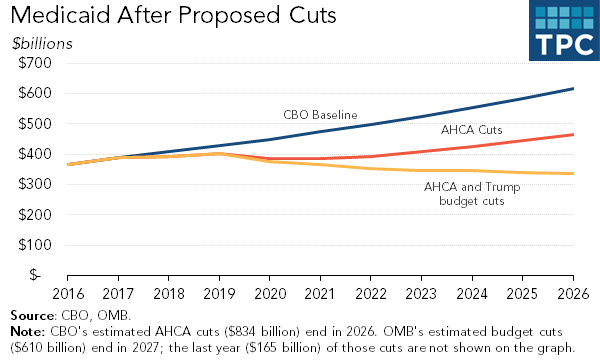
Start with state government’s largest expenditure, Medicaid (nearly 30 percent). The Trump budget, combined with proposals in the House-passed American Health Care Act (AHCA), could cut the federal contribution to Medicaid more than $1 trillion over the next decade.
The AHCA would gradually eliminate the Affordable Care Act’s Medicaid expansion and change the federal match rate to a per-capita cap, which would grow at a slower rate than current Medicaid spending. In total, the Congressional Budget Office (CBO) estimates the AHCA changes would reduce federal Medicaid spending $834 billion over 10 years. The president’s budget includes another $600 billion in cuts, which appear to be in addition to the AHCA’s cuts. However, in line with the rest of this “black box” budget, even the White House doesn’t know for sure (or won’t say). But if they are combined, they would cut federal Medicaid funding nearly in half by 2026.
In its typical understated way, the CBO describes what comes next. Its March score of the AHCA (which looked a lot like the new CBO score), said, “How individual states would ultimately respond [to Medicaid cuts] is highly uncertain.”
That’s because Trump and the House Republicans are offering states a trade-off that would fundamentally change the way the half-century old program works. Under the current funding mechanism, the federal government pays a percentage of program costs no matter how fast they grow. The Trump-House GOP replacement would cap federal contributions based on each state’s number of enrollees (per-capita cap), or offer funds in a block grant. States would get far more control over how they run the program—but with far less money to do so.
So would states raise taxes to fill the funding gap or drop people from health care? Connecticut and New Jersey established task forces to prepare responses to Medicaid cuts. But Texas Gov. Gregg Abbot cheered Obamacare’s “spiraling to a hasty death.” Regardless, even states that want to maintain current coverage levels would need billions in new dollars every year. That’s a huge lift for states and why CBO estimated 14 million would lose Medicaid if AHCA became law.
Then there’s the rest of Trump’s budget. Along with some budget tricks, the administration finds balance by reducing non-defense discretionary spending 2 percent each year—totaling $1.4 trillion over 10 years.
Specifically, it proposes double-digit percentage cuts to the departments of Agriculture, Commerce, Education, Health and Human Services, Housing and Urban Development, and Transportation, all of which send money to states. Some examples of program cuts over the 10-year period:
$200 billion cut from the SNAP (i.e., food stamps); currently completely federally funded, the budget also proposes requiring states to chip in a quarter of funds.
$100 billion cut from the Highway Trust Fund, which sends money to states for highway and mass transit projects.
$20 billion from Temporary Assistance for Needy Families, a joint federal-state funded program that provides welfare cash.
The National Association of State Budget Officers has a good roundup of the numerous other state administered programs cut or eliminated in the budget, including EPA grants, community development block grants, rental assistance programs, low income home energy assistance programs, and more. And what about the administration’s new social program, paid parental leave? The budget forces states to raise their unemployment taxes to pay for it.
Would states raise taxes to keep these programs? Does the equation change if the state and local tax deduction is repealed?
There are a lot of unknowns, but we know the administration and Congress are both interested in cutting federal payments to states, and that states don’t have enough money to replace those funds. As with health care, the federal budget cuts would probably reduce services and beneficiaries. But because they’re state programs, what each state does is highly uncertain.
Posts and Comments are solely the opinion of the author and not that of the Tax Policy Center, Urban Institute, or Brookings Institution.
The President’s fiscal year 2018 budget request to Congress includes many elements that shift more responsibility to state and local governments or modify some longstanding fiscal federalism practices through funding eliminations or major reductions.
Below are statements pulled directly from the Administration’s budget documents produced by the Office of Management and Budget and the individual Departments, and written testimony on the budget from Administration officials.
New State Financial Requirements
SNAP – First-time State Funding Match Shift to States – $191 billion from 2020-2023
The Budget also proposes to re-balance the Federal/State partnership in SNAP benefits to low-income households by gradually establishing a State match for benefit costs, phasing in from a national average of 10 percent in 2020 to 25 percent, on average, by 2023. To help States manage their costs, new flexibility regarding benefit levels would be provided. This proposal allows States to determine their level of SNAP benefits…and gives States options that can mitigate the effects of the funding shift…By giving States a financial stake in the cost of providing these benefits, rather than relying entirely on Federal funds, it would increase State incentives to create economic paths to self-sufficiency.
FEMA – State Homeland Security Grant and Urban Area Security Initiative – First-time State Funding Match Shift to States – $267 million
The Budget proposes a 25 percent non-Federal cost match for grant dollars with State and local partners. General Kelly, May 24, 2017 written testimony to Congressional committee: By using a cost-sharing approach, Federal dollars are spent on activities that our non-Federal partners themselves would invest in, providing clear results in priority areas.
Parental Leave – Funded by State Unemployment Insurance (UI) Taxes
The Budget also includes a proposal to provide six weeks of paid parental leave, which is paid for with a package of mandatory savings proposals to improve Unemployment Insurance (UI) program integrity and solvency. Using the UI system as a base, the proposal will allow States to establish paid parental leave programs in a way that is most appropriate for their workforce and economy. States would be required to provide six weeks of parental leave and the proposal gives States broad latitude to design and finance the program. The proposal is fully offset by a package of sensible reforms to the UI system—including reforms to reduce improper payments, help unemployed workers find jobs more quickly, and encourage States to maintain reserves in their Unemployment Trust Fund accounts.
Better Done At The State And Local Level
Labor – Workforce Investment and Opportunity Act (WIOA)Adult Employment and Training, Youth Activities and Dislocated Workers and Employment Service Reduced – $1.3 billion or 39%
The Budget would decrease funding for WIOA Title I and III formula programs by $1.3 billion, shifting more responsibility for funding these programs and training American workers to States, localities, and employers and giving them more freedom to design their programs. The Budget also provides States and localities with new flexibility and discretion to serve workers based on the specific training needs of their workforce.
Education – 21st Century Community Learning Centers Eliminated – $1.16 billion
The provision of before- and after-school academic enrichment opportunities may be better supported with other Federal, State, local or private funds, including the $15 billion Title I Grants to Local Educational Agencies program.
Education – Student Support and Academic Enrichment Grants Eliminated – $277 million
Also, the activities authorized under this program generally can be supported with funds from other Federal, State, local or private sources, including the $15 billion Title I Grants to Local Educational Agencies program.
Transportation – Transit Capital Investment Program (New Starts)-Future Grants Eliminated – $928 million
Future investments in new transit projects would be funded by the localities that use and benefit from these localized projects. Several major metropolitan regions have recently passed multi-billion revenue measures to fund transit projects, and the Administration believes that is the most appropriate way to fund transit expansion and maintenance efforts. These regions realize waiting for Federal grant funding is not the most efficient way to meet their local transportation needs.
HUD – Community Development Block Grant (CDBG) Eliminated – $2.9 billion
The Budget recognizes that State and local governments are better positioned to address local community and economic development needs.
Regional Commissions Eliminated – $156 million
The Appalachian Regional Commission (ARC), the Delta Regional Authority (DRA), the Denali Commission and the Northern Border Regional Commission (NBRC) are independent agencies that award Federal grants for regional development. The proposed elimination of the regional commissions reflects the need to reduce unnecessary Federal spending and streamline the Federal Government’s role, while encouraging States and localities to partner with the private sector to develop local-tailored solutions to local problems.
EPA – Geographic Programs Eliminated – $427 million
These programs perform local ecosystem protection and restoration activities, which are best handled by local and State entities. The EPA will encourage (the six Chesapeake Bay states and Washington D.C., five Gulf of Mexico states, New York and Vermont, Long Island Sound states and local entities, state, tribal, and local entities, the state of California and local entities, the eight Great Lakes states and tribal and local entities) to continue to make progress from within core water programs in (restoring the Bay, restoring the Gulf of Mexico, restoring Lake Champlain, restoring the Sound, restoring the Puget Sound, restoring the San Francisco Bay, protecting and restoring sensitive aquatic ecosystems in South Florida, restoring the Great Lakes).
HUD – Choice Neighborhoods Eliminated – $125 million
State and local governments may be better positioned to fund locally-driven strategies for neighborhood revitalization. Moreover, local government’s commitment to policy changes and interagency coordination are critical to achieving the educational and public safety goals associated with the program, and to achieve the necessary scale to impact entire neighborhoods.
HUD – Home Investment Partnerships Program Eliminated – $948 million
The Administration devolves affordable housing activities to State and local governments who are better positioned to comprehensively address the array of unique market challenges, local policies, and impediments that lead to housing affordability problems.
HUD – Housing Trust Fund and Capital Magnet Fund Eliminated – $194 million
The Budget would devolve some affordable housing activities to State and local governments who are better positioned to comprehensively address the array of unique market challenges, local policies, and impediments that lead to housing affordability problems.
Legal Services Corporation Eliminated – $351 million
The proposal also puts more control in the hands of State and local governments which better understand the needs of their communities.
You’re Doing Too Much
EPA – Categorical Grants Reduced – $482 million
Many States have been delegated authority to implement and enforce Federal environmental laws including the Clean Air Act, Clean Water Act, and Safe Drinking Water Act. The Budget proposes to eliminate or substantially reduce Federal investment in State environmental activities that go beyond EPA’s statutory requirements. States may be able to adjust to reduced funding levels by reducing or eliminating additional activities not required under Federal law, prioritizing programs, and seeking other funding sources including fees. Grants proposed for elimination include Beaches Protection, Lead, Multipurpose Grants, Nonpoint Source, Pollution Prevention, Radon and Underground Storage Tanks. Grants proposed for reductions include Hazardous Waste Financial Assistance, Pollution Control, Public Water System Supervision, and State and Local Air Quality Management.
The Budget also recognizes the need for greater contribution from State and local governments and the private sector to help address affordable housing needs among low-income households.
You’re Already Doing It
DHS – Transportation Security Administration Law Enforcement Grants Eliminated – $45 millionThe amount of financial support offered by this program has waned in recent years, declining below 50 percent of total State and local law enforcement costs in fiscal year 2016 and continuing to decline. As such, State and local jurisdictions are supporting more of the cost of providing law enforcement presence at airports. Discontinuing this program should not place an undue burden on State and local jurisdictions, since they already pay the majority of law enforcement costs.
You Have Other Funds You Can Use
EPA – Water Quality Research and Support Grants Eliminated – $26.8 million
States have the ability to develop technical assistance plans for their water systems using Public Water System Supervision funds and set-asides from the Drinking Water State Revolving Fund (DWSRF).
HHS – Social Services Block Grant (SSBG) Eliminated – $1.4 billion
SSBG is a permanently authorized program, which funds a wide variety of services. There are 29 broad service categories within SSBG (including “other”). However, better targeted State and Federal programs currently fund most of these services. SSBG lacks strong performance metrics and the means to hold States accountable for spending SSBG funds effectively.
You’re Not Doing It Right
HHS – Temporary Assistance for Needy Families (TANF) Reduction and TANF Contingency Fund Reduced TANF by 10% – $1.2 billion Eliminated Contingency Fund – $567 million
While the proposal would reduce the amount available to States for cash assistance and other benefits that promote self-sufficiency, the proposal also recognizes that TANF’s flexible spending rules have resulted in States using a large portion of TANF funds for benefits and services that do not directly serve the core intent of the program – to help low-income families meet their basic needs and move them toward self-sufficiency.
While the intent of the Contingency Fund has been to assist States experiencing increased demand for cash assistance during economic downturns, States may use contingency funds for any TANF purpose, many of which have no direct relationship to helping families meet needs in hard economic times. Some States have used contingency funds to simply replace existing block grant funds, without spending more to address increased need.
Labor – Unemployment Insurance Solvency Standard
Despite several years of recovery since the recession, State Unemployment Insurance (UI) programs are still not adequately financed. Fewer than half the States have sufficient reserves to weather a single year of recession, the common measure of trust fund solvency. The Budget proposes to add a minimum solvency standard to address the challenge States face in maintaining sufficient reserves in their Unemployment Trust Fund accounts to weather future recessions. This proposal would impose credit reductions on States that fail to meet the solvency standard for two consecutive years.
It’s Yours Anyhow
FEMA – Continuing Training Grants, National Domestic Preparedness Consortium, Countering Violent Extremism/Complex Coordinated Terrorist Attack Grants, and Emergency Food and Shelter Program Eliminated – $279 million
These programs are eliminated because they are duplicative of other Federal programs and are primarily State and local responsibilities.
Justice – State Criminal Alien Assistance Program Eliminated – $210 million
This program represents a general revenue transfer to States that neither focuses resources on immigration enforcement nor fully reimburses their detention costs.
You No Longer Need It
HHS – Low Income Home Energy Assistance Program (LI-HEAP) Eliminated – $3.38 billion
Perhaps more notably, the Budget recognizes the program is no longer a necessity as States have adopted their own policies to protect constituents against energy concerns.
Reduction reflects success of LUST cooperative agreement funding over the past decade to a position where states can now undertake a more primary responsibility.
Education – Impact Aid Payments to Local Education Agencies (LEAs) for Federal Property Eliminated – $67 million
The Administration believes that the majority of LEAs receiving assistance under this program have now had sufficient time to adjust to the removal of the property from their tax rolls.
Posted inbudget, economy, Trump|Taggedbudget, OMB|Comments Off on What the Federal Government is Telling States: Statements from the President’s 2018 Budget Proposal
I read Mr. Zeldin’s op-ed concerning the opioid epidemic in wonderment. It is hard to disagree with his view that the opiod epidemic is a crisis America needs to confront. But, to see Mr. Zeldin pound his chest over his so-called achievements is an insult to all of us.
He has already broken his promise to “continue working to advance legislation that helps those coping with drug addiction, by increasing treatment and recovery services to stop the tragic loss of life, family, and community as a result of addiction.” House Republican just approved a health care bill (of which Mr. Zeldin is still an outspoken champion) that, in the view of experts, make the epidemic even worse — by repealing Obamacare protections for access to drug addiction treatment.
The Affordable Care Act (also known as Obamacare) required insurers to cover ten essential health benefits, one of which is mental health services and addiction treatment.
In contrast, the American Healthcare Act (AHCA), the Republican health care bill, allows states to get waivers to this requirement that would allow state insurers to exclude mental health services and addiction treatment from the coverage available.
Before Obamacare, it was fairly common for insurers to leave out addiction treatment in their plans. If someone with a drug use disorder wanted coverage, she would need to find a more expensive plan that did include addiction treatment — and perhaps she wouldn’t be able to find a plan, particularly an affordable one, at all. Obamacare solved that problem.
An analysis of Obamacare concluded that it helped 2.8 million Americans with drug use disorders and nearly 1.3 million with serious mental disorders. Under Mr. Zeldin’s AHCA, these people would stand to lose addiction and mental health coverage if essential health benefits were repealed.
The AHCA’s waiver provision is not the only hurdle to obtaining addiction coverage. Several other aspects of the AHCA threaten to reduce health coverage, particularly to people who rely on coverage to get drug treatment.
Over the next few years, the AHCA would phase out the Medicaid expansion. It would pull back Obamacare’s tax credits, as well as regulations that shield older people from high premiums, effectively making coverage more expensive for older, low- income Americans. It also cuts Medicaid by transitioning its benefits to a “per capita cap” system or a block grant system that gives states less money for the program, on top of imposing a work requirement for Medicaid eligibility.
Obviously, losing access to Medicaid and other insurance would hurt a lot of people in general, removing access to any health care. But one of the forms of health care that is most affected here would be coverage for drug treatment. And those most affected will low-income people, for whom the cost of insurance will not be offset by the proposed tax credit plan under the AHCA. This group simply will not be able to afford addiction-related care. So millions of Americans with drug use disorders stand to suffer under the bill — in the middle of the deadliest drug crisis in US history.
For Mr. Zeldin to brag about his efforts to fight the opiod endemic in the face of championing a healthcare bill that will eviscerate coverage borders on outrage. This is just a continuation of his penchant for deceiving his constituency over his actions in Congress.
Bruce Colbath
R&R has published several other posts on Zeldin and the drug crisis:
Regarding the drug epidemic, the CDC (Center for Disease Control) has pointed out 2 trends: A 15-year increase in overdose deaths involving prescription opioid pain relievers and a recent surge in illicit opioid overdose deaths, driven largely by heroin. Prescription …
This letter appeared today March 1st in the East Hampton Press on page A7 Rep. Lee Zeldin writes about his health care goals in the Riverhead Local: “… here in Suffolk County, our communities and families have been severely impacted …
Published by Mother Jones The Office of National Drug Control Policy is facing a 95 percent budget cut. JULIA LURIE MAY 5, 2017 12:45 PM The White House is calling for a 95 percent funding cut for the Office of National …
Published by ShareBlue Media By Oliver Willis |APRIL 28, 2017 Rep. Lee Zeldin (R-NY) refused to answer a mother after she pleaded with him to stop Donald Trump from gutting coverage for substance abuse treatment for her heroin-addicted son. Rep. Lee …
Previously unannounced directives will limit the Department of Justice’s use of a storied civil rights enforcement tool, and loosen the Department of Education’s requirements on investigations.
An American flag outside the Justice Department in Washington, D.C. (Cliff Owen/AP Photo)
For decades, the Department of Justice has used court-enforced agreements to protect civil rights, successfully desegregating school systems, reforming police departments, ensuring access for the disabled and defending the religious.
Now, under Attorney General Jeff Sessions, the DOJ appears to be turning away from this storied tool, called consent decrees. Top officials in the DOJ civil rights division have issued verbal instructions through the ranks to seek settlements without consent decrees — which would result in no continuing court oversight.
The move is just one part of a move by the Trump administration to limit federal civil rights enforcement. Other departments have scaled back the power of their internal divisions that monitor such abuses. In a previously unreported development, the Education Department last week reversed an Obama-era reform that broadened the agency’s approach to protecting rights of students. The Labor Department and the Environmental Protection Agency have also announced sweeping cuts to their enforcement.
“At best, this administration believes that civil rights enforcement is superfluous and can be easily cut. At worst, it really is part of a systematic agenda to roll back civil rights,” said Vanita Gupta, the former acting head of the DOJ’s civil rights division under President Barack Obama.
Consent decrees have not been abandoned entirely by the DOJ, a person with knowledge of the instructions said. Instead, there is a presumption against their use — attorneys should default to using settlements without court oversight unless there is an unavoidable reason for a consent decree. The instructions came from the civil rights division’s office of acting Assistant Attorney General Tom Wheeler and Deputy Assistant Attorney General John Gore. There is no written policy guidance.
Devin O’Malley, a spokesperson for the DOJ, declined to comment for this story.
Consent decrees can be a powerful tool, and spell out specific steps that must be taken to remedy the harm. These are agreed to by both parties and signed off on by a judge, whom the parties can appear before again if the terms are not being met. Though critics say the DOJ sometimes does not enforce consent decrees well enough, they are more powerful than settlements that aren’t overseen by a judge and have no built-in enforcement mechanism.
Such settlements have “far fewer teeth to ensure adequate enforcement,” Gupta said.
Consent decrees often require agencies or municipalities to take expensive steps toward reform. Local leaders and agency heads then can point to the binding court authority when requesting budget increases to ensure reforms. Without consent decrees, many localities or government departments would simply never make such comprehensive changes, said William Yeomans, who spent 26 years at the DOJ, mostly in the civil rights division.
“They are key to civil rights enforcement,” he said. “That’s why Sessions and his ilk don’t like them.”
Some, however, believe the Obama administration relied on consent decrees too often and sometimes took advantage of vulnerable cities unable to effectively defend themselves against a well-resourced DOJ.
“I think a recalibration would be welcome,” said Richard Epstein, a professor at New York University School of Law and a fellow at the Hoover Institution at Stanford, adding that consent decrees should be used in cases where clear, systemic issues of discrimination exist.
Though it’s too early to see how widespread the effect of the changes will be, the Justice Department appears to be adhering to the directive already.
On May 30, the DOJ announced Bernards Township in New Jersey had agreed to pay $3.25 million to settle an accusation it denied zoning approval for a local Islamic group to build a mosque. Staff attorneys at the U.S. attorney’s office in New Jersey initially sought to resolve the case with a consent decree, according to a spokesperson for Bernards Township. But because of the DOJ’s new stance, the terms were changed after the township protested, according to a person familiar with the matter. A spokesperson for the New Jersey U.S. attorney’s office declined comment.
Sessions has long been a public critic of consent decrees. As a senator, he wrote they “constitute an end run around the democratic process.” He lambasted local agencies that seek them out as a way to inflate their budgets, a “particularly offensive” use of consent decrees that took decision-making power from legislatures.
On March 31, Sessions ordered a sweeping review of all consent decrees with troubled police departments nationwide to ensure they were in line with the Trump administration’s law-and-order goals. Days before, the DOJ had asked a judge to postpone a hearing on a consent decree with the Baltimore Police Department that had been arranged during the last days of the Obama administration. The judge denied that request, and the consent decree has moved forward.
The DOJ has already come under fire from critics for altering its approach to voting rights cases. After nearly six years of litigation over Texas’ voter ID law — which Obama DOJ attorneys said was written to intentionally discriminate against minority voters and had such a discriminatory effect — the Trump DOJ abruptly withdrew its intent claims in late February.
Attorneys who worked on the case for years were barely consulted about the change — many weren’t consulted at all, according to two former DOJ officials with knowledge of the matter. Gore wrote the filing changing the DOJ’s position largely by himself and asked the attorneys who’d been involved in the case for years to sign it to show continuity. Not all of the attorneys fell in line. Avner Shapiro — who has been a prosecutor in the civil rights division for more than 20 years — left his name off the filings written by Gore. Shapiro was particularly involved in developing the DOJ’s argument that Texas had intentionally discriminated against minorities in crafting its voter ID legislation.
“That’s the ultimate act of rebellion,” Yeomans, the former civil rights division prosecutor, said. A rare act, removing one’s name from a legal filing is one of the few ways career attorneys can express public disagreement with an administration.
Gore has no history of bringing civil rights cases. A former partner at the law firm Jones Day, he has instead defended states against claims of racial gerrymandering and represented North Carolina when the state was sued over its controversial “bathroom bill,” which requires transgender people to use the facility that matched their birth gender.
All of the internal changes at the DOJ have left attorneys and staff with “a great deal of fear and uncertainty,” said Yeomans. While he says the lawyers there would like to stay at the department, they fear Sessions’ priorities will have devastating impact on their work.
The DOJ’s civil rights office is not alone in fearing rollbacks in enforcement. Across federal departments, the Trump administration has made moves to diminish the power of civil rights divisions.
The Department of Education has laid out plans to loosen requirements on investigations into civil rights complaints, according to an internal memo sent to staff on June 8 and obtained by ProPublica.
Under the Obama administration, the department’s office for civil rights applied an expansive approach to investigations. Individual complaints related to complex issues such as school discipline, sexual violence and harassment, equal access to educational resources, or racism at a single school might have prompted broader probes to determine whether the allegations were part of a pattern of discrimination or harassment.
The new memo, sent by Candice Jackson, the acting assistant secretary for civil rights, to regional directors at the department’s civil rights office, trims this approach. Jackson was appointed deputy assistant secretary for the office in April and will remain as the acting head of the office until the Senate confirms a full-time assistant secretary. Trump has not publicly nominated anyone for the role yet.
The office will apply the broader approach “only” if the original allegations raise systemic concerns or the investigative team argues for it, Jackson wrote in the memo.
As part of the new approach, the Education Department will no longer require civil rights investigators to obtain three years of complaint data from a specific school or district to assess compliance with civil rights law.
Critics contend the Obama administration’s probes were onerous. The office “did such a thorough review of everything that the investigations were demanding and very expensive” for schools, said Boston College American politics professor R. Shep Melnick, adding that the new approach could take some regulatory pressure off schools and districts.
But some civil rights leaders believe the change could undermine the office’s mission. This narrowing of the department’s investigations “is stunning to me and dangerous,” said Catherine Lhamon, who led the Education Department’s civil rights office from August 2013 until January 2017 and currently chairs the United States Commission on Civil Rights. “It’s important to take an expansive view of the potential for harm because if you look only at the most recent year, you won’t necessarily see the pattern,” said Lhamon.
The department’s new directive also gives more autonomy to regional offices, no longer requiring oversight or review of some cases by department headquarters, according to the memo.
The Education Department did not respond to ProPublica’s request for comment.
Education Secretary Betsy DeVos has also proposed cutting over 40 positions from the civil rights office. With reduced staff, the office will have to “make difficult choices, including cutting back on initiating proactive investigations,” according to the department’s proposed budget.
Elsewhere, Trump administration appointees have launched similar initiatives. In its 2018 fiscal plan, the Labor Department has proposed dissolving the office that handles discrimination complaints. Similarly, new leadership at the Environmental Protection Agency has proposed entirely eliminating the environmental justice program, which addresses concerns that almost exclusively impact minority communities. The Washington Post reports the plan transfers all environmental justice work to the Office of Policy, which provides policy and regulatory guidance across the agency.
Mustafa Ali, a former EPA senior adviser and assistant associate administrator for environmental justice who served more than 20 years, quit the agency in protest days before the plan was announced. In his resignation letter, widely circulated in the media, Ali suggested the new leadership was abandoning “those who need our help most.”
The New York Times has a good look at how one particular conspiracy theory, a completely false notion that ex-FBI director James Comey said Trump did not ask he halt the Flynn investigation in his mid-May Senate testimony despite Comey in fact asserting no such thing, ricocheted around the usual conservative sites in a transparent hoax. It started with troll Jack Posobiec, who simply made it up. Breitbart and Alex Jones jumped on it and soon it made it to Rush Limbaugh and, of course, Fox News’ Sean Hannity.
It was an absolute fraud, and one that could easily have been proven a fraud by anyone who bothered to check—and it’s difficult to believe that the entire staff of Breitbart and Sean Hannity’s show were so uninformed as to the explosive nature of Comey’s testimony that they could have plausibly believed it in the first place. Comey’s testimony about Trump pressuring him to drop the investigation was the top news story of the day; peddling a tweet from a known hoaxer that claims the exact opposite can’t be described as “falling for” a hoax. It counts as being an accessory to it. Sean Hannity and his ilk were spreading the false version on purpose.
In an email, Mr. Posobiec described his work as “reality journalism — part investigative, part activist, part commentary.” A day before his tweet, the White House had allowed him into an Oval Office photo op with the president, and he tried to ask a question about Seth Rich, the murdered Democratic National Committee staff member.
The reason for peddling the hoaxes is simple: Many or most of their followers will believe them. They won’t check. So it doesn’t matter whether the news they present is entirely fabricated. They will get the desired effect—angry conservatives obligingly believing the conservative president has been vindicated—and suffer no consequences no matter how quickly their claims are proven false in other venues. It helps when you have an administration eager to help the effort. It helps more to have already pre-segregated news markets such that conservative fans aren’t likely to ever find out you’ve lied to them.
“The ability to mitigate such disinformation campaigns was far easier in the 1990s,” said Chris Lehane, who worked as an aide in the Clinton White House. Back then, he added, “for the most part the existing distribution channels were not as segmented across ideological lines that, in effect, create parallel realities that run along ideological grounds.”
It’s a conservative propaganda effort. It’s the dissemination of provably false information up and down the conservative “news” chain, from the lowest dregs to the Fox News cameras, facilitated by a conservative movement so contemptuous of mere objective reality that they don’t just tolerate, but demand they be given more pleasing versions.
The Times doesn’t touch on just how frighteningly dangerous the embrace of such tactics is. It is the cornerstone of authoritarian, fundamentalist, and fascist governments. When the government and their compliant media figures simply alter the news to best benefit the party, that’s the end of things. Democracy cannot exist in such places, and there is no informed consent of the governed if the governed are simply given whatever false information will render them most compliant.
Ever since winning the Republican nomination, the majority of President Donald Trump’s companies’ real estate sales have gone to shell companies that conceal the buyers’ identities.
Since President Trump won the Republican nomination, the majority of his companies’ real estate sales are to secretive shell companies that obscure the buyers’ identities, a USA TODAY investigation has found.
Over the last 12 months, about 70% of buyers of Trump properties were limited liability companies – corporate entities that allow people to purchase property without revealing all of the owners’ names. That compares with about 4% of buyers in the two years before.
Since Election Day, Trump’s businesses have sold 28 of those U.S. properties for $33 million. The sales include luxury condos and penthouses in Las Vegas and New York and oceanfront lots near Los Angeles. The value of his companies’ inventory of available real estate remains above a quarter-billion dollars.
Profits from sales of those properties flow through a trust run by Trump’s sons. The president is the sole beneficiary of the trust and can withdraw cash any time.
The increasing share of opaque buyers comes at a time when federal investigators, members of Congress and ethics watchdogs are asking questions about Trump’s sales and customers in the U.S. and around the world. Some Congressional Democrats have been asking for more detail about buyers of Trump’s domestic real estate since USA TODAY’s initial report.
Their concern is that the secretive sales create an extraordinary and unprecedented potential for people, corporations or foreign interests to try to influence a President. Anyone who wanted to court favor with the President could snap up multiple properties or purposefully overpay, without revealing their identity publicly.
The real estate cache, which Trump has never fully revealed and is not required by law to disclose, offers unique opportunity for anyone to steer money to a sitting President. The increase in purchasers shielded by LLCs makes it far more difficult to track who is paying the President and his companies for properties ranging in price from $220,000 to $10 million – or more.
The clear post-nomination shift since last year to more shell-company purchases is unique to sales by Trump’s companies, even in his own towers and neighborhoods. Condos owned by others in the same buildings, and sold during the same time period, were bought by LLCs in no more than 20% of the transactions. In some areas, the share was far less.
“If what’s going on is somebody is buying something from The Trump Organization to buy favor, there’s no way you’d ever figure out who that person is or what favor they’re trying to buy,” said Jack Blum, a Washington attorney specializing in offshore tax evasion and financial crime and former staff lawyer for two U.S. Senate committees.
The reason for the shift is unclear. The White House refers all questions about Trump’s businesses to The Trump Organization, which would not answer questions about the sales.
Experts in real estate and corporate law say there are many reasons to create an LLC and use it to buy property. Some buyers, including celebrities, foreign political dissidents and even police officers, may use them to protect privacy. Investment groups use them to purchase properties in partnership.
The method is more common among the wealthy or famous in the buying of multimillion-dollar properties. For instance, President Obama and his wife are behind Homefront Holdings LLC, a corporation registered in Delaware which in May purchased the family’s home in the Kalorama neighborhood of Washington D.C. for $8.1 million, according to district property records
There are more nefarious reasons to use LLCs, including to illegally hide assets, shield profits from taxation and launder drug money or funds embezzled from a foreign company or government. Even when LLCs are used legally, they can hide the identities of the buyers.
USA TODAY found no sales by Trump’s companies that were obviously above the market rate, based on analysis of comparable properties in the same buildings and neighborhoods.
In Las Vegas, condos sold by Trump’s companies sold within a few dollars per square foot of other resellers’ units in the building. Prices were near flat, moving up $6 per square foot since Trump took office compared to before he announced he was running.
In New York, the tiny number of sales and uniqueness of each skews comparisons. Two were below-market sales by Trump to his son, Eric. The two since the election are at opposite ends of the spectrum. One $16 million deal was a short sale of a penthouse at Trump Park Avenue. At $3,800 per square foot, it sold in the low end of the range of a dozen comparable units in its Manhattan neighborhood. A smaller $2.5 million condo at Trump Parc East, at $3,085 per square foot, was at the high end of the range for 47 recent sales of comparable condos in the area.
The Trump Organization announced in January that a new corporate ethics officer would screen all real estate deals to prevent conflicts of interest. Neither the company, nor the ethics lawyer, would discuss on the record its screening process, specific deals or buyers’ identities.
Sen. Sheldon Whitehouse, a Rhode Island Democrat on the Senate Judiciary Committee investigating the Trump campaign’s contacts with Russians during the 2016 election, raised concerns about the source of funds, considering Trump’s history with foreign investors in his development projects.
“Once you know—as we do – that corrupting influence by Russia is a matter of Russian practice through shell corporations, that puts a particular spotlight on transactions in which the President of the United States through his direct business interests is involved,” said Whitehouse, who is pushing legislation that would force more disclosure about the owners of all LLCs in real-estate transactions. “It’s easy: simply disclose who the party of interest is on the other side so we know it’s an ordinary business transaction and it’s not influence peddling.”
Tracking down the people behind 2 L Nevada LLC shows how difficult it can be to determine who is paying Trump.
The LLC paid a half-million dollars for two condos in the President’s shimmering golden tower near the Las Vegas strip in April. The only person identified for the buyer in public real estate records is the lawyer for the company.
In incorporation papers, 2 L Nevada lists one officer — another LLC with an address at a Vancouver mail drop being used by as many as a dozen Canadian companies.
USA TODAY reporters scoured public records to identify the names of every company and person using the mail drop address in Canada, and eventually found the buyer.
Brian Lovig of Kelowna, British Columbia, the conservative blogger behind 2 L Nevada LLC, said he had nothing to hide. It’s an investment, and he said his family used an LLC on the advice of their trust’s manager. He said he didn’t think any buyer could influence the President via real estate purchases.
“Buying a few units in a hotel isn’t going to make the President jump circles,” Lovig said.
In fact, Trump attorneys have argued that same point, saying profits from individual real-estate sales route through a maze of subsidiaries and eventually become mixed in a large pool of undifferentiated money in the trust. That, they say, makes a conflict from an individual sale difficult to imagine.
Another entity using LLCs to deal in luxury Trump real estate is the Black Tulip Organization, a French-owned investment firm with offices in New York and Miami. Records show Black Tulip provided the money behind the purchase of two of Trump’s Vegas condos during the election, and three more since Election Day – using five different LLCs.
Public records tie the $1.3 million worth of purchases to Benoit Pous Bertran, a French national, who said he was not trying to hide his firm’s identity with shell company names like “JOYP Holdings” and “Galiz Holdings.” Rather, Black Tulip was using the routine protections of a LLC. He said the purchases are not aimed at gaining attention or influence from Trump.
“This is one of the few buildings in Las Vegas where you can buy hotel condominium units, which is why we purchased there. I’m not too into politics and I’m not even a citizen. I’m French,” Pous Bertran said.
Black Tulip, which Pous Bertran said has invested in other Trump projects, runs a real estate investment fund it has said is bankrolled by investors around the world, including Brazil and Russia.
At Trump National Golf Course near Los Angeles, the President’s company sold a pair of oceanfront lots to LAT Homes LLC and Author Homes LLC in April. The two companies trace to one address, a house on the same street. The LLCs are incorporated in Michigan by a Bangladesh-born author and investor who owns a mansion adjacent to the lots.
Subir Chowdhury said his deal was motivated by a desire to develop the oceanfront properties, not politics.
Chowdhury buys high-end lots and develops luxury houses, and he says he likes working with The Trump Organization. “My experience, not only with Mr. Trump but the Trump Organization, is stunning — literally stunning experience. Brilliant. Because of the professionalism,” he said.
Chowdhury, a management expert who has written 15 books including several bestsellers, negotiated an earlier land buy in the Rancho Palos Verdes neighborhood with Trump over Twitter back in 2013.
Chowdhury’s companies paid Trump $3.8 million and $2.4 million for two lots this year. Per square foot of ground, that is about twice what others paid for lots on the same street. He said the premium reflects the lots’ much-better views of the Pacific Ocean.
Even though he tweeted a picture of Eric Trump, thanking him for visiting his family’s home, weeks before the sale, Chowdhury repeatedly asked a reporter not to reveal his purchase.
“Because these are all LLC owners,” he said, “and I don’t want the rest of the world (to) know, hey, I’m the owner of these properties.”
The Science Team of the Canadian Research Icebreaker CCGS Amundsen has cancelled the first leg of the 2017 Expedition due to complications associated with the southward motion of hazardous Arctic sea ice, caused by climate change.
This regrettably postpones the much-anticipated Hudson Bay System Study (BaySys) involving 40 scientists from five universities across Canada. Timing was key for this $17 million, four-year, University of Manitoba-led project.
The need to deal with extreme ice conditions in the south meant the ship would arrive too late on site to meet research objectives.
The Arctic deployment of the Canadian Research Icebreaker CCGS Amundsen is undertaken through a long-standing collaboration between the Canadian Coast Guard (CCG) and University-led Arctic science in Canada.
This productive partnership has been providing Canadian researchers and their international colleagues with the ability to monitor and understand the impacts of climate change and resource development on Arctic marine and coastal ecosystems and northern communities since 2003.
This year the Expedition Logistics and Science Teams accelerated the mobilization of the 2017 Arctic Expedition to permit departure of the Amundsen six days ahead of schedule.
This would allow CCG to carry out critical marine safety and security operations in the unusually severe ice conditions in the Strait of Belle Isle and along the northeast coast of Newfoundland before beginning the Science Mission.
Unfortunately, the conditions required much more extended support than anticipated. Fleet management issues and inadequate alternative ships forced the cancellation of the science program due to significant safety concerns.
This decision to cancel the BaySys 2017 program was not made lightly. Although the cancellation was due to circumstances beyond control of the Expedition Team, every effort was made to develop a viable option to allow this valuable work to proceed.
The decision to terminate the 2017 program has significant impacts on partners and the large number of graduate students involved.
“Considering the severe ice conditions and the increasing demand for Search And Rescue operations (SAR) and ice escort, we decided to cancel the BaySys mission. A second week of delay meant our research objectives just could not be safely achieved – the challenge for us all was that the marine ice hazards were exceedingly difficult for the maritime industry, the CCG, and science,” says Dr. David Barber, Expedition Chief Scientist and BaySys Scientific Lead.
Dr. Barber and his team of experts were able to use the state-of-the-art equipment onboard the Amundsen to confirm that a significant proportion of the sea ice present originated from the high Arctic.
He noted that, “Climate-related changes in Arctic sea ice not only reduce its extent and thickness but also increase its mobility meaning that ice conditions are likely to become more variable and severe conditions such as these will occur more often.”
The Sea Ice Research Team collected a comprehensive dataset on the physics of the ice, ocean and atmosphere in the area and these data will contribute to the understanding of these events and assist Canada in preparing for climate change driven increases in marine ice hazards.
“This extremely unfortunate event is not expected to affect the remainder of the 2017 Amundsen Expedition resuming on July 6. We believe that the oceanographic studies will proceed as planned and do not anticipate an impact on the Nunavik Inuit Health Survey, says Dr. Louis Fortier, Scientific Director of the Amundsen and ArcticNet Science programs. “The Amundsen Science Team is committed to working with Canadian Coast Guard and our industrial partners to plan a 2018 BaySys program.”
The research of our scientists clearly indicate that climate change is not something that is going to happen in the future – it is already here. Research results from scientists onboard the Amundsen and innovative Networks like ArcticNet show the impacts of climate change in Canada’s Arctic and Arctic Ocean affect not only northern ecosystems and communities, but also the environments and people living in the south of Canada – as so dramatically seen off the coast of Newfoundland.
The provision of the best information possible is essential for proper planning, decision–making and adaptation to the realities of climate change.
This experience, and climate change conditions currently affecting Churchill, Man., clearly illustrates that Canada is ill prepared to deal with the realities of climate change.
Posted inUncategorized|Comments Off on Large Canadian Arctic climate change study cancelled due to climate change
The president is allying himself with those blockading the tiny country, but he’s made attempts to secure Qatari investments in the past.
Clayton Swisher HuffPost
JONATHAN ERNST / REUTERS
Qatar’s Emir Sheikh Tamim Bin Hamad Al-Thani meets with U.S. President Donald Trump in Riyadh, Saudi Arabia, May 21, 2017.
Donald Trump, his daughter Ivanka Trump and her husband Jared Kushner all repeatedly sought financing for various investments in recent years from leading figures in Qatar, according to sources with direct knowledge of the meetings.
Those previously unreported overtures have taken on new relevance as a diplomatic crisis aggravated by President Trump has left the small Gulf nation blockaded and isolated by its rivals, with tensions in the Middle East reaching historic highs.
President Trump on Friday characterized Qatar as “historically” a “funder of terrorism at a high level,” an accusation that came just an hour after his Secretary of State Rex Tillerson appealed for “no further escalation” in the Gulf Cooperation Council squabble, urging dialogue to quickly resolve the crisis, which pits Qatar against Saudi Arabia, Egypt, UAE, and Bahrain. Tillerson noted the Qatari emir “made progress in halting financial support and expelling terrorist elements from his country,” comments echoed by the U.S. ambassador to Qatar, Dana Smith, who tweeted “Qatar is a strong partner in combating terrorist financing.”
That partnership is not merely rhetorical. Qatar is home to Al-Udeid air base, the regional Central Command headquarters from which American bombers depart on daily missions against ISIS and al Qaeda. Reacting to the GCC dispute, the Defense Department praised Qatar’s commitment to fighting ISIS as its secretary, James Mattis, expressed his confidence that the turmoil would not interrupt Qatar’s contribution to those efforts.
Given the weave of interests and close cooperation between the U.S. and Qatar, many are seeking ways to interpret Trump’s abrupt turn against Qatar in the dispute. Some think the answer lies not in the realm of policy but in the history of Trump’s business deals with the various actors in the dispute.
The Trump Organization (now under the stewardship of son Donald Jr.) is reportedly in talks with Emirati tycoons to receive several billion dollars of investment in addition to owning two golf courses in Dubai. The New York Times reports that Trump has previously had as many as eight business entities registered in Jeddah alone. In 2015, Trump spoke about his admiration for the Saudis and attributed it to his business dealings with them:
Saudi Arabia — and I get along great with all of them. They buy apartments from me. They spend $40 million, $50 million. Am I supposed to dislike them? I like them very much.
Therein lies the source of much consternation among Qataris. Several people interviewed for this piece expressed concern that Trump’s bias against their country might stem from a series of failed business overtures that he (along with his son-in-law Jared Kushner) made seven years ago, which are only now being reported. They did not go as swimmingly as the deals made with the Saudis and Emiratis.
In 2010, as markets were still reeling from the 2008 global economic crisis, Qatar was flush with cash and countless business executives and foreign governments came calling. Some came to get liquidity; others searching for silver linings amidst the global chaos. Trump was in the latter category, then as CEO of the Trump Organization but also as host and star of the hit domestic American reality TV show, “The Apprentice.”
Traveling with his daughter Ivanka, Trump visited Doha in 2010 for separate meetings with Qatar Investment Authority (QIA) executive board member Dr. Hussain Al-Abdullah and as well as Sheikh Hamad bin Jassim al-Thani (commonly abbreviated as “HBJ”), who was then serving as foreign minister and prime minister. Neither responded to requests for comment on this article.
At the time, the pair constituted the brain trust of Qatar’s financial and investment sector. QIA is the world’s second largest sovereign wealth fund (presently estimated at having $338 billion in assets under management). Then as now, Sheikh HBJ had renown for being kingmaker of not just political deals but financial ones too. Using his business and political savvy, he has sealed deals ranging from Britain’s Harrods to Germany’s Deutsch Bank to America’s Miramax Hollywood studios.
A source close to the 2010 talks with Trump say he made the Doha stopover (along with stops in Dubai and Abu Dhabi) to raise money for a distressed real estate fund he was assembling. Trump opened the discussion with QIA by bragging about the success of Trump International and the many deals he had personally put together. Trump had hardly got through his own biography when Dr. Al-Abdullah, QIA’s senior executive, interrupted to say words to the effect of: We know who you are and what you have done. Tell us what you can do for us right now.
That single, curt interruption apparently left Trump stunned. He had expected his hosts to be impressed, if not grateful, that a person of Trump’s stature would visit the Qatari capital. Apparently distracted by the lack of decorum, Trump barely continued with his pitch. The meeting abruptly ended, according to one account, with Trump exiting the room visibly angered.
According to another, the meeting ended pleasantly and the decision not to invest in Trump was simply about Trump’s lack of track record in doing real estate funds. The same source also said any coldness to Trump was more a function of Dr. Al-Abdullah’s becoming numb to the same repetitive proposals—QIA routinely received such pitches. In the Qataris view, if not Trump’s, all that distinguished his proposal from so many others was his own celebrity status.
A subsequent meeting that day between Trump and Sheikh HBJ ended with pleasantries but with the top Qatari businessman keeping hold of his wallet. Trump was unable to move any Qatari funds to the Trump Organization, and within months after leaving, observers noted that even Trump himself quit the distressed real estate fund idea, having failed to get a single backer anywhere.
The Trump family interactions with Qatar expanded as Ivanka Trump returned to Doha within several months with her husband Jared Kushner, a wealthy real estate and media investor in his own right. Jared had a new pitch to make, this time on a different real estate deal.
Ironically, some of Jared’s introductions within Qatar were facilitated by a national of the country that is a key player in the present crisis: Saudi Arabia. Through a personal friendship with Saudi Prince Bandar bin Sultan’s son Khalid, (who knew Jared and who remained in the U.S. after his father’s legendary tenure as ambassador ended in 2005) Jared gained entry to a younger cadre of successful Qatari businessmen during his trip.
Jared and wife Ivanka overnighted at the Doha Four Seasons, and observers with direct knowledge of the visit say the atmosphere between them and their host was perceptibly better, if not warm. Jared had his own mission in mind to present to his Qatari hosts. He was desperate to secure funds to recapitalize his 666 Fifth Avenue property which, then as now, was severely underwater. But in high-level meetings in Doha, neither QIA nor Sheikh HBJ showed interest in Jared’s building. This was the same issue with follow-up meetings between Ivanka and Qatari investors held in New York in 2011. According to The New York Times:
The Kushner Companies bought the building in January 2007, closing the deal on Jared Kushner’s birthday and paying the highest price ever for a New York office building. “This is a great acquisition for our company,” Jared Kushner said at the time. According to the Kushners, they put $500 million into the purchase.
The luxury high-rise has been plagued by massive debt ever since—insiders say the Kushner family overpaid—which offers one explanation for why they have turned to foreign sources to help bail it out. Discussions to buy a stake in 666 Fifth Avenue between Jared and Sheikh HBJ—who left government in 2013 to pursue his own vast business interests—are said by a source with knowledge of the talks to have continued right up until the election of 2016.
But the hunt for capital continued after Jared ended his pursuit of Qatari investors last year. In March 2017, Bloomberg reported that Kushner Companies was close to securing “unusually favorable terms” in talks with the Angbang Insurance Company, despite its ties to the “highest echelons of China’s Communist Party.” On the same day, Trump attacked Qatar as a financier of terrorism, lawyers from his Justice Department offered an advisory opinion arguing that as president he could accept payments from foreign governments after all, which would presumably include countries like Qatar and China.
Today, with Trump allying himself and the United States with those blockading their tiny country, Qataris can’t help but wonder: is this all about Trump’s hurt feelings over business deals that didn’t pan out?
For years America preached that the Arab countries should fight corruption and have financial transparency. Yet neither the American public much less most foreign countries dealing with Trump have any true understanding about the nature and volume of Trump family investments abroad whether in Saudi Arabia the UAE or elsewhere.
For example, journalistic exposure of Jared’s family history of investing in illegal West Bank settlements provide Palestinians and the international community insights to his obvious personal conflicts, even if in Trump’s eyes that still makes him a suitable mediator of the Arab-Israeli conflict. So too with Qatar, it is necessary for Trump and his family to declare all their Mideast interests and holdings. This will enable others to form a view as to whether Trump’s recent weighing in on the side of Saudi Arabia and the UAE is a genuine attempt to perform the statesman role, or merely payback for business deals that never happened.
Many Qataris suspect that they know the answer and are distressed by it. Could anyone have imagined that five or ten years ago, when businessmen turned down a New York mogul and reality TV host auditioning for its investment, that they were jeopardizing the security of their country? Not to mention America’s security interests in the Middle East.
Clayton Swisher is an investigative journalist and author of two books on the Arab-Israeli conflict. He can be reached via Twitter @claytonswisher. The views represented in this article are the author’s alone.
After video footage surfaced of her husband bragging about sexually assaulting women, Melania Trump contributed to damage control efforts by sitting down to an interview with CNN’s Anderson Cooper. Over the course of the conversation, she defended Donald Trump as being a precocious 59-year-old boy victimized by Billy Bush and the left-wing media. In an added effort to distract, Melania pledged to tackle the epidemic that is cyberbullying. You’re familiar with cyberbullying, right? It’s exactly that thing where the man you married gets up at 3am to call people “fat pigs,” “stupid” and — irony alert! — “liars” on Twitter.
Here’s what Melania actually said while keeping a completely straight face during the interview:
My passion is the same [as I’ve said in the past]: helping children and helping women. And also, I see now in 21st century, the social media, it’s very damaging for the children. We need to guide them and teach them about social media, because I see a lot of negativity on it, and we need to help them. It has some positive effects as well, because this is the life that we live in now. But has a lot of negativity as well. And I see more and more children being hurt by it . . . A lot of bullying.
When Cooper asked Melania if she had spoken to her husband about how often he uses Twitter—because, seriously, the tweets are coming from inside the house — she said only that she gives her husband “many advices” he can take or leave, and that “he’s an adult, he knows the consequences.” Which should also be true of committing and boasting about criminal sex acts, you would think, but I digress.
Melania revisited this topic again during a rare appearance on the campaign trail in Pennsylvania. In her address, she bemoaned how “our culture has gotten too mean and too rough” and suggested Americans — without using specific names like, say, Donald — “have to find a better way to talk to each other, to disagree with each other, to respect each other.”
“We must find better ways to honor and support the basic goodness of our children, especially in social media,” Melania concluded in a speech Michelle Obama probably delivered somewhere first. “It will be one of the main focuses of my work if I’m privileged enough to become your First Lady.”
Despite anti-cyberbullying work being a “passion” of hers, Melania did nothing to tackle the issue once her husband took office. In early May, USA Today reached out to “leaders and activists in anti-cyberbullying efforts” to see how things were going, but found that “neither Trump nor her East Wing staff [had] reached out, nor have they responded to offers to help.” Melania’s press secretary, Stephanie Grisham, said her boss had been spending all those months thinking really hard about what she wanted to do.
“Mrs. Trump is being very thoughtful when it comes to building out her initiatives,” Grisham told the outlet. Melania hadn’t hired much staff to help her with her initiative, a reflection of her commitment to “quality over quantity.”
Now comes news from Politico that Melania will not be launching her cyberbullying campaign after all, despite the fact that her gilded penthouse in Trump Tower must provide a lot of quiet and space for thinking about how to stop cyberbullying. Not to mention it costs New Yorkers $146,000 a day to keep her there, far from the White House and her beloved husband.
According to Politico, a White House official confirmed that the cyberbullying “initiative has . . . been cast aside.” The reason is definitely not because Melania would rather not be bothered with any of this in the first place, especially since Ivanka already got a “First Lady” tattoo on inauguration day. Instead, it’s an issue of Melania being so busy juggling her passions that she’s taking on numerous worthy causes.
“While cyberbullying is something she speaks out against,” Grisham told the outlet, “that is but one subset of her focus around the overall wellness of children.”
Actually, Melania hasn’t “spoken out” against cyberbullying since the election. Her silence on the issue is perhaps an indication of how incredibly passionate she is about the other issues that have instead grabbed her attention, such as developing an anti-hand holding martial arts form for people who hate their spouses.
Melania and 11-year-old Barron Trump are supposed to move to the White House on June 14. Politico reports that “it’s still not clear exactly what initiative Melania Trump will make her platform.” Maybe living with the Cyberbully-in-Chief will inspire her to get back into the cause she originally pretended to love.



 The AHCA would