Exclusive: White House Task Force Echoes Pharma Proposals

KAISER HEALTH FOUNDATION

 June 16, 2017

President Donald Trump speaks during an event in the Roosevelt Room of the White House. (Jabin Botsford/The Washington Post via Getty Images)

President Donald Trump repeatedly talks tough about reining in the pharmaceutical industry, but his administration’s efforts to lower drug prices are shrouded in secrecy.

Senior administrative officials met Friday to discuss an executive order on the cost of pharmaceuticals, a roundtable informed by Trump’s “Drug Pricing and Innovation Working Group.” Kaiser Health News examined documents that shed light on the workings of this working group.

The documents reveal behind-the-scenes discussions influenced by the pharmaceutical industry. Joe Grogan, associate director of health programs for the Office of Management and Budget (OMB), has led the group. Until March, Grogan served as a lobbyist for Gilead Sciences, the pharmaceutical company that priced its hepatitis C drugs at $1,000 per pill.

To solve the crisis of high drug prices, the group discussed strengthening the monopoly rights of pharmaceuticals overseas, ending discounts for low-income hospitals and accelerating drug approvals by the Food and Drug Administration. The White House declined to comment on the working group.

The group initially met May 4 in the Eisenhower Executive Office Building and has since met every two weeks.  In addition to OMB, the working group includes officials from the White House National Economic Council, Domestic Policy Council, Health and Human Services, the FDA, the Federal Trade Commission, the Department of Commerce, the Office of the U.S. Trade Representative and the Department of Justice.

According to the documents — the latest of which is dated June 1— the working group focused on the following “principles” and “talking points”:

  1. Extending the patent life of drugs in foreign markets to “provide for protection and enforcement of intellectual property rights.” This will ensure “that American consumers do not unfairly subsidize research and development for people throughout the globe.”

Extending monopoly protections for drugs overseas has been one of the pharmaceutical industry’s top priorities since the Trans-Pacific Partnership was defeated last year.

That policy would push up global drug prices, according to Médecins Sans Frontières.

  1. Promoting competition in the U.S. drug market — both by “modernizing our regulatory and reimbursement systems” and limiting “barrier to entry, including the cost of research and development,” according to the documents.

The working group also discussed two broad policy ideas that have been championed by the pharmaceutical industry, according to sources familiar with the process:

  1. Value-based pricing, when pharmaceutical companies keep the list prices of drugs unchanged but offer rebates if patients don’t improve. It’s unclear who would audit the effectiveness of the drugs, what criteria they would use to evaluate them and who would receive the rebates. Grogan invited Robert Shapiro — an adviser for Gilead and former secretary of Commerce under President Bill Clinton — to brief the working group on value-based pricing on May 18. Shapiro is the chairman and co-founder of Sonecon LLC, a Washington, D.C., firm that consulted with Gilead, Amgen and PhRMA, according to his curriculum vitae.
  1. Grogan and Shapiro also discussed issuing 10-year U.S. Treasury bonds to drug manufacturers to pay for expensive, hepatitis C drugs like Sovaldi and Harvoni under Medicare and Medicaid, to avoid rationing drugs to the sickest patients. The 2015 Senate investigation, for example, found that though Medicaid spent more than $1 billion on Sovaldi, just 2.4 percent of Medicaid patients with hepatitis C were treated.

After the working group’s first meeting on May 4, Grogan distributed detailed policy recommendations on expediting generic drug approvals, creating a new tax credit “of up to 50 percent” for investments in generic drug manufacturing, distribution and research and development. The documents also propose scaling back the 340B program, which requires drug manufacturers to provide some medicines at a discount to hospitals that treat low-income patients.

Most of these policies would not ease patient costs, and at least one would increase prices, say experts who reviewed the documents at the request of Kaiser Health News.

“This six-page document contains the kind of solutions to the cost-of-drugs problem that you would get if you gathered together all the executives of pharma and asked them ‘What sort of token gestures can we do?’ ” said Vinay Prasad, a professor of medicine at Oregon Health and Sciences University who studies the costs of cancer drugs.

The pharma-friendly recommendations appear to clash with earlier press reports indicating that OMB Director Mick Mulvaney was considering requiring drugmakers to pay rebates to Medicare patients, a measure the pharmaceutical lobby fiercely opposes.

Brand-name drug prices — which account for 72 percent of drug spending — go untouched in the handouts, said Fiona Scott Morton, a Yale economics professor and former attorney with the Justice Department’s antitrust division.

“The changes to generic markets to promote competition look helpful, but there need to be some more ideas to create more competition for branded drugs or consumers aren’t really going to notice this,” Scott Morton said.

Some of the text in the document is cribbed directly from policy papers published by the pharmaceutical industry’s powerful lobby — Pharmaceutical Research and Manufacturers Association (PhRMA).

Under the subtitle, “Encourage Use of 21st Century Tools for Drug Evaluation, Review and Approval,” one handout proposes the FDA use less rigorous clinical trial standards to speed drug approvals.

The handout cites a PhRMA paper from March 2016 that includes an identical subtitle, “Encourage Use of 21st Century Tools for Drug Evaluation, Review and Approval,” and recommends the FDA implement less rigorous clinical trial standards.

These recommendations would not lower drug prices, experts say.

Such measures “would be like a firefighter spraying gasoline on your burning garage,” Prasad said.

Another section — which recommends giving the FDA more discretion to evaluate generic copies of complex drugs — closely resembles a National Law Review article written by two lobbyists in the pharmaceutical division of Foley & Lardner, whose clients include generic drugmakers.

The handouts further recommend allowing drugmakers to supply data and off-label information to insurers and pharmacy benefit managers during the clinical trial period, before they secure FDA approval.

That’s a “terrible idea,” said Jerry Avorn, a professor at Harvard Medical School and the chief of the Division of Pharmacoepidemiology and Pharmacoeconomics at Brigham and Women’s Hospital. “That’s why we have the whole approval process, to determine what’s actually true,” he said.

KHN’s coverage of prescription drug development, costs and pricing is supported in part by the Laura and John Arnold Foundation.

Kaiser Health News, a nonprofit health newsroom whose stories appear in news outlets nationwide, is an editorially independent part of the Kaiser Family Foundation.

Posted in AHCA, FDA, Health Care, Trump | Tagged , , | Comments Off on Exclusive: White House Task Force Echoes Pharma Proposals

What I’m Doing to Keep Birth Control Free in the Face of Trump’s and the GOP’s Health Care Rollback

Op-Ed in Teen Vogue

By Eric Schneiderman

The summer after I graduated high school, I worked in an abortion clinic in Washington, D.C.

This was a year before Roe v. Wade, and abortion was still outlawed in states throughout the country. Many women still had to travel far from home for safe, legal reproductive health care.

I used to drive our patients from the airport to the clinic and back again. I still remember the fear in the eyes of many women as they tried to leave the recovery room too early because they wanted to get home as quickly as possible. Their parents or husbands or bosses had no idea they were there. Abortion was still something that was whispered about — and anti-women laws made it far more dangerous than it should have been.

After Roe v. Wade, I remember thinking, Well, at least we’ll never see that kind of inhumane treatment of women in America ever again.

But unless Americans — especially young Americans — rise up to stop President Trump and his allies in Congress, I’m afraid we could be heading back to those bad old days.

We’re already seeing the Trump administration take some big steps to limit the rights of women to control their own bodies.

The new House health care bill, which passed this spring, aims to defund Planned Parenthood and the vital health care it provides. I’ve made clear that if Trump signs the bill into law, I will challenge it in court.

And right now, Trump’s team is considering a new rule that would allow any company to drop coverage for birth control — a cruel and unnecessary rollback of common sense policy. I don’t need to tell you that access to affordable birth control is not a trivial issue. The pill can cost up to around $1,200 per year. If you’re earning minimum wage in New York, that’s about the equivalent of a full month’s pay.

So it’s no surprise that before the Affordable Care Act’s free contraception mandate, more than half of women under age 34 had been through times when they couldn’t afford birth control. Before the Affordable Care Act’s contraception rules went into effect, about 20% of women paid out of pocket for oral contraceptives. Now less than 4% do, according to the Kaiser Family Foundation.

Thanks to the Affordable Care Act’s contraception mandate, the National Women’s Law Center reported that American women now save roughly $1.4 billion per year on oral contraceptives — and more women now have the financial freedom to choose the birth control that’s right for them, like an IUD.

If you care about women’s autonomy, if you care about preventing unplanned pregnancies, protecting cost-free access to birth control is a no-brainer.

I won’t sugarcoat it — these rights are under attack. But we can fight back.

In my state of New York, I’ve introduced a bill that would require all health plans to provide cost-free contraceptive coverage — no matter what Washington does. It would also mandate that health plans cover emergency contraception and male contraception.

States have the power to make a real difference, and New York isn’t alone. A number of states have taken similar action.

So get on the phone. Call your state senator. Call your governor. Call your state attorney general. Tell them to ensure anti-choice leaders in Washington can never take away your access to affordable contraception. States have the power to protect you, even if the federal government won’t. Demand that they stand with you and fight for your rights.

There are many people in Washington who want to take us back to the pre-Roe days. But there are allies in every state ready and eager to fight. Find them. Join them. And together, we can protect the rights of all women to the reproductive health care they need.


Thank you for taking the time to read my op-ed. Together we will ensure that all New Yorkers have access to cost-free contraception.

All my best,

Eric Schneiderman

Posted in AHCA, American Health Care Act, Birth Control, Family Issues, Family Planning, Planned Parenthood, Trump | Tagged | Comments Off on What I’m Doing to Keep Birth Control Free in the Face of Trump’s and the GOP’s Health Care Rollback

Treating patients with opioid disorders is not just about treating addiction. Here’s why

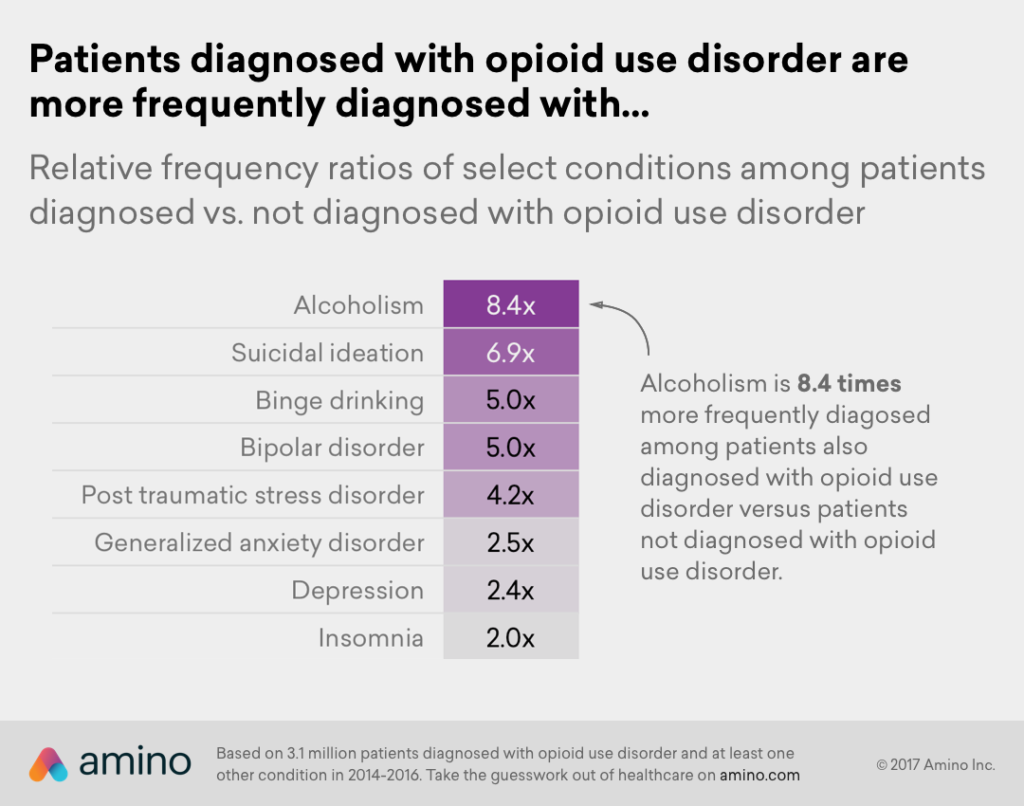
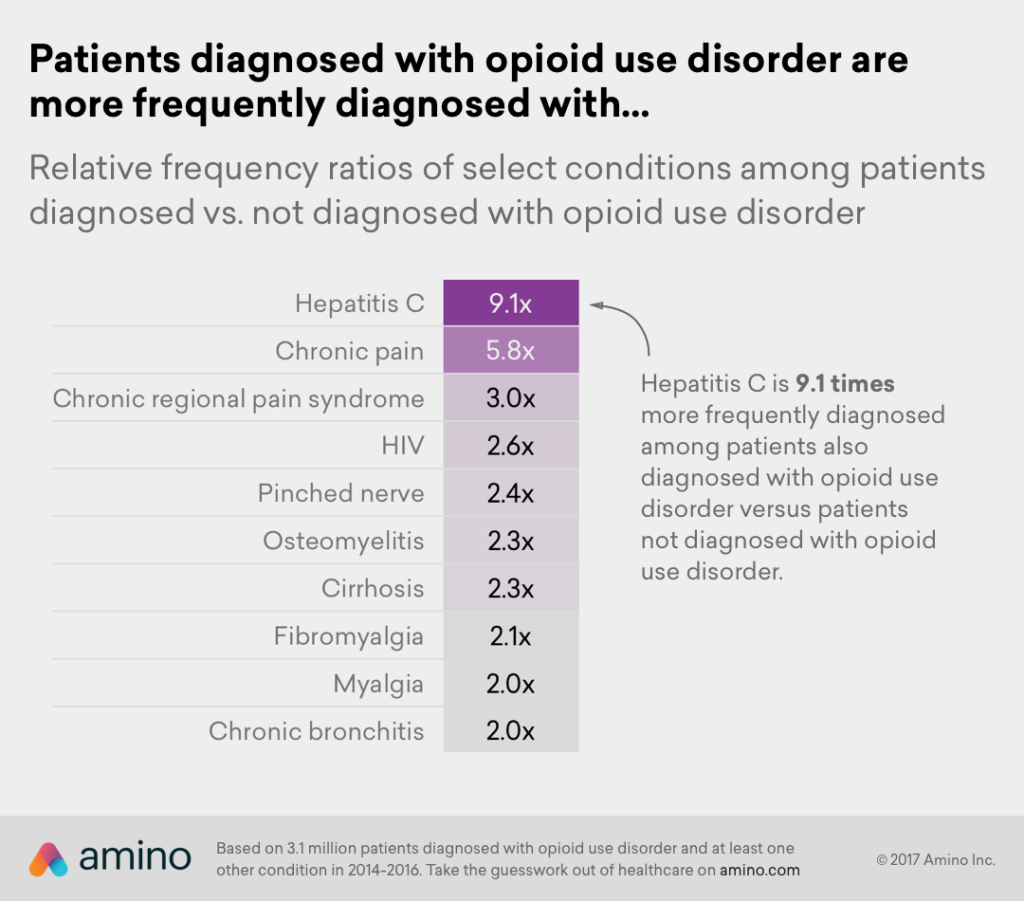
Patients with opioid use disorder are much more likely than the general population to have a host of other health conditions, including hepatitis C, post-traumatic stress disorder, and anxiety.

That’s according to a new analysis from health care company Amino, which culled data from the claims of 3.1 million privately insured patients between 2014 and 2016. It calculated the frequency of a slew of health conditions — from back pain to binge drinking — in patients diagnosed with opioid use disorder. Then, it compared those rates to the general patient population.

Here’s what it found.

As the chart shows, patients with opioid use disorder are diagnosed with hepatitis C nine times as often as other patients, at least among the privately insured.

Cases of hepatitis C have skyrocketed as the opioid epidemic has spread: There were an estimated 30,500 new cases in the U.S. in 2014, nearly double the number of new cases in 2011. Most of those new cases are among people who inject drugs such as heroin.

Hepatitis C infections have increased particularly sharply among young people who live in rural areas of Appalachian states, according to the Centers for Disease Control and Prevention.

Painkiller prescriptions for back pain were an early target in the efforts to curb opioid misuse and abuse — and for good reason. The analysis by Amino shows that “failed back syndrome” — a broad category that covers back pain after surgery — is seven times more frequently diagnosed in patients with opioid use disorder.

Earlier this year, the American College of Physicians reviewed the evidence on treating back pain and released a new set of guidelines. Its recommendation: Opioids should be a last resort for treating lower back pain, after every other treatment has failed. It recommendeds patients first try non-drug therapies such as exercise, massage, and yoga.

If those don’t work, the ACP told doctors to have patients pop an over-the-counter pain reliever and wait it out, noting that most back pain improves over time regardless of treatment.

The new report also adds to the evidence of the connection between substance abuse disorders and other mental health conditions.

Alcoholism is diagnosed eight times more often in patients with opioid use disorder, according to the new analysis. And patients with opioid use disorder are also more frequently diagnosed as having suicidal thoughts, anxiety, depression, and insomnia. Many find it difficult to get the care they need. In part, that’s because people with mental health conditions and substance abuse problems are among the most likely to be uninsured.

Former President Barack Obama established a task force last year to tackle that problem. In October, the task force released a report urging mental health and substance abuse treatments to be covered like medical and surgical care.

 © 2017 STAT
Posted in Addiction, AHCA, Health Care, Opioid, Trump, trumpcare | Tagged , | Comments Off on Treating patients with opioid disorders is not just about treating addiction. Here’s why

Adviser says Donald Trump wants to resign

The Palmer Report

The demise of Donald Trump’s presidency is now inevitable, with his exit merely being a matter of when and how. Will the Republican Congress throw him overboard to try to avoid being wiped out in the midterms? Will a Democratic Congress impeach him after the midterms? Will Mike Pence and the cabinet invoke the 25th Amendment? According to one of Trump’s own advisers, Trump wants to resign – he just has hesitations about doing it.

All the way down in the last full paragraph of a new Politico article (link), you’ll find this reveal: “But Trump, too, is cognizant of the comparison to Nixon, according to one adviser. The president, who friends said does not enjoy living in Washington and is strained by the demanding hours of the job, is motivated to carry on because he ‘doesn’t want to go down in history as a guy who tried and failed,’ said the adviser. ‘He doesn’t want to be the second president in history to resign.’”

In other words, Donald Trump very clearly wants to resign. His only hangup, according to what he’s telling his own advisers, is how history will end up portraying him. He’s only five months into his term, and he’s still clueless about the realities of politics. So perhaps he hasn’t figured out that his historically low popularly will never recover. And perhaps he’s in denial about how his scandals will ultimately force him out of office one way or the other. But the key here is that he wants out, which is half the battle when it comes to getting rid of him.

How much worse do things have to get before Donald Trump figures out that his presidency has already failed, and that the longer he remains in office, the worse history will judge him? That’s unclear. But by his own words he already wants out, which means we’re closer to his exit than was previously known.

All of Palmer Report’s content is made available to you for free, with no subscription fees or paywalls.
Posted in Trump | Tagged , , | 2 Comments

Descent Into Secrecy: Senate Health Talks Speak To Steady Retreat From Transparency

Kaiser Health News

REPEAL & REPLACE WATCH

June 14, 2017

(Photo courtesy of the Office of the Architect of the Capitol)

Congress struggling to finish a huge budget reconciliation bill. A GOP president pushing a major overhaul of federal payments for health insurance that could transform the lives of sick patients.

Sound familiar? The year was 1986. I was a rookie health reporter on Capitol Hill and watched a Medicare bill move from introduction, to hearings, to votes in subcommittees, to full committees and then to the entire House — an operation that took months and was replicated in the Senate, before the two chambers got together to iron out their differences for final passage. Everything was published in the official Congressional Record in almost excruciating detail for everyone to see — as long as they could read really tiny type.

Since then, in three decades of reporting, I’ve had a front-row seat to Congress’ slow, stuttering retreat from such step-by-step transparency, a process known as “regular order.”

It has now culminated in the Senate GOP leadership’s top-secret process to try to write a health bill that could change the formula for nearly one-fifth of the nation’s economy, with a vote they want to cast by July 4. In fact, a GOP Senate aide told the news site Axioson Monday that no details would be forthcoming until the bill is finished, adding, “We aren’t stupid.” That means bypassing the debate that traditionally went into lawmaking, in order to achieve consensus.

The extreme secrecy is a situation without precedent, at least in creating health law. Still, it’s not hard to see how we got here — and there is plenty of bipartisan blame to go around.

Since 1986, I have chronicled the passage (and repeal) of the Medicare Catastrophic Coverage Act, the fight over President Bill Clinton’s health proposal, passage of the Medicare prescription drug bill and passage of the Affordable Care Act, in addition to a dozen budget reconciliation measures that altered health care, often in fundamental ways.

Despite promises from incoming Democratic and Republican leaders over the past decade to restore a time-honored process, regular order has not returned. In fact, not only has it become increasingly rare, but the legislative process itself has become ever-more truncated, with Congress skipping steps it deemed inconvenient to partisan ends, particularly as leaders have “end run” the committees that are supposed to do the lion’s share of legislative work.

So long as there is bipartisan agreement, regular order can still prevail. A major bill completed in 2015 to reconfigure how Medicare pays doctors was the product of 15 months of work by Democrats and Republicans in the House and Senate, and passed three committees in open session by unanimous roll call votes.
But it has become progressively — and distressingly — more acceptable to set transparency aside in lawmaking over the years.

In the 1980s, Rep. Bill Natcher (D-Ky.) routinely closed the subcommittee markup of the spending bill to fund the Departments of Labor, Health and Human Services, and Education, even when there was no particular controversy to avoid. Reporters got to see the bill for the first time at the full Appropriations Committee markup.

Markups at the House Ways and Means Committee under Chairman Dan Rostenkowski (D-Ill.) also were frequently closed to the press and public, mostly for tax bills. Still, once I personally held up a health subcommittee markup for nearly a half-hour because the vote to close the session required a majority of members present. I refused to leave until a couple of committee members could be located and brought to the room to vote in person and kick me out.

Even meetings open to the press were sometimes less than revealing. In House-Senate conference meetings, members would frequently refer to what they were talking about using numbers on notes that were not shared with the audience, including reporters. So they basically spoke in code, and if you didn’t have the key you were just out of luck.

Of course, today there are fewer and fewer formal conference committees, places the two sides hammer out their differences in the public eye. Often the final versions of contentious bills are worked out behind closed doors, often without all of the members of the conference committee. In 2003, House Ways and Means Committee Chairman Bill Thomas (R-Calif.) retreated with all the Republican conferees and two of seven Democrats into his Capitol hideaway office in a group he called “the coalition of the willing.” They wrote the final bill in secret while reporters and lobbyists stood outside in the hall for weeks on end. (Sitting in the Capitol is considered civil disobedience and is strictly forbidden.) We were there so long and got to know one another so well that on my birthday someone got all the conferees in the room to sign a birthday card for me.

The final version of that bill was the one that passed the House in the dead of night – Republicans purposely scheduled the vote to begin at 1 a.m. (on the theory it would be easier to get wavering members to vote yes if only to go home to bed). The vote didn’t end until nearly 6 a.m., after President George W. Bush reportedly got the last few members to switch, via phone calls.

In 2009, creation of the Affordable Care Act was both open and closed. There were hundreds of hearings and markups that lasted days, or, in the case of the Senate Health, Education, Labor and Pensions Committee, months. But the unsuccessful effort by Senate Finance Committee Chairman Max Baucus (D-Mont.) to bring Republicans into the fold consisted of weeks of closed-door discussions, and the Senate bill that would ultimately become the foundation of the ACA was written in Senate Majority Leader Harry Reid’s office before being debated on the Senate floor for almost a month.

We got a sneak preview of how the GOP might shepherd its health bill through in 2015, when Republicans — who by then controlled Congress — orchestrated a “dress rehearsal” ACA repeal bill that was vetoed (as they knew it would be) by President Barack Obama. The bill was prewritten by leadership, approved by the relevant House committees, passed by the House and sent to the Senate. The Senate passed it with small changes (and without committee consideration). Rather than having a conference, the amended Senate bill was then simply approved by the House and sent to Obama for his veto.

That secretive process is being reiterated now. Only this time a Republican, Donald Trump, is president and the potential for change is real. People are outraged over the lack of transparency and the loss of regular order. But both Democrats and Republicans have laid the track on which this train is rolling.


  •  Kaiser Health News, a nonprofit health newsroom whose stories appear in news outlets nationwide, is an editorially independent part of the Kaiser Family Foundation.
Posted in American Health Care Act, Congress, Environment, FDA, GOP, Medicaid, Politics, Trump | Comments Off on Descent Into Secrecy: Senate Health Talks Speak To Steady Retreat From Transparency

What Climate Deniers Want Next After Winning Paris Pullout

Posted on Ecowatch

President Trump‘s decision to pull the U.S. out of the Paris climate agreement earlier this month was a clear winfor conservative groups and individuals that support the weakening of environmental regulations.

So what do these politically powerful forces have next on the agenda?

The first target could be the U.S. Environmental Protection Agency’s (EPA) endangerment finding, David Stevenson, a former EPA transition team member and policy director at the libertarian think tank Caesar Rodney Institute told New Republic.

This Obama-era finding that greenhouse gas emissions endangers public health and welfare might seem wholly unremarkable. However, the endangerment finding not only cemented a consensus within the scientific community, it also legally obligates the EPA to regulate sources of that pollutant under the Clean Air Act—including power plants, cars, trucks and other sources that combust coal, oil and natural gas. By unraveling the endangerment finding, the U.S. is legally washing its hands of climate change litigation brought by environmental groups.

“As long as that’s sitting there, the potential for legal challenges just goes on and on and on, and that’s not productive for any of us,” Stevenson explained.

Undoing the 2009 finding was a major topic of discussion at a March conference hosted by the Heartland Institute, the nation’s leading climate skeptic think tank. Reuters reported that at least three conservative groups has petitioned the EPA to undo the finding. Myron Ebell, who led Trump’s EPA transition team, similarly considers it a major priority.

As it happens, current EPA administrator and former Oklahoma Attorney General Scott Pruitt filed a lawsuit in 2010 to overturn the endangerment finding, which he and his fellow litigants characterized as “arbitrary and capricious.” And let’s not forget that Pruitt, who urged Trump to exit from the Paris accord, does not even believe that carbon dioxide is a “primary contributor” to climate change.

However, there could be more sinister moves at play. For one, “undoing the endangerment finding would also empower the federal government to instantly repeal all existing regulations that reduce global warming,” New Republic’s Emily Atkin noted, such as the Clean Power Plan and Obama-era fuel economy standards for cars and light trucks—two of the Heartland Institute’s top five environmental policy priorities.

Other potential post-Paris moves include gutting the scope and powers of the EPA. Stevenson lauded Trump’s proposed EPA budget, which cuts the agency’s funds by 31 percent.

“There are about 50 small EPA programs that look like they’re ineffective,” he said. “They’re going to be cut.”

Lastly, the New Republic piece highlighted one of the most daunting post-Paris goals of all: the “intellectual validation” of climate denial.

“Now that denial is the official policy of the U.S. government, they are getting the legitimacy they desire, whether they deserve it or not,” Atkin wrote. “For an ideology based in falsehoods, that is perhaps the greatest victory they could possibly achieve under Trump.”


EcoWatch is the nation’s leading environmental news site engaging millions of concerned citizens every month. We are leading the charge in using online news to drive fundamental change to ensure the health and longevity of our planet.

Posted in climate change, Environment, EPA, science, Trump | Comments Off on What Climate Deniers Want Next After Winning Paris Pullout

Polemicists in Robes — We Are In Deep Trouble

Slate.com

The president’s latest batch of bomb-throwing judicial nominees will transform the federal bench for generations to come.

Trump's judicial nominees Kevin Newsom, an 11th Circuit nominee from Alabama; John Bush, a 6th Circuit nominee from Kentucky
John Bush, left, and Damien Schiff.

Photos by Bingham Greenebaum Doll LLP and Pacific Legal Foundation


If the republic survives four years of Donald Trump, much of the damage he has done to civil liberties, environmental protections, health coverage, reproductive freedom, LGBTQ rights, and police reform can theoretically be undone. What cannot be undone, regardless of what the future may hold, are his Article III federal judicial appointees. These judges will sit for life, and many of them have been selected expressly for the long, long lifespans they will bring to the bench.

At this moment, Trump has more than 130 judicial vacancies to fill, in large part because Senate Republicans used their authority to obstruct dozens of judicial picks toward the end of Barack Obama’s second term. Trump has now named 16 potential jurists to the federal trial and appellate courts—work that has been farmed out almost entirely to the Federalist Society. Given the option to put up any number of nominees with moderate temperaments and conservative but sane academic or intellectual records—conservatives in the mold of Neil Gorsuch, Trump’s successful choice for the Supreme Court—the decision seems to have been made that these jobs should instead go to polemicists and bomb-throwers, performance artist lawyers who have spent their intellectual lives staking out absurd and often abhorrent legal positions.

On Wednesday, three of them had a turn before the Senate Judiciary Committee: 44-year-old Kevin Newsom, an 11th U.S. Circuit Court of Appeals nominee from Alabama; 52-year-old John Bush, a 6th Circuit nominee from Kentucky; and 37-year-old Damien Schiff, a nominee for the U.S. Court of Federal Claims, which oversees environmental and agency suits. With the exception of Newsom, this was no ordinary slate of wonky, diligent legal thinkers. Bush and Schiff are to blogging as the president is to tweeting: all in.

Schiff, an attorney at the Pacific Legal Foundation, has a sideline as a blogger. In a 2007 post on his personal blog, he wrote, “It would seem that Justice [Anthony] Kennedy is (and please excuse the language) a judicial prostitute, ‘selling’ his vote as it were to four other Justices in exchange for the high that comes from aggrandizement of power and influence, and the blandishments of the fawning media and legal academy.” In 2009, Schiff railed against the anti-bullying program in a California school district: “I have not seen the proposed lesson, but … it seems to teach not only that bullying of homosexuals is wrong, but also that the homosexual lifestyle is … good, and that homosexual families are the moral equivalent of traditional heterosexual families.” Schiff then added: “Perhaps someone will respond: would you have objected to an anti-racism curriculum being taught in 1950s Arkansas? I guess my answer there would be a qualified yes, that I would have objected, not that I would approve of racism, but that, as a prudential matter, the best way to get people to drop their racist views would not be to force the teaching of their children.”

Referencing Schiff, Sen. Sheldon Whitehouse observed that “if President Obama had sent in a nominee who had called Justice Kennedy a ‘judicial prostitute,’ the other side of this dais would have its hair on fire.” Whitehouse didn’t even bother to question the lawyer/blogger, yielding his time with the observation that “this just isn’t normal.”

Then there is Bush, who is becoming a familiar type in the fake news era. Blogging under a pseudonym, the Kentucky lawyer wrote more than 400 posts for the website Elephants in the Bluegrass. His wide-ranging and unfiltered commentary has included, for instance, the claim that abortion and slavery are “[t]he two greatest tragedies in our country.” His blog posts have cited conspiracy theories and false information, including references to the claim that President Obama was not born in the United States. In his Senate questionnaire, he described the vicious 1991 beating of Rodney King as a “police encounter.” As Eleanor Clift notes in the Daily Beast, he has also gone on record arguing that the Supreme Court made a bad ruling in the landmark freedom of the press case New York Times Co. v. Sullivan. In the Trump era, that’s a feature, not a bug.

Members of the Judiciary Committee must typically comb through decades of writing to find this volume of inflammatory material. By collecting years’ worth of this stuff on their own blogs, Schiff and Bush made a bunch of staffers’ jobs a whole lot easier. When it came time to testify, though, both men tried to argue that what they’d written back then somehow didn’t reflect their views now.

In his hearing Wednesday, Bush simply took the position that, while he had written all of these things, they were simply “political” ideas that wouldn’t affect his work as a jurist. He apologized for his use of anti-LGBTQ slurs and insisted that once he dons the black robes, he will be a new man, cleansed of all such beliefs and positions.

To which the response, not offered by Schiff or Bush but ricocheting around the chamber, is quite simple: You say it because you can.

Posted in Courts, Judiciary, Trump | Tagged , , , | Comments Off on Polemicists in Robes — We Are In Deep Trouble

Alexandria Shooting

hate-speech-is-not-free-speech
From my friend S:
One can only hope that this horrible shooting results in some tampering down of the D.C. vitriol.  From my perspective, Trump unleashed this intense anger and permission to spew uncivil rhetoric. Trump started by using the debates to debase participants, calling them names. Exactly when did that become an acceptable debate technique? And now, we will have to abide the debate about “gun control” versus “Congress should be allowed to carry guns”. Really, have we returned to the Wild West?
I am not interested in living in a country where everyone is free to carry a gun. It’s simply uncivilized. How did we arrive at this awful crossroads?
And a day later:
I’m no Pollyanna and know that the professed unity of Democrats & Republicans in the face of the awful events at yesterday’s baseball practice will be short lived & some cracks are already evident.
However, in a small but revealing way, Jake Tapper had a joint interview with Pelosi and Ryan, who spoke of their respect for each other and personal anecdotes concerning their families. Americans need to see more of these insightful moments of the humanity between opponents and how they respect and are respectful of each other.
Someone like Sean Hannity should be forced to watch the Pelosi/Ryan interview multiple times. Even perhaps the McConnel and Schumer interview. In my memory, politicians have never before underscored their ability to work together rather than the animosity resulting from their differences of opinion. I watched some of Hannity’s program last evening, my first time ever, & was struck at how he spews hateful views and ideas.
This may not last, but it’s helpful and a modest step forward. Something struck a chord and this kumbaya moment, no matter how short, is valuable.
Posted in Guns, Trump, Uncategorized | Tagged , , , , | Comments Off on Alexandria Shooting

Trump’s War on Energy Efficiency Will Kill Energy Star Program

President Trump and his allies in Congress are seeking to eliminate energy efficiency requirements for appliances, automobiles and other energy consuming applications in an effort that will cost American families and consumers trillions of dollars over time, according to a new report issued today by Public Citizen.

“Trump’s decision to target efficiency initiatives discredits his claim that he withdrew from the Paris climate accord because of concerns that the deal would cost U.S. jobs. These programs unambiguously would help meet the goals of the accord and benefit the U.S. economy and yet Trump is still targeting them,” said Taylor Lincoln, research director of Public Citizen’s Congress Watch division and author of the report, Blinded by the Light.

Among the findings of the report:

The far-right U.S. House Freedom Caucus seeks to repeal 22 efficiency standards for appliances that would save consumers $212 billion over the next 30 years if the standards are left intact, according to U.S. Department of Energy projections. Standards for all appliances are projected to cumulatively save Americans $2.4 trillion by 2035.

The Trump administration has proposed eliminating the Energy Star program, which recognizes products with outstanding efficiency performance. The program saved Americans $430 billion from 1990 to 2015, and $36 billion in 2015, alone, according to the U.S. Environmental Protection Agency.

The Trump administration has put on hold automobile fuel efficiency standards for vehicles sold in 2022 to 2025 that would save consumers $56 billion due to reduced fuel costs just for vehicles sold in those model years.

Additionally, the Trump administration proposes to eliminate the Advanced Research Projects Agency-Energy program, which provides capital for early-stage clean energy pursuits. Relatedly, the administration proposes to cut the budget of the U.S. Office of Energy Efficiency and Renewable Energy (EERE) by 70 percent. EERE conducts research into clean energy technologies and is credited with helping to bring the cost of solarelectricity down nearly to that of electricity generated by fossil fuels.

Energy efficiency requirements have a record of spurring innovation that yields better products, as in the case of the light bulb standard in the 2007 energy bill, which hastened the development of inexpensive, super-efficient LED light bulbs, according to the report. Improved efficiency also has been the primary reason that U.S. electricity consumption has increased by only five percent since 2001 while the economy has grown by 75 percent.

“Even if Trump believes that climate change is a hoax and breathing smog builds character, he should see his way to supporting energy efficiency initiatives simply because they save consumers so much money,” said David Arkush, managing director of Public Citizen’s climate program. “The savings from these programs literally approach the scale of Trump’s most lavish promises for infrastructure spending.”

Posted in Uncategorized | Comments Off on Trump’s War on Energy Efficiency Will Kill Energy Star Program

No One in Zeldin’s Office Could Care Less

By Steven Lupo

I called Senators Schumer and Gillibrand’s office yesterday.   I spoke to Jason at Schumer’s office and Saj (her nickname) at Gillibrand’s office.
I stated I heard that 13 Republican men were hiding behind closed doors, trying to come up with a bill that was abominable enough for the Republican caucus to support.   That bill would destroy the ACA, gut Medicaid and give huge tax cuts to the rich.
I asked them both to urge the senators to do everything in their power — procedurally — to stall this legislation at least until the summer recess.   This way the Republican senators will get an ear full from their constituents when they return home to their states.
I told them my personal story, of my autistic brother. I informed them that my brother is not a lazy person looking for “free stuff”.  My brother is disabled.   My family has relied on Medicaid for his care most of his life.   My family would’ve been devastated without Medicaid. And now the Republicans are trying to take that away — to give tax cuts to their rich donor class?!?
This is where I found a stark contrast.
Both staffers seemed genuinely concerned. They asked me questions about my brother.
You can pay a staffer to take down comments from a constituent but you cannot make a staffer compassionate or empathetic.  Those traits come from the person.  When I called Zeldin’s office and repeated the same story, I just get an unemotional, “I’ll pass that on to the congressman” line.   No one in Zeldin’s office could care less about my brothers situation.   No one!
Both tried to ease my anxiety by stating the senators are going to do everything in their power to prevent the Republicans from destroying the ACA.
Jason tried to ease my anxiety by stating he personally did not believe the Senate would find consensus to destroy the ACA.  I politely reminded him that many of my friends kept telling me not to worry, that Donald Trump would not win. I simply cannot find comfort in hopeful thinking.   I informed him that although I believe Republicans destroying the ACA will be a political disaster for them, I do not want to see Americans suffer in order to have another reason to bash the Republican Party.
Posted in ACA, AHCA, Health Care, mental health, trumpcare, Uncategorized, Zeldin | Tagged , , , | Comments Off on No One in Zeldin’s Office Could Care Less