
Zeldin Gets It Wrong Again

The House just passed the Creating Hope and Opportunity for Investors, Consumers, and Entrepreneurs Act, otherwise known as the Financial CHOICE Act of 2017 (H.R. 10).  Lee Zeldin was a champion of the bill and just issued a press release touting its supposed benefits.  As has been his wont, Zeldin (like his puppet master Trump) can’t find anything to commend in legislation enacted by the Obama administration.

For example, in his press release, Mr. Zeldin harshly criticizes the Consumer Financial Protection Bureau:

“Dodd-Frank also created the Consumer Financial Protection Bureau (CFPB), a highly unconstitutional and unaccountable fourth branch of government exercising immense power over the financial sector that has harmed too many of the middle income Americans it was supposedly created to help. As a result of this agency’s undue influence, auto loans have become far more expensive and bank fees have increased for so many Americans. To make matters worse, small businesses have found that their sources of credit have been dramatically reduced, cutting their access to capital and limiting their potential for growth and job creation.”

Recently, Scott Stringer, the NYC Comptroller, released a report of the results of the actions by the CFPB and the benefits conferred upon New Yorkers.  It puts the lie to Zeldin’s false statements.  Here is an excerpt (a link to the entire report is at the bottom of this post):

Executive Summary

The Consumer Financial Protection Bureau (CFPB) is a federal agency charged with protecting American consumers as they navigate our nation’s complex landscape of financial products, ranging from credit cards and payday loans to mortgages and student loans. Created by the Dodd-Frank Wall Street Reform and Consumer Protection Act in 2008, the CFPB monitors both traditional financial service providers like banks and credit unions, as well as other providers of consumer financial services like auto lenders, debt collectors and others. In addition, the agency works to educate consumers about financial services products and, through its Office of Consumer Response, helps consumers resolve individual disputes or concerns.

Through its work, the CFPB has returned almost $12 billion to 29 million American consumers and has helped guard hundreds of thousands more against unfair, deceptive, or abusive products and services. And yet numerous proposals in Congress as well as recent legal actions could severely hamper the agency’s ability to serve as a fair and impartial advocate for consumers. Specifically, pending legislation would all but decimate the agency, including legislation that would dismantle the agency, replace the independent director with a five member commission, or change its funding structure to require annual appropriations from Congress.[1]

This report from New York City Comptroller Scott M. Stringer focuses on how the CFPB has helped protect consumers in the nation’s financial capital, New York City. Drawing on data from the agency’s Consumer Complaints Database, this report highlights the tangible assistance the CFPB has delivered to New Yorkers struggling with financial companies or products. The Database comprises nearly one million consumer complaints dating back to July 2011 and provides a rich set of data about the challenges facing consumers.

Some key facts and trends include:

  • New York City residents lodged more than 23,700 complaints between December 1, 2011 and January 13, 2017, dealing with a full spectrum of financial issues.
  • As the database has expanded to include more types of products, the number of complaints from New York City residents has risen from about 2,400 complaints per year in 2012, to almost 7,000 per year in 2016.
  • Almost 22 percent of New York City complaints focus on mortgages, 19 percent concern credit reporting, and 17 percent pertain to bank accounts, credit cards, and debt collections.
  • Over 90 percent of New York City consumers who submitted a complaint to the CFPB received a response from the target of their complaint, receiving either an explanation, a resolution to their issue, or monetary relief.
  • Reflective of the differences in New York City’s neighborhoods (Chart I), there is variation in the types of complaints based on borough. While mortgages were the issue most frequently raised by residents of Brooklyn, Queens, and Staten Island, the most frequent complaint from the Bronx concerned credit reporting. The most frequent complaint from Manhattan concerned credit cards.
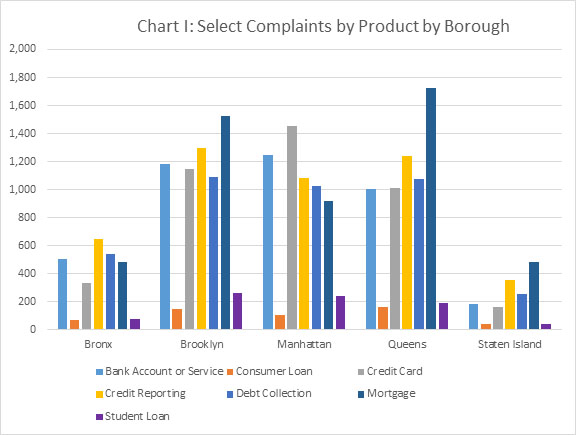
Chart I: Select Complaints by Product by Borough

The increasing number of complaints and CFPB’s effectiveness at helping to resolve them demonstrates the important role that the agency plays in protecting New York City consumers. Proposals to scale back the scope and independence of the CFPB are misguided and should be rejected so that New Yorkers and all Americans can continue to enjoy the benefits of having a strong financial services regulator working to protect consumers every day.


Here is the link to the report: https://comptroller.nyc.gov/reports/cfpb-and-nyc-how-the-consumer-financial-protection-bureau-empowers-and-protects-new-yorkers/

Posted in CFPB, GOP, Student Debt, Student Loans, Tax Reform, Trump | Tagged , , | 1 Comment

Block a disastrous health care vote in the U.S Senate

From:  Mike Anthony

The Republican leadership in the U.S. Senate is about to unveil a bill that, with a few tweaks and camouflage, is pretty much just like the House-passed bill eviscerating Obamacare. The Senate bill is so bad that they’ve had 13 white guys drafting it secretly behind closed doors. The Leadership plans to pressure Republicans into voting for the bill in the Senate next week.


We can stop this train wreck if three or more Republican senators vote “no” on the bill or oppose having the Senate vote at all on such a major bill affecting every American family and one sixth of the U.S. economy – a bill that has been contrived in secret without the usual open and deliberative process of committee hearings, public input, and transparent consideration.


It appears there are four undecided Senators who are the most promising prospects to oppose if persuaded by public pressure from constituents and other concerned citizens and four more Senators who for various reasons might oppose. But the reality is that Majority Leader Mitch McConnell is making all kinds of backroom deals to get undecided Republicans on board. Unless public opposition from our side is overwhelming there’s a good chance McConnell will succeed in getting an up-or-down vote and winning that vote.


I urge you to call the offices of the following eight Senators asking that they oppose voting on this or any other major health bill unless there first are a transparent process, real committee hearings, public input, and careful deliberation and refinement – or whatever message and words feel most natural to you.


Shelley Moore Capito (WV)    202-224-6472

Susan Collins (ME)      202-244-2523

Lisa Murkowski (AK)   202-224-6665

Bill Cassidy (LA)          202-224-5824


Tom Cotton (AR)         202-224-2353

Jeff Flake (AZ)            202-224-4521

Dean Heller (NV)        202-224-6244

Marco Rubio (FL)        202-224-3041


Resist!

Posted in AHCA, American Health Care Act, Congress, Health Care, Trump, trumpcare | Tagged | Comments Off on Block a disastrous health care vote in the U.S Senate

Winners And Losers: 40 Is Old In Senate GOP Health Plan’s Subsidy Structure

KAISER HEALTH NEWS — REPEAL & REPLACE WATCH
June 22, 2017

People getting subsidies to help buy health insurance would see at least three sharp changes — tied to both age and income — that could dramatically affect how much they pay for coverage if the Senate Republican health plan becomes law.

The Senate bill released Thursday would reduce the income thresholds that determine eligibility, change the amount people who receive help pay toward their insurance premiums and peg subsidies to less generous coverage.

About 85 percent of the nearly 10 million consumers who enrolled in coverage last year through federal and state marketplaces received tax credit subsidies and other types of financial assistance. Under the Senate plan, some could pay less in premium costs, but many, particularly older Americans, could see their share of payments go up. And let’s be clear — you’re old at about 40.

Incomes Eligible For Help Fall To 350 Percent Of Poverty

The Affordable Care Act provides tax credit subsidies on a sliding scale for people earning up to 400 percent of the federal poverty level — an amount that equals about $47,520 this year for individuals. Starting in 2020, the Senate bill would drop that to 350 percent, which is now an annual income of about $41,580. As a result, fewer people would qualify. To be sure, some enrollees who exceed that new income limit might lose only a small subsidy because of the way the current law is structured, but older enrollees could lose substantial amounts. The Center on Budget and Policy Priorities estimated Thursday that a 60-year-old earning just above the cutoff would lose at least $3,000 annually in subsidies.

Age Matters

Tax credits are just one part of the picture. Under the ACA, subsidy-eligible enrollees must pay a percentage of their annual household income toward premiums, ranging from about 2 percent to just over 9.5 percent for those with higher incomes. Those amounts go up over time. The Senate bill would adjust those percentages based on age, keeping the lower limit at around 2 percent, but exceeding 16.2 percent at the highest income and age group. So if you are 39 or younger, you generally would pay smaller percentages of your income when compared with what you pay under the ACA, ranging from about 2 percent to 8.9 percent.

But once you hit 40, things change. Let’s say you earn $41,580 — 350 percent of poverty — you would pay more than 12.5 percent of your income, or $5,197, under the Senate plan. That compares with $4,029, or 9.69 percent currently under the ACA. At that same income level, percentages rise to 15.8 for those ages 50 to 59 and up to 16.2 percent of income for those 60 and up.

Aiming For Bronze: Subsidies Tied To Less Generous Coverage

The Senate would link the subsidies to plans with less generous coverage than the ACA. Subsidies under current law are pegged to a benchmark “silver” plan, which covers an average of about 70 percent of medical expenses. The Senate would peg the subsidy to the median price of a policy that covers about 58 percent of health costs, roughly equivalent to today’s “bronze” plans. Consumers pay the rest of the cost, usually through deductibles and copayments. This year, average deductibles for bronze plans were more than $6,000, while silver plans averaged $3,500, according to consumer website HealthPocket. People could still use subsidies to buy more generous plans, but the premiums would be higher.

Christopher Condeluci, who served as tax and benefit counsel to the Senate Finance Committee when the ACA was drafted, said the changes might prompt more people to buy insurance, noting that subsidies will be available to those who are under the federal poverty level, which they aren’t under current law. Younger people also might benefit by paying less toward coverage, helping boost their enrollment.

To make that happen, however, he said, the formula had to be adjusted so older people at the higher-income end of subsidy eligibility pay more.

“The current ACA discourages younger people from getting in,” said Condeluci, who expects “the older-age lobby will continue to criticize this type of proposal.”

While getting people under the poverty level covered by insurance would be a good thing, it should be done by expanding Medicaid, said Sabrina Corlette, who studies the individual insurance market as research professor at Georgetown University’s Health Policy Institute.

“It’s much more expensive for the federal government to subsidize private insurance than provide a Medicaid benefit,” said Corlette, who also doubts that many people earning less than $12,000 a year have enough saved to cover the cost of a deductible in the types of plans the Senate proposal would subsidize.

In total, the changes proposed in the Senate bill mean, Corlette said, “the subsidy buys you less and the older you are, the more you will be asked to pay.”

Kaiser Health News, a nonprofit health newsroom whose stories appear in news outlets nationwide, is an editorially independent part of the Kaiser Family Foundation.

Posted in ACA, AHCA, American Health Care Act, Health Care, Medicaid, mental health, Pre-existing Conditions, Trump, trumpcare | Comments Off on Winners And Losers: 40 Is Old In Senate GOP Health Plan’s Subsidy Structure

Promises Made To Protect Preexisting Conditions Prove Hollow

KAISER HEALTH NEWS — REPEAL & REPLACE WATCH

June 23, 2017

Congressional Democrats joined activists on May 4 for a rally to urge not to replace the Affordable Care Act. (Alex Wong/Getty Images)

Senate Republicans praised the Affordable Care Act replacement bill they presented Thursday as preserving coverage for people with cancer, mental illness and other chronic illness.

But the legislation may do no such thing, according to health law experts who have read it closely.

Built into the bill are loopholes for states to bypass those protections and erode coverage for preexisting conditions. That could lead to perverse situations in which insurers are required to cover chronically ill people but not the diseases they suffer from.

Depending on what states and governors do, plans sold to individuals might exclude coverage for prescription drugs, mental health, addiction and other expensive benefits, lawyers said. Maternity coverage might also be dropped.

Somebody with cancer might be able to buy insurance but find it doesn’t cover expensive chemotherapy. A plan might pay for opioids to control pain but not recovery if a patient became addicted. People planning families might find it hard to get childbirth coverage.

“The protection your insurance provides could depend a lot on where you live,” said Sabrina Corlette, a research professor at Georgetown University’s Health Policy Institute. In some states, “over time, [patients with chronic illness] might find it increasingly difficult to find insurance companies that will offer plans that cover their needs.”

The Senate provisions aren’t expected to affect job-based health plans or Medicare for seniors. They would mainly affect the kind of insurance sold to individuals through the Affordable Care Act’s online exchanges, which cover about 10 million people.

Obamacare overhauls in both the House and Senate would also limit spending on Medicaid for low-income people, which analysts say would cause coverage losses for millions.

The Senate legislation, expected to be voted on next week, follows a widely criticized House bill that would also overhaul the Affordable Care Act, in its case giving states the option of denying coverage or raising premiums for those with preexisting illness.

On Thursday Republican Senators touted their bill as avoiding those features.

“I feel comfortable that no one is going to be denied coverage because they’ve been sick before,” said Sen. Lindsey Graham (R-S.C.) The bill “doesn’t change [protections for] preexisting illnesses, which is good,” he said.

Not explicitly. But it still gives insurers a potential way to shrink coverage for the chronically ill, albeit less obviously, said health law scholars.

“There’s nothing in the Senate bill that specifically would allow withdrawal of coverage for a person with a preexisting condition,” said Timothy Jost, emeritus law professor at Washington and Lee University in Virginia and an expert on health reform. “What it does do is allow states to get waivers” allowing exceptions to rules requiring comprehensive coverage, he said.

The Affordable Care Act required carriers to offer “essential health benefits” covering a wide range of services including hospitalization, maternity, prescription drugs and mental health.

Both the Republican House bill and the Senate bill would let states change that rule. Under those measures, states could set their own standards that might not be as generous, allowing insurers to exclude benefits for those with preexisting illness.

“The Senate bill guarantees people with preexisting conditions access to insurance at the same rate as healthy people, but there is not a guarantee that the benefits they need will be covered by insurance,” said Larry Levitt, a senior vice president at the Kaiser Family Foundation. (Kaiser Health News is an editorially independent program of the foundation.)

Obamacare, too, allows states to make exceptions for essential health benefits — but with strict limits. Coverage must be at least as comprehensive as the federal standard, for one thing. The Senate bill contains no such safeguard.

“As long as they can show that it’s budget neutral, states would have a lot of latitude” to cut essential benefits, said Christopher Koller, president of the Milbank Memorial Fund and a former Rhode Island insurance commissioner.

Insurance plans for individuals might again start to look as they did in the days before Obamacare, when they typically excluded coverage for maternity, mental health and substance abuse, health policy experts said.

That’s especially true because the Senate bill would allow governors to lower coverage standards by executive certification — without approval from legislatures, Corlette said. The measure would also permit governors to raise or eliminate Obamacare’s caps on what patients pay annually out of pocket before insurance kicks in. That could make care for preexisting conditions unaffordable even if it’s covered by the plan.

For their part, insurers may heavily pressure states to make such changes, analysts said.

Unlike the Affordable Care Act and the House bill, the Senate bill contains no incentives or inducements for healthy people to maintain medical coverage. That could result in a disproportionately sick group of people buying individual insurance, driving up carriers’ costs and prompting them to seek ways to trim coverage and cut claims.

“If the only people motivated to buy insurance are going to be the ones who really need it, insurers are really going to have a strong incentive to use their benefit design to deter enrollment for the sickest people,” said Corlette.


Kaiser Health News, a nonprofit health newsroom whose stories appear in news outlets nationwide, is an editorially independent part of the Kaiser Family Foundation.

Posted in AHCA, American Health Care Act, Congress, Health Care, Medicaid, Pre-existing Conditions, Uncategorized | Tagged , , | Comments Off on Promises Made To Protect Preexisting Conditions Prove Hollow

Some Of Trump’s New Election Investigators Don’t Seem To Have Much Election Experience

Sometimes I think that I’m on the set of a “Dukes of Hazard” episode — BAC

Posted on HuffPost

“I’m just a very small old country boy from Arkansas in this bigger commission with Vice President Pence, and I’m just going to do the best I can, to be honest.”

X

President Donald Trump quietly announced Wednesday evening he intended to appoint three more people to a commission to investigate voter fraud, but two of the people he wants to appoint don’t seem to have any expertise in voting issues or elections.

The three officials named were Luis Borunda, the deputy secretary of state of Maryland; David Dunn, a former Arkansas Democratic state lawmaker; and Mark Rhodes, a county clerk in West Virginia.

Dunn, who served in the Arkansas legislature from 2005 to 2011 and now runs a government relations firm, said he was eating dinner with his children when the White House sent out a press release announcing the president intended to appoint him to the commission. Arkansas Secretary of State Mark Martin (R), an old friend of Dunn’s from the legislature, recommended him to the commission, Dunn said. He said he also spoke with Kris Kobach, the Kansas secretary of state and the commission’s vice chair, just once about his interest in the role, but didn’t expect much to come of it until he saw the White House’s press release.

The commission, which will be led by Kobach and Vice President Mike Pence, is charged with examining election systems to study the issues that undermine and affect confidence in them.

In a Thursday interview, Dunn sounded openly stunned he was chosen for the role and admitted he did not have any expertise in elections or voting issues.

“I don’t know why this has fallen on my shoulders,” he told HuffPost, adding that he was concerned about voters’ access to the polls, particularly in rural areas of the state. “I’m just a very small old country boy from Arkansas in this bigger commission with Vice President Pence, and I’m just going to do the best I can, to be honest.”

I don’t know why this has fallen on my shoulders.”David Dunn, former Arkansas state representative.

Critics are closely watching the probe and say it is an unnecessary effort to try to justify Trump’s unsubstantiated claim that millions voted illegally in the 2016 election. Several studies and investigations have shown voter fraud is not a widespread problem. Many have been particularly alarmed by Trump’s decision to tap Kobach to lead the commission, since Kobach has pushed some of the most restrictive voting laws in the country in his state and has a history of exaggerating voter fraud. Kobach is now also running for governor of Kansas.

Dunn said he didn’t believe millions voted illegally in 2016, and he said Kobach told him he wasn’t looking for people who would just go along with what the commission wanted. Dunn also said he didn’t think the commission would look into Russia’s interference in the 2016 election, even though two of its members told The Boston Globe they thought the hacking should be part of the committee’s inquiry.

Borunda, the Maryland deputy secretary of state, didn’t return a request for comment. An online biography detailing his portfolio doesn’t make any mention of work on voting or elections. He formed a Hispanic commission to support the campaign of Maryland Gov. Bob Ehrlich (R) in 2003 and has served on the Maryland Economic Development Commission and the Baltimore Board of Education. His biography notes he’s responsible for handling the operations of the secretary of state’s office.

Jennifer Bevan-Dangel, executive director of Common Cause Maryland, called Borunda’s appointment “bizarre” because elections in Maryland are administered by the state Board of Elections, not the secretary of state’s office. Bevan-Dangel noted Borunda’s LinkedIn page lists an expertise in “non-profit, start up organization, visionary, branding & graphic design,” but not voting.

“Maryland is a great state to draw on expertise from. We have a state board that has really been paving the way working with other states ensuring that voter rolls are up to date and developing ways for interstate cooperation,” she said. “There was an incredible opportunity to tap into that expertise and instead we’ve tapped into someone, I’m not sure what expertise he can bring to the table.”

Kobach’s office did not return a request for comment on the appointments.

Of the three new people Trump intends to appoint, the only one with deep election experience is Mark Rhodes, the county clerk in Wood County, West Virginia. Rhodes said he spoke with Kobach after West Virginia Secretary of State Mac Warner (R) recommended him for the position a month ago. While he found out he had passed a background check for the position, he wasn’t formally notified of Trump’s intention to nominate him until he saw the White House’s press release.

As someone with experience administering elections, Rhodes said, he could offer the commission an on-the-ground perspective. He oversees elections for 56,000 registered voters in a county with a population of 82,000 people, and said his office went through death certificates and obituaries every day to make sure its voter rolls were accurate and up to date.

Rhodes, who won a 2014 election by just five votes, said he had seen no evidence of voter fraud in his county, but was open to the commission investigating it. He dismissed the concern the commission was intent on finding evidence of voter fraud.

“It’s not gonna hurt. If the commission would improve the voters’ or the people’s security, that their vote is counted and counted correctly, then it’s gonna help,” he said. “I have a preconceived notion that there is no election fraud, and that’s here in Wood County, West Virginia.”

The other Democratic members of the commission are Maine Secretary of State Matt Dunlap and New Hampshire Secretary of State Bill Gardner. The Republicans are Kobach, Indiana Secretary of State Connie Lawson and former Ohio Secretary of State Ken Blackwell. Christy McCormick, a commissioner on the Election Assistance Commission, is also serving.

This article has been updated with comment from Bevan-Dangel.

Posted in Trump, Voter Fraud | Tagged , | 1 Comment

Trump Wants to Charge Retailers to Accept SNAP Benefits (Food Stamps)

When is the GOP’s cruel assault on the most vulnerable going to end?

From Modern Farmer

You’ve probably heard about the White House’s proposed overhaul of the Supplemental Nutrition Assistance Program (SNAP) program, formerly known as food stamps—the program would see deep cuts if President Donald Trump’s budget goes forward. But you may not be familiar with another proposal that could also affect the 43 million Americans who rely on SNAP, as well as the grocers who accept these benefits from their customers.

Trump wants to charge grocery stores and other retailers a fee for accepting SNAP benefits to the tune of more than $2 billion over 10 years, with businesses from corner stores to Walmart bearing the cost. Currently, retailers don’t pay a fee to get authorized to accept SNAP benefits, but they are required to register with the Department of Agriculture, the agency responsible for overseeing the program.

As outlined in the White House’s Major Savings and Reforms—which makes up the budget plan and also A New Foundation for American Greatness—the fees would be on a sliding scale, and would be charged when a retailer first signs up to participate and again when they renew their application every five years. Small businesses, like convenience stores, would pay somewhere in the range of $250 while large supermarket chains would have to shell out as much as $20,000. It’s unclear what type of fee farmers markets and CSAs—many of which now accept SNAP benefits–would be responsible for under the proposal.

According to The Office of Management and Budget (OMB), which is responsible for producing the president’s budget plan, the current system “fails to recognize the Federal costs of application processing and oversight of retailers, and the significant portion of a retailer’s revenue that SNAP can represent.”

 Also:  Check out what Food & Wine has to say:  http://www.foodandwine.com/news/trump-charges-stores-for-accepting-food-stamps
Posted in budget, Congress, Family Issues, Politics, Trump | Tagged , , , , | Comments Off on Trump Wants to Charge Retailers to Accept SNAP Benefits (Food Stamps)

EPA completes purge of scientists from its scientific advisory board

Posted On Daily Kos

WASHINGTON, DC - JUNE 02:  Environmental Protection Agency Administrator Scott Pruitt answers reporters' questions during a briefing at the White House June 2, 2017 in Washington, DC. Pruitt faced a barrage of questions related to President Donald Trump's decision to withdraw the United States from the Paris climate agreement.  (Photo by Chip Somodevilla/Getty Images)

Keep your demon science away from my agency.

Scott Pruitt had already moved to replace much of the scientific review boards at the EPA with industry lobbyists. 

The Environmental Protection Agency has dismissed at least five members of a major scientific review board, the latest signal of what critics call a campaign by the Trump administration to shrink the agency’s regulatory reach by reducing the role of academic research.

And with that minor test run over, Pruitt has moved on to a wholesale purge of scientists from his supposedly scientific agency.

The Environmental Protection Agency has given notice to dozens of scientists that they will not be renewed in their roles in advising the agency, continuing a scientific shake-up that has already triggered resignations and charges from some researchers that the administration is politicizing the agency.

With climate change data hidden or destroyed, Pruitt directly working to raise funds for Republicans, and actions that go beyond accepting climate change to denying basic science, it’s no doubt inconvenient to have people around who know what the hell they’re doing. So that is being remedied. Pronto. And just in case any of those scientists were thinking about saying something Pruitt wouldn’t like, he made sure that wouldn’t happen—at least not on EPA grounds.

None of the subcommittees will have a chair or vice chair, and all committee meetings scheduled for late summer and fall have been cancelled.

Pruitt’s actions completely wipes out the existing Board of Scientific Counselors. It means the whole board can now be reappointed, filled with industry lobbyists and science deniers, and the EPA can then go forward on the basis that “its scientific advisers” tell it that carbon dioxide is good for plants, only God can change the climate, and Donald Trump is nature’s bestie.

President Trump has directed Mr. Pruitt to radically remake the E.P.A., pushing for deep cuts in its budget — including a 40 percent reduction for its main scientific branch — and instructing him to roll back major Obama-era regulations on climate change and clean water protection.

No clean water. No clean air. Certainly no scientists.

It seems pretty clear that neither Trump nor Pruitt understand what “protection” means. They certainly don’t understand “environmental.”

Posted in Air Pollution, climate change, Environment, EPA, science, Trump | Comments Off on EPA completes purge of scientists from its scientific advisory board

New polling numbers are out for ‘Trumpcare’, and they’re a disaster for Republicans  

Senate Majority Leader Mitch McConnell of Ky., speaks on Capitol in Washington, Thursday, Dec. 8, 2016, during the signing ceremony for the 21st Century Cures Act. From left are, McConnell, Rep. Tim Murphy, R-Pa., House Speaker Paul Ryan of Wis., and Max Schill, 7, who suffers from Noonan Syndrome.  (AP Photo/Cliff Owen)

Which is exactly why they’re trying to ram a Senate bill through without letting the public know what’s in it.

Take Action

Send a letter to Republican senators and stop Mitch McConnell from forcing Trumpcare!

As Republicans continue to barrel towards repealing the nation’s healthcare reform efforts regardless of the suffering it will cause, their efforts continue to get even more wildly unpopular among voters.

As the GOP-led Senate prepares to take up the measure, only 35 percent of voters surveyed approve of the bill passed by the House last month. Nearly half of voters, 49 percent, disapprove of the bill. The other 16 percent don’t know or don’t have an opinion, the poll shows.POLITICO/Morning Consult polling indicates the bill has become less popular since the House advanced it in early May. Immediately after the bill passed, slightly more voters approved of the bill, 38 percent. Opposition to the bill was lower, too, immediately after the House passed it: 44 percent.

Which is the one and only reason Senate Republicans are keeping their version of the bill a closely-held secret until the last possible moment: They know the public is going to hate it. It’s going to look very much like the House bill, it’s going to uninsure millions of American citizens for no other reason than to pass the House-style tax cuts, people are going to die as a direct result and nearly everybody in America knows all of that.

Many in the Republican base are still fine with it, because they would agree to saw off their own legs and glue live chickens to the stumps if they thought Barack Obama would be against them doing that, but anyone with a preexisting condition, anyone who has health insurance now that didn’t have it before, anyone on Medicaid who couldn’t get it before and anyone who has a basic sense of decency isn’t a fan. And Republican disapproval, too, is rapidly rising:

Among Republican voters, 30 percent disapprove of the GOP health care bill. That is up from 15 percent of Republicans disapproving in early May.

That’s a trend that Republicans can’t afford to see continue, hence both the secrecy and the speed. There won’t be hearings because the Republican leadership simply can’t afford to have their own base continue to hear about this thing—and given that only a third of all American voters like it, total, that shows you just how despised it is among voters who aren’t a part of their base.

[I]ndependent voters disapprove of the bill by a 2-to-1 margin: 26 percent approve, versus 53 percent who disapprove.

That’s abysmal. You could get higher approval ratings by promising to give everyone in America free herpes.

[F]ew voters are cheering for the legislation’s passage. Only 27 percent think it will make the U.S. health care system better, compared to 41 percent who think it will make the system worse. Just 17 percent think it will decrease costs for them and their families, while 46 percent think costs will increase.

Voters are making a dramatic statement here: All but a handful detest this “reform” effort and oppose Republicans following through on it. And nearly everyone is clear on the effects, saying this bill will hurt both the overall U.S. healthcare system and them, personally.

The bad news is that the Republican lawmakers installed by those voters simply do not seem to care. At all. Rather than listening to voters warning them about how disastrous the bill will be they’ve decided to hunker down and simply not tell anyone what will be in it from now on, rushing to pass a final version within days of public release so that the public won’t have a chance to either review it or complain.

Why? What’s in this for Republican lawmakers? It’s going to cost them votes even among their own base, it’s going to open them up to endless future campaign commercials each featuring individual Americans from their own states and districts who lost insurance, or care, or even loved ones due to the Republican effort, and in return they get—what?

What’s being promised to them that outweighs all that?

Posted in AHCA, American Health Care Act, Health Care, Medicaid, mental health, Planned Parenthood, trumpcare | 1 Comment

Jared Kushner solves government’s technology problems by reading his book report

Posted on Daily Kos

My report is on Moby Dick. Moby Dick was a whale and he was mean, so my dad went to fight him. I stopped reading after a while but I think he had superpowers or something.

Among the now uncountably large list of government functions Trump son-in-law Jared Kushner is now in charge of, for some reason: our government’s “technology.” Something about it, anyway. It’s unclear. The job seems to entail throwing a lot of buzzwords at the wall and seeing what sticks.

But Jared’s first real foray into the world of being an administration-approved public speaker did not go well, so we suspect the White House won’t be doing that again.

Kushner is not a very impressive speaker. He’s reciting his speech like a sixth grader, not like a White House aide who actually knows what he’s talking about.But put that aside. It’s the content that’s appalling. Kushner burbles about heading up the Office of American Innovation, which has “empowered interagency teams” that are “analyzing and auditing current infrastructure.” They have discovered that the government operates 6,100 data centers, the “vast majority” of which can be migrated to the cloud.

That sounds like quite the audit! Of course, I was able to come up with the same information in about five minutes by hopping over to the GAO website:

Whichever Team Trump hangers-on wrote Jared’s speech are evidently from the same team that writes Donald Trump’s speeches, and have similar faith in their charge when it comes to understanding or retaining information. As is now commonplace with Trump himself, Jared here isn’t describing a new government initiative—he’s describing an old government initiative, but giving himself and his own team credit for it. If Jared and his team at any point did more research on the matter than simply sitting around a table googling federal websites, it isn’t evident in their efforts.

Well, at least Jared is now free to more fully focus on his other administration efforts, like bringing peace to the Middle East and solving the nation’s opioid epidemic. Surely at least one of these intractable problems can be brought to heel with the equivalent of a high school book report.

NB.  This is a pretty good synopsis of Jared’s presentation.

Posted in Jared Kushner, Trump | Tagged , , | Comments Off on Jared Kushner solves government’s technology problems by reading his book report

This is what kleptocracy looks like

1600x-1

Trump, Arif and Sater, at right, Trump Soho launch party, 2007 Photographer: Mark Von Holden/WireImage
 Special counsel Robert Mueller’s investigation is looking at “suspicious financial activity” involving “Russian operatives.” Bloomberg’s Timothy L. O’Brien reports that the other shoe to drop may involve “a troubling history of Trump’s dealings with Russians exists outside of Russia: in a dormant real-estate development firm, the Bayrock Group, which once operated just two floors beneath the president’s own office in Trump Tower.” O’Brien writes that “one of Bayrock’s principals was a career criminal named Felix Sater who had ties to Russian and American organized crime groups. Before linking up with the company and with Trump, he had worked as a mob informant for the US government, fled to Moscow to avoid criminal charges while boasting of his KGB and Kremlin contacts there, and had gone to prison for slashing apart another man’s face with a broken cocktail glass.” Lots of other shady details at the link.

https://www.bloomberg.com/view/articles/2017-06-21/trump-russia-and-those-shadowy-sater-deals-at-bayrock

Posted in Ethics, Russian connection, Trump | Tagged , | Comments Off on This is what kleptocracy looks like