Cost of Green Energy

By Don Matheson, East Hampton

Mark Harrington reported in Newsday, on May 7, 2017, about the demands from “ratepayers, lawmakers, and industry groups,” to know the exact cost of the green energy program announced by Governor Cuomo and LIPA.  This is analogous to demanding to know the final score of an upcoming Yankee game before deciding to buy a ticket.  Obviously, like any procurement program on this scale and spread over numerous years, the exact cost will not be known until the Requests for Proposals are issued and answered.

But there are strong indications that claims that the sky is falling are misguided.  LIPA did evaluate, in the case of the 90-megawatt offshore wind program off Montauk, the proposed cost, in competition with proposals for fossil fuel options, and the wind proposal was the winning bidder.  LIPA/PSEG’s Integrated Resource Plan, on page 14, has shown a cost comparison based on previous price quotes of between 12 and 16 cents per kw for both large scale renewable power and large-scale fossil power plants.  They are now at virtual parity.

Further, technological innovation in fossil plants is mature, so costs are not expected to drop on that side, in contrast to renewables.  Within the last month, bids of 6 to 7 cents/KW have been seen for renewables in places where the industry is advanced.

Further, nobody could possibly answer these long-range cost questions for fossil fuels, as the cost of fuels varies on a daily basis, so LIPA would need to guarantee purchasing power from a fossil plant for many years without knowing the cost.  Wind and sun are free, so costs for renewable technology can be known on the front end, when RFP’s are issued.

Finally, the whole reason this transition to renewables is happening is that we now know that continuing to burn fossil fuels will exact devastating costs on society in the form of rising seas, storms, droughts, acidification of the ocean, and catastrophes too numerous to list here. What has changed is that the price for renewable energy has dropped precipitously as economies of scale and technological innovation have kicked in,

Long Islanders, who are already making choices about land that must be surrendered to eroding shores, should buckle their seat belts.  The most heavily subsidized and most profitable business in the world, the fossil fuel industry, will fund numerous PR campaigns, armies of lawyers, and wholly-owned politicians to defend their profits from clean energy in the years ahead.


Posted in climate change, Environment, Uncategorized | Tagged , , | Comments Off on Cost of Green Energy

Trump’s Executive Order Creates A Sham Voter Fraud Commission

Ron Sachs/picture-alliance/dpa/AP Images

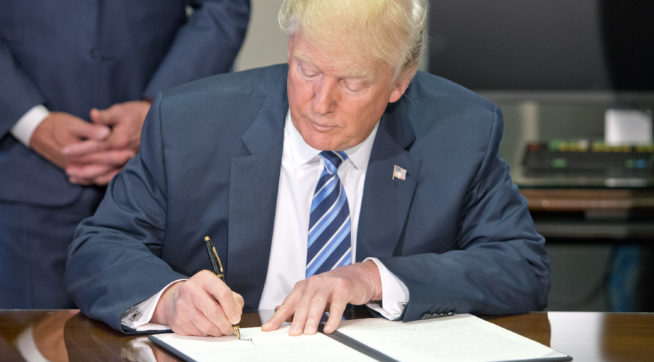
The White House released the executive order Mr. Trump signed today creating a “commission on election integrity” — commencing the long awaited voter fraud investigation Trump promised after claiming baselessly that “millions” voted illegally in the 2016 election.

Mr. Trump signed an executive order Thursday to establish a commission to investigate voter fraud.  The signing comes months after Trump claimed he lost the popular vote because of  voter fraud, claiming that between 3 million and 5 million people voted illegally in last year’s presidential election.  The administration has come forward with no evidence to support this claim.

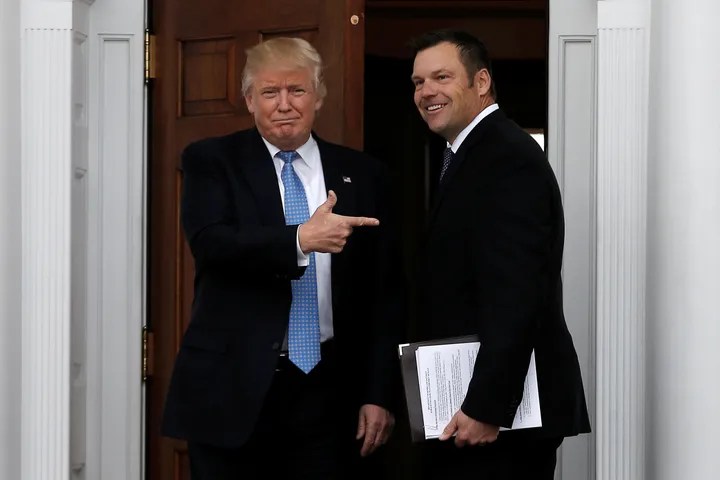
The commission, which will be chaired by Vice President Mike Pence and have Kansas Secretary of State Kris Kobach (a Republican) as its vice chair, is directed to  review policies and practices that enhance or undermine the American people’s confidence in the integrity of federal elections ― including improper registrations, improper voting, fraudulent registrations, fraudulent voting and voting suppression, according to the White House.

However, the text of the order, which is formally called the Presidential Advisory Commission on Election Integrity, says it will study “laws, rules, policies, activities, strategies, and practices” relating to election processes.  While the order does not specifically mention voter suppression or barriers to voting, the committee is formally tasked with investigating both voter fraud and suppression.  Unfortunately, Kobach’s appointment sends a clear signal that while the stated purpose of the commission will be focused on combatting fraud, it is more likely that it will identify voting restrictions that will operate to suppress voting.

Mr. Kobach pushed one of the most restrictive voting laws in the country, which required Kansas residents to show proof of citizenship when they registered to vote and photo ID when they go to the polls.  If residents could not prove properly provide proof of citizenship, they were placed on a “suspense list” for 90 days and then purged from the voter rolls.

MIKE SEGAR / REUTERS


A report by the Kansas Advisory Committee to the U.S. Commission on Civil Rights found that the 2011 law “may have been written and implemented with improper, discriminatory intent.”  In his testimony to the panel, Kobach said the only burden the photo ID requirement could possibly impose was the effort needed to reach for a wallet to pull out identification.  Kobach’s voter fraud law has been challenged in court because the proof of citizenship requirement arguably created an unnecessary obstacle to voting and discouraged low-income, elderly and minority residents from voting.  A federal appeals court blocked Kansas from implementing the proof of citizenship requirement.

It is insulting that the new commission is headed by two champions of voter suppression ― Mike Pence and Kris Kobach.  It is hard to believe that any “findings” of this commission headed by those individuals will do anything but condone and seek to justify voter suppression efforts.  In short, the proposed committee is a sham.


Read the text of the executive order below:

– – – – – – –

ESTABLISHMENT OF PRESIDENTIAL ADVISORY COMMISSION ON ELECTION INTEGRITY

By the authority vested in me as President by the Constitution and the laws of the United States of America, and in order to promote fair and honest Federal elections, it is hereby ordered as follows:

Section 1. Establishment. The Presidential Advisory Commission on Election Integrity (Commission) is hereby established.

Sec. 2. Membership. The Vice President shall chair the Commission, which shall be composed of not more than 15 additional members. The President shall appoint the additional members, who shall include individuals with knowledge and experience in elections, election management, election fraud detection, and voter integrity efforts, and any other individuals with knowledge or experience that the President determines to be of value to the Commission. The Vice President may select a Vice Chair of the Commission from among the members appointed by the President.

Sec. 3. Mission. The Commission shall, consistent with applicable law, study the registration and voting processes used in Federal elections. The Commission shall be solely advisory and shall submit a report to the President that identifies the following:

(a) those laws, rules, policies, activities, strategies, and practices that enhance the American people’s confidence in the integrity of the voting processes used in Federal elections;

(b) those laws, rules, policies, activities, strategies, and practices that undermine the American people’s confidence in the integrity of the voting processes used in Federal elections; and

(c) those vulnerabilities in voting systems and practices used for Federal elections that could lead to improper voter registrations and improper voting, including fraudulent voter registrations and fraudulent voting.

Sec. 4. Definitions. For purposes of this order:

(a) The term “improper voter registration” means any situation where an individual who does not possess the legal right to vote in a jurisdiction is included as an eligible voter on that jurisdiction’s voter list, regardless of the state of mind or intent of such individual.
(b) The term “improper voting” means the act of an individual casting a non-provisional ballot in a jurisdiction in which that individual is ineligible to vote, or the act of an individual casting a ballot in multiple jurisdictions, regardless of the state of mind or intent of that individual.

(c) The term “fraudulent voter registration” means any situation where an individual knowingly and intentionally takes steps to add ineligible individuals to voter lists.

(d) The term “fraudulent voting” means the act of casting a non-provisional ballot or multiple ballots with knowledge that casting the ballot or ballots is illegal.

Sec. 5. Administration. The Commission shall hold public meetings and engage with Federal, State, and local officials, and election law experts, as necessary, to carry out its mission. The Commission shall be informed by, and shall strive to avoid duplicating, the efforts of existing government entities. The Commission shall have staff to provide support for its functions.

Sec. 6. Termination. The Commission shall terminate 30 days after it submits its report to the President.

Sec. 7. General Provisions. (a) To the extent permitted by law, and subject to the availability of appropriations, the General Services Administration shall provide the Commission with such administrative services, funds, facilities, staff, equipment, and other support services as may be necessary to carry out its mission on a reimbursable basis.

(b) Relevant executive departments and agencies shall endeavor to cooperate with the Commission.

(c) Insofar as the Federal Advisory Committee Act, as amended (5 U.S.C. App.) (the “Act”), may apply to the Commission, any functions of the President under that Act, except for those in section 6 of the Act, shall be performed by the Administrator of General Services.

(d) Members of the Commission shall serve without any additional compensation for their work on the Commission, but shall be allowed travel expenses, including per diem in lieu of subsistence, to the extent permitted by law for persons serving intermittently in the Government service (5 U.S.C. 5701-5707).

(e) Nothing in this order shall be construed to impair or otherwise affect:

(i) the authority granted by law to an executive department or agency, or the head thereof; or

(ii) the functions of the Director of the Office of Management and Budget relating to budgetary, administrative, or legislative proposals.

(f) This order shall be implemented consistent with applicable law and subject to the availability of appropriations.
(g) This order is not intended to, and does not, create any right or benefit, substantive or procedural, enforceable at law or in equity by any party against the United States, its departments, agencies, or entities, its officers, employees, or agents, or any other person.

DONALD J. TRUMP

THE WHITE HOUSE,
May 11, 2017.

Posted in Executive Order, Voter Fraud | 1 Comment

217 House Members did Something ‘Revolting’

images-2


Fighting words from  Jon Favreau, Co-Host of Pod Save America, Former Director of Speechwriting for President Barack Obama, at OFA Time to Fight:

Seriously — what the House of Representatives did last week was revolting. It didn’t matter to those 217 House members that the bill they passed was overwhelmingly opposed by America’s doctors, nurses, and hospitals [ed: patient groups too and even some insurance companies. See this, and see the attached lists below]. It didn’t matter that the bill was supported by only 17% of Americans. It didn’t matter that they had no idea how much it would cost, or what kind of impact it would have on the millions of Americans with pre-existing conditions.

All that mattered to those 217 House members [ed: including our congressman Lee Zeldin] was that they got a political win. All that mattered was that their millionaire and billionaire friends got another big tax cut.

What they did was pathetic. And we have to do everything we can to make sure their garbage bill never becomes law.

I’m proud that I worked in a White House that wanted to help people. We spent 18 long months on Obamacare. We listened to experts: health care providers, the AARP, the American Cancer Society. President Obama even debated the law with House Republicans on live television. Most importantly, we listened to the people whose lives it would affect.

We certainly didn’t get it perfect, but we did everything we could — and we helped a lot of people in the process.

This bill will destroy that progress. It will deny medical care to millions of Americans who desperately need it. People will go bankrupt. People will die. I wonder if anyone who voted for this heinous bill gave a minute’s thought to how a medical emergency could financially destroy the average family — especially when insurance companies are once again allowed to charge people more just for being sick or older.

We can’t let that happen. We have to start making phone calls. We have to show up at their town halls. And if they won’t hold town halls, we have to show up at their offices.

We need to protest. We need to march. We need to harness all of our energy and our outrage into a movement that they cannot ignore.

It’s time to fight — are you in?

The following is a list of associations opposed to AHCA (also called #Trumpcare, #Swampcare, #wealthcare)

  • The American Medical Association
  • American Nurses Association
  • American College of Physicians
  • National Nurses United
  • National Physicians Alliance
  • Association of American Physicians and Surgeons
  • American Academy of Pediatrics
  • American Academy of Family Physicians,
  • Association of American Medical Colleges,
  • American Hospital Association
  • Children’s Hospital Association
  • American Cancer Society Cancer Action Network
  • American Diabetes Association
  • American Heart Association
  • American Lung Association
  • Cystic Fibrosis Foundation
  • JDRF (Juvenile Diabetes Research Foundation)
  • March of Dimes
  • National Organization for Rare Disorders
  • National MS Society
  • WomenHeart: The National Coalition for Women with Heart Disease

Here is another list of 50 groups opposing AHCA including patient advocacy groups.

Some Medical Insurance companies oppose the bill too!  Although their trade group, AHIP, seems ambivalent according to Daniel Gross, a Slate contributor:

Rather than condemning the bill or expressing its opposition, AHIP offered a short serving of word salad on how, by “working together, we can create good private market solutions that improve the health and financial stability of all people.”

The natural conclusion, of course, is that the health insurers—the only major component of the industry not to oppose the AHCA—would be the big winners from this legislation. After all, components of the legislation might free them in some states from having to cover pre-existing conditions and allow them to charge much higher premiums to older and sicker people and offer bare-bones plans that don’t provide much in the way of coverage.

But the reality is that health insurers, just like the rest of their industry, are also losers in this legislation. Their actions over the last several years lay bare just how poorly they have performed and innovated despite a law, the Affordable Care Act, that despite all their complaints should have helped them. There is something fundamentally askew and unsustainable about the business models of America’s for-profit insurers. And freeing them to deliver more expensive, more parsimonious products to customers who will no longer be forced to buy them won’t change that.


Posted in ACA, AHCA, American Health Care Act, Health Care, Medicaid, trumpcare, Uncategorized, Zeldin | Tagged , , , | 8 Comments

Preet Bharara, Sally Yates & James Comey: “You are Fired!”

It is “Apprentice” live!

FBI Director Comey is the latest official to fall foul of Trump mid-investigation. Former Acting Attorney General Sally Yates and US Attorney for the Southern District of New York Preet Bharara had previously been dismissed

As reported on CNN

After President Donald Trump fired FBI Director James Comey, questions immediately arose about the President’s motivations…

Senate Minority Leader Chuck Schumer said Comey’s firing was part of a “deeply troubling pattern from the Trump administration,” that appears to be linked to two other high-profile dismissals:
“They fired Sally Yates. They fired Preet Bharara. And they fired James Comey, the very man leading the investigation. This does not seem to be a coincidence,” Schumer said shortly after the announcement, calling for a special independent prosecutor into the Trump campaign’s ties to the Kremlin.
“Any person who he appoints to lead the Russian investigation will be concerned that he or she will meet the same fate as Director Comey,” he said.
CNN’s senior legal analyst Jeffrey Toobin was not buying the idea that Comey was sacked over the Clinton investigation, saying it was “absurd.”
Toobin branded the move a “grotesque abuse of power by the President of the United States,” comparing the sacking of Comey to President Richard Nixon’s firing of special prosecutor Archibald Cox during the Watergate scandal.

James Comey

Why was he fired?
The Trump administration attributed Comey’s dismissal to his handling of the investigation into Democratic nominee Hillary Clinton’s use of a private email server. In a signed letter released by the White House, Trump informed Comey that he was “hereby terminated and removed from office, effective immediately,” explaining that he reached the conclusion that the erstwhile director was “not able to effectively lead the bureau.”
What was he investigating?
As head of the FBI, he was overseeing the investigation into the Trump campaign’s alleged ties to the Kremlin. Democrats have ridiculed the notion that the Clinton issue is what truly prompted Comey’s dismissal, drawing parallels to Watergate-era firings and suggesting Comey was getting too close to the White House with the Russia probe.
Where is the investigation now?
At a hearing last week, Comey confirmed that the FBI’s investigation into accusations of coordination between Trump’s presidential campaign and Russian officials was continuing. It’s not clear if the incoming FBI director will pick up where Comey left off.

Sally Yates

Why was she fired?
Ostensibly for her refusal to implement the first iteration of Trump’s ban on travelers from a number of Muslim-majority countries.
“The acting Attorney General, Sally Yates, has betrayed the Department of Justice by refusing to enforce a legal order designed to protect the citizens of the United States,” White House press secretary Sean Spicer said in a statement at the time, explaining the President’s actions.
What was she investigating?
As part of the probe into possible collusion between Russia and the Trump administration, then-acting Attorney General Yates met with White House counsel to inform them that then-National Security Advisor Michael Flynn wasn’t telling the truth about his interactions with Russian ambassador Sergey Kislyak and, as a result, represented a blackmail risk.
“We believed that General Flynn was compromised with respect to the Russians,” Yates said in a Senate subcommittee hearing aimed at gathering details of the Russian hacking of the 2016 election on Monday in Washington.
“Logic would tell you that you don’t want the national security adviser to be in a position where the Russians have leverage over him,” she added.
Where is the investigation now?
Yates said last Monday that she warned the White House earlier this year that former Trump national security adviser Michael Flynn could be “essentially blackmailed by the Russians.”

Preet Bharara

Preet Bharara, former US Attorney for the Southern District of New York, was known as one of Wall Street’s fiercest watchdogs and a widely respected prosecutor.
Why was he fired?
Bharara first refused to resign along with 46 US attorneys across the country. Although it is common for incoming administrations to replace US attorneys when transitioning to power, Trump had previously assured Bharara that he’d keep his job.
Sources told CNN that Bharara had been told after a meeting with Trump in November that he could stay on, and that he felt blindsided by the request. He was fired after refusing to comply.
At the time, Democratic Senator Elizabeth Warren posted a series of tweets suggesting Bharara was removed in part because he “had authority over Trump Tower.”
Bharara suggested that this was indeed the case. “I wanted it to be on record that there was a deliberate decision to change (his) mind and fire me, particularly given what my office’s jurisdiction is,” he said.
What was he investigating?
Bharara’s office had many investigations ongoing at the time of his firing, including one involving Trump favorite Fox News.  And then there’s the President’s claim that he was wiretapped in Trump Tower on orders of then-President Obama, whose investigation led back to the Southern District of New York.  “Trump has undoubtedly decided that he wants his own pick rather than the choice of Senate adversary (and minority leader) Chuck Schumer in place as the top federal prosecutor in New York,” CNN legal analyst Paul Callan wrote in March.
Where is the investigation now?
Members of both parties have said they have seen no evidence to back up Trump’s allegations about Obama, and, addressing a hearing before the House Intelligence Committee, Comey said that he had “no information” to support claims by the President that he was wiretapped on the orders of his predecessor.
Posted in Ethics, FBI, immigration/deportation, Russian connection, Sally Yates, Travel Ban, Trump, Uncategorized | Tagged , , , , , , , , , , , | Comments Off on Preet Bharara, Sally Yates & James Comey: “You are Fired!”

What did Rod Rosenstein say? This is his letter in full.

President Donald Trump followed the recommendation of his deputy attorney general when he fired FBI boss James Comey.

Memorandum for the Attorney General

FROM: Rod J Rosenstein

SUBJECT: Restoring public confidence in the FBI

The Federal Bureau of Investigation has long been regarded as our nation’s premier federal investigative agency. Over the past year, however, the FBI’s reputation and credibility have suffered substantial damage, and it has affected the entire Department of Justice. That is deeply troubling to many Department employees and veterans, legislators and citizens.

The current FBI Director is an articulate and persuasive speaker about leadership and the immutable principles of the Department of Justice. He deserves our appreciation for his public service. As you and I have discussed, however, I cannot defend the Director’s handling of the conclusion of the investigation of Secretary Clinton’s emails, and I do not understand his refusal to accept the nearly universal judgment that he was mistaken. Almost everyone agrees that the Director made serious mistakes; it is one of the few issues that unites people of diverse perspectives.

The director was wrong to usurp the Attorney General’s authority on July 5, 2016, and announce his conclusion that the case should be closed without prosecution. It is not the function of the Director to make such an announcement. At most, the Director should have said the FBI had completed its investigation and presented its findings to federal prosecutors. The Director now defends his decision by asserting that he believed attorney General Loretta Lynch had a conflict. But the FBI Director is never empowered to supplant federal prosecutors and assume command of the Justice Department. There is a well-established process for other officials to step in when a conflict requires the recusal of the Attorney General. On July 5, however, the Director announced his own conclusions about the nation’s most sensitive criminal investigation, without the authorization of duly appointed Justice Department leaders.

Compounding the error, the Director ignored another longstanding principle: we do not hold press conferences to release derogatory information about the subject of a declined criminal investigation. Derogatory information sometimes is disclosed in the course of criminal investigations and prosecutions, but we never release it gratuitously. The Director laid out his version of the facts for the news media as if it were a closing argument, but without a trial. It is a textbook example of what federal prosecutors and agents are taught not to do.

In response to skeptical question at a congressional hearing, the Director defended his remarks by saying that his “goal was to say what is true. What did we do, what did we find, what do we think about it.” But the goal of a federal criminal investigation is not to announce our thoughts at a press conference. The goal is to determine whether there is sufficient evidence to justify a federal criminal prosecution, then allow a federal prosecutor who exercises authority delegated by the Attorney General to make a prosecutorial decision, and then – if prosecution is warranted – let the judge and jury determine the facts. We sometimes release information about closed investigations in appropriate ways, but the FBI does not do it sua sponte.

Concerning his letter to the Congress on October 28, 2016, the Director cast his decision as a choice between whether he would “speak” about the FBI’s decision to investigate the newly-discovered email messages or “conceal” it. “Conceal” is a loaded term that misstates the issue. When federal agents and prosecutors quietly open a criminal investigation, we are not concealing anything; we are simply following the longstanding policy that we refrain from publicizing non-public information. In that context, silence is not concealment.

My perspective on these issues is shared by former Attorneys General and Deputy Attorneys General from different eras and both political parties. Judge Laurence Silberman, who served as Deputy Attorneys General under President Ford, wrote that “it is not the bureau’s responsibility to opine on whether a matter should be prosecuted.” Silberman believes that the Director’s “Performance was so inappropriate for an FBI director that [he] doubt[s] the bureau will ever completely recover.” Jamie Gorelick, Deputy Attorney General under President George W. Bush, to opine that the Director had “chosen personally to restrike the balance between transparency and fairness, department from the department’s traditions.” They concluded that the Director violated his obligation to “preserve, protect and defend” the traditions of the Department and the FBI.

Former Attorney General Michael Mukasey, who served under President George W Bush, observed the Director “stepped way outside his job in disclosing the recommendation in that fashion” because the FBI director “doesn’t make that decision”. Alberto Gonzales, who also served as Attorneys General under President George W Bush, called the decision “an error in judgement.” Eric Holder, who served as Deputy Attorneys General under President Clinton and Attorneys General under President Obama, said that the Director’s decision “was incorrect. It violated long-standing Justice Department policies and traditions. And it ran counter to guidance that I put in place four years ago laying out the proper way to conduct investigations during an election season.” Holder concluded that the Director “broke with these fundamental principles” and “negatively affected public trust in both the Justice Department and the FBI”.

Former Deputy Attorneys General Gorelick and Thompson described the unusual event as “read-time, raw-take transparency taken to its illogical limit, a kind of reality TV of federal criminal investigation,” that is “antithetical to the interests of justice”.

Donald Ayer, who served as Deputy Attorneys General under President HW Bush, along with former Justice Department officials, was “astonished and perplexed” by the decision to “break[] with longstanding practices followed by officials of both parties during past elections.” Ayer’s letter noted, “Perhaps most troubling… is the precedent set by this departure from the Department’s widely-respected, non-partisan traditions.”

We should reject the departure and return to the traditions.

Although the President has the power to remove an FBI director, the decision should not be taken lightly. I agree with the nearly unanimous opinions of former Department officials. The way the Director handled the conclusion of the email investigation was wrong. As a result, the FBI is unlikely to regain public and congressional trust until it has a Director who understands the gravity of the mistakes and pledges never to repeat them. Having refused to admit his errors, the Director cannot be expected to implement the necessary corrective actions.

Posted in FBI, Trump | Comments Off on What did Rod Rosenstein say? This is his letter in full.

Constitutional Crisis: Trump tries to Cover up Russia Collusion

The firing of FBI Director Comey is unprecedented and highly suspicious in light of recent developments in the Russia-Trump campaign collusion investigations. First, there was the testimony of former National Intelligence Director James Clapper and former acting Attorney General Sally Yates. Watch it on Rachel Maddow! Both testified about former National Security Advisor Michael Flynn’s connections to Russia and that the White House knew about this, and kept him on for 18 days knowing that he was a paid Russian agent and had not disclosed his Russian ties even though he was told to do so in writing. The White house did nothing.  Sen. Chris Murphy from CT thinks, there is more and more evidence for collusion in Russia-Trump campaign story.

Sen. Chris Murphy from CT thinks, there is more and more evidence for collusion in Russia-Trump campaign story.  Indictments of Trump campaign people, probably Paul Manifort, General Flynn, Roger Stone and Carter Page are likely to come in the near future. This puts Donald Trump in direct danger. Was he part of the Russia collusion too? And is this treason?

Just yesterday a Grand jury apparently issued subpoenas as reported by CNN. One gets the impression that Donald Trump is getting increasingly nervous. He is calling these investigations a “hoax”, a “charade”, and “fake news”. Since the FBI investigation was the most threatening investigation (they have the power to bring a criminal indictment in contrast to the House and Senate investigations), it is quite obvious what Trump’s motivation was, in firing Comey.  This makes Trump look even more guilty.

The White House, AG Sessions (who is supposed to have recused himself) and Deputee AG Rod Rosenstein, have offered an excuse for the firing of Comey. It is laughable. They say (along with Fox talking heads) that it is about Comey’s handling of the Clinton emails! Utter nonsense that anyone can see through, given that this all occurred in July – Nov. 2016 and we are now May 2017!

Nixon fired Archibald Cox to avoid handing over his tapes. Ultimately it did not save him. Republicans joined Dems to declare their intent to vote for impeachment. Today, we will see which Republican senators will put the country in front of politics and vote to appoint a special prosecutor to investigate Donald Trump and his campaign.

Posted in GOP, Russian connection, Sally Yates, Trump, Uncategorized | Comments Off on Constitutional Crisis: Trump tries to Cover up Russia Collusion

Trump Administration Cites Segregation-Era Ruling To Defend Its Travel Ban

Published by HUFFINGTON POST

POLITICS

05/08/2017 06:57 pm ET | Updated 2 hours ago

In 1971, the Supreme Court decided that courts shouldn’t investigate the motivations of officials who closed public pools rather than integrate them.

SHAWN THEW/POOL PHOTO/GETTY IMAGES
President Donald Trump and Attorney General Jeff Sessions at a White House discussion on March 29. Sessions’ Justice Department has cited a ruling in a swimming pool closure case in its defense of the travel ban.


WASHINGTON ― In a brief defending its ban on citizens from six Muslim-majority countries, President Donald Trump’s Justice Department approvingly cited a segregation-era Supreme Court decision that allowed Jackson, Mississippi, to close public pools rather than integrate them.

In the early 1960s, courts ordered Jackson to desegregate its public parks, which included five swimming pools. Instead, the city decided to close the pools. Black residents of Jackson sued. But in 1971, the Supreme Court, in a 5-4 decision, decided that closing the pools rather than integrating them was just fine.

The dissents, even at the time, were furious. “May a State in order to avoid integration of the races abolish all of its public schools?” Justice William O. Douglas asked in his dissent.

“I had thought official policies forbidding or discouraging joint use of public facilities by Negroes and whites were at war with the Equal Protection Clause” of the Fourteenth Amendment, Justice Byron White wrote in another dissent. “Our cases make it unquestionably clear, as all of us agree, that a city or State may not enforce such a policy by maintaining officially separate facilities for the two races. It is also my view, but apparently not that of the majority, that a State may not have an official stance against desegregating public facilities and implement it by closing those facilities in response to a desegregation order.”

The ruling in Palmer v. Thompson didn’t explicitly uphold segregation. But it did call for courts to avoid investigating the constitutionality of officials’ motivations.

It is difficult or impossible for any court to determine the ‘sole’ or ‘dominant’ motivation behind the choices of a group of legislators,” the majority opinion said. “Furthermore, there is an element of futility in a judicial attempt to invalidate a law because of the bad motives of its supporters.”

The Trump administration emphasizes this in its citation of the case, arguing that looking into “governmental purpose outside the operative terms of governmental action and official pronouncements” is “fraught with practical ‘pitfalls’ and ‘hazards’ that would make courts’ task ‘extremely difficult.’”

But in some cases, such as the closure of the Jackson pools, officials’ motivations are clear, said Paul Brest, the director of Stanford University’s Law and Policy Lab.

“When it is absolutely clear that an official acted for unconstitutional purposes … [the courts] should be willing to strike down that decision because, even though the decision might have been reached legitimately, a public official violates the constitution when he or she acts for unconstitutional reasons,” Brest said. “It’s as simple as that. … Race discrimination is the best example of where courts are quite willing to take people’s motivations into account — or religious discrimination.”

Palmer is one of the worst Supreme Court decisions ever handed down in regards to race, said Michele Goodwin, the chancellor’s professor of law at the University of California, Irvine.

“Citing Palmer is like citing Buck v. Bell for a premise of equal protection,” Goodwin says. (Buck v. Bell legalized eugenics.) She added that a case like Palmer also doesn’t hold up over time.

“[Palmer] doesn’t represent our view of how law, how people, how society [and] how equality has evolved in the United States,” she said. “To cite a case that, in and of itself, coheres ideas about inequality and explicit racism in spaces where racism could mean the end of someone’s life, then one would really have to question why a president would cite such a case — given how much it’s been refuted.”

John Paul Schnapper-Casteras, a special counsel at the NAACP Legal Defense Fund, wrote in a Sunday blog post that it’s “stunning” to see the Department of Justice approvingly cite a case that “at best allowed pretextual measures for avoiding racial integration ― and, more realistically, facilitated segregation by turning a blind eye to what was clearly going on in the City of Jackson.”

Justice Department lawyers know exactly what they’re doing ― citing different doctrines in an attempt to thwart any reason to examine what Trump on the campaign trail “said, very unambiguously, was to ban Muslims from coming into the country,” he told HuffPost.

“This is less about national security and more about them trying to find any way to insulate the motivation behind this order. Sometimes they invoke national security cases,” Schnapper-Casteras said. “In this case, they invoked a case about segregation.”

A Justice Department spokesman declined to comment.

LAURA BUCKMAN / REUTERS
President Donald Trump’s executive order on travel from Muslim-majority nations draws protests at Dallas/Fort Worth International Airport on Jan. 29. On the campaign trail, Trump often spoke of a ban on Muslims entering the U.S. 


But there’s a clear reason why the Trump administration doesn’t want the courts to consider potential motivations for Trump’s revised travel ban: The idea that the president’s intent was to discriminate against Muslims has come up in prior rulings against his executive order. As a candidate, Trump called for a “complete shutdown” of Muslims entering the U.S. and has spoken disparagingly of refugees. He and the White House say the travel executive orders are not the same as a Muslim ban, but opponents say his past statements show they likely had the same motivation.

The executive order blocks certain foreign nationals of six Muslim-majority nations ― Iran, Libya, Somalia, Sudan, Syria and Yemen ― from the U.S. for 90 days. (An earlier executive order had included Iraq.) It also bans all refugees for 120 days and cuts total refugee resettlement numbers for the year by more than half of the previous cap. The order was blocked in the courts before implementation.

Pools have a history as a racial flashpoint. In the 1960s, “so unacceptable through almost all of the South was the idea of blacks and whites swimming together that even the Gulf of Mexico was off-limits to blacks in some areas,” The New York Times reported in 2006.

White racial anxiety about swimming was common in the North, too. “Water fueled white racism,” Marta Gutman, a professor at the City College of New York, wrote in a 2008 paper.

“The practice of bathing had expanded to include swimming for exercise, but water retained the longstanding symbolic link with purity,” Gutman wrote. “Swimming pools became places where those seen as impure or polluted would be excluded (even though water had to be sanitized in order to be pure). When pressed to integrate, white operators protested pools would have to be emptied, scrubbed clean and refilled with fresh water after black children swam in them.”

Airplanes were segregated, too.

Elise Foley and Ryan Reilly contributed reporting.


Posted in Executive Order, foreign policy, GOP, immigration/deportation, Travel Ban, Trump | Comments Off on Trump Administration Cites Segregation-Era Ruling To Defend Its Travel Ban

Scrapping ‘Essential Benefits’ May Be Biggest Health Care Change

Newborn baby

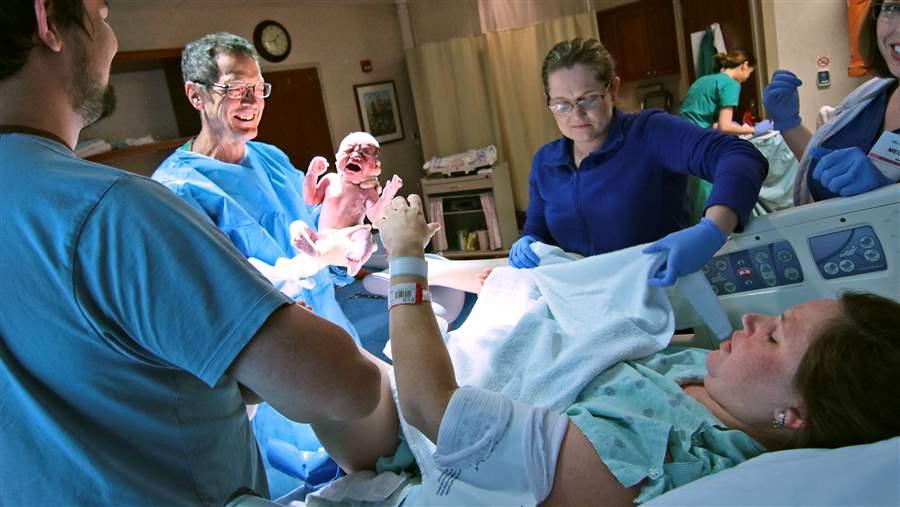
A baby is born at AnMed Health Women’s and Children’s Hospital in Anderson, South Carolina. Under the Republican health care proposal the House passed last week, insurance plans would not have to cover maternal and newborn care. © The Associated Press


Critics of the Republican health care plan the House passed last week mostly have focused on how it might harm Americans with pre-existing health conditions and poor and disabled people who rely on Medicaid — two vulnerable, but defined, populations.

But another change might have more far-reaching effects: eliminating the Affordable Care Act’s “essential health benefits,” or EHBs. That shift could affect almost everybody, including the 156 million Americans who receive health coverage through their employers.

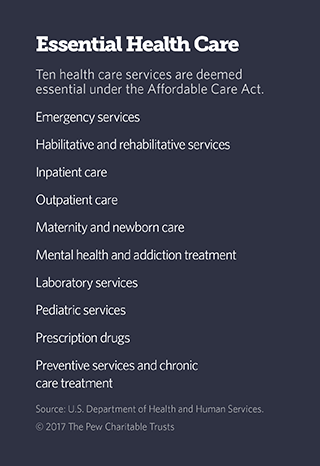
Under the ACA, health plans sold to individuals and small groups (employers with 50 or fewer employees) must include 10 essential benefits: emergency services, habilitative and rehabilitative services, inpatient care, outpatient care, maternity and newborn care, mental health and addiction treatment, lab tests, preventive care, prescriptions, and pediatric services, including oral and vision care.

Plans offered by larger employers do not have to include all 10 essential benefits. However, if the plans cover any EHBs, they cannot impose annual or lifetime limits on reimbursements for those expenses.

The House GOP plan would eliminate the federal mandate under the ACA, and instead give states the power to determine what health plans sold on the individual and small group market must cover.

Insurers would be free to sell cheaper, bare-bones plans to young and healthy consumers who don’t think they’ll need certain benefits. Many of those consumers would end up paying less for their health insurance.

Supporters of the GOP plan say it makes little sense to force people to pay for services they don’t want. Why, for example, should a single man have to pay extra for a policy that covers maternal health care?

“That is a commandeering approach to health insurance which those of us on our side find objectionable,” said Edmund Haislmaier, senior health policy research fellow at the Heritage Foundation, a conservative think tank.

But for people needing broader coverage, the change likely would mean higher premiums and fewer choices. It also would force people who opt for bare-bones coverage to pay out-of-pocket for services they unexpectedly need.

The change would affect even those who receive coverage through their employers, because the prohibitions on annual and lifetime caps are tied to the essential benefits.

A late amendment to the GOP bill, which now moves to the Senate, would allow large employers to choose benefit packages from any state, instead of being bound by the rules in their home state. For example, an employer looking to cut its insurance costs could choose to follow the rules of a state that had made hospitalization nonessential. The employer could then impose annual or lifetime limits on reimbursement for hospitalization — something barred under the ACA.

“The quality of health insurance will vary widely from state to state, as would the depth of those services,” said Michael Williams, director of the Center for Health Policy at the University of Virginia.

Widespread Concern

The Republican proposal has drawn opposition from many prominent health care groups, including the American Medical Association, the American Hospital Association, the American Academy of Family Physicians, the National Alliance on Mental Illness and the American Diabetes Association. Some Republicans, including U.S. Sen. Susan Collins of Maine, have objected to the elimination of some EHBs, especially addiction treatment services at a time when her state, like many others, is facing a crisis of opioid addiction.

Even the insurance industry, which might be expected to welcome the increased flexibility it would have under the GOP plan, has been circumspect about the question of EHBs. Kristine Grow, a spokeswoman for America’s Health Insurance Plans, the lobbying arm of the commercial health insurance industry, said the group has taken no position on whether they should be scrapped.

Most health care policy analysts are adamantly opposed to scrapping the essential benefits mandate, fearing a return to pre-ACA days when most plans offered on the individual market provided bare-bones coverage or high deductibles and copayments.

“The essential health benefits made insurance coverage really meaningful,” said Karen Pollitz, a senior health policy fellow at the Henry J. Kaiser Family Foundation. “It really took a lot of junk off the market, and there was a lot of it.”

Higher Premiums?

Pollitz said the elimination of the essential health benefits would cause a cascade of negative effects, both for people who opt to purchase the bare-bones plans and those who opt for more comprehensive coverage.

For the former, Pollitz said, the change “would make monthly premiums less expensive, but it adds to the risk that if something did happen that they didn’t anticipate, they’d have to pay for their health care out of their own pockets.”

For the latter, premiums would go up, because insurers could no longer spread risk across a broader pool of beneficiaries.

As an example, Pollitz pointed to maternal health care, which most pre-ACA individual policies did not offer. If insurers were not required to include it, only pregnant women or women who hoped to become pregnant would opt to pay more for policies that included that benefit. Because nearly all of them likely would use it, the premiums for such policies would be extremely high, probably “pretty close to the cost of labor and delivery themselves,” Pollitz said.

Pollitz and other critics also contend that eliminating the essential health benefits would undermine the popular ACA provision requiring health insurers to accept policyholders with pre-existing health conditions.

House Speaker Paul Ryan recently called the Republican bill a “rescue mission” to provide affordable health insurance, “especially and including people with pre-existing conditions.” Opponents note, however, that the bill would reduce ACA subsidies that help people pay for coverage.

The reduction of the subsidies, coupled with the end of the essential benefits mandate, would make it difficult for many with pre-existing conditions to find and afford the kind of coverage they would need.

“The reality is that if states strip out the [essential health benefits], that could very well take out the very services needed to address that pre-existing condition,” said Molly Smith, senior associate director for policy development at the American Hospital Association.

That could hit hospitals hard, since presumably many of the people who would go to hospitals for care not covered by their insurance would be unable to pay for it out of their own pockets, leaving hospitals to pick up the tab.

Williams of the University of Virginia pointed out another problem hospitals could face if the essential health benefits are jettisoned: Patients who are ready for discharge but not yet capable of returning home may no longer be covered for treatment in rehabilitative or skilled nursing care facilities. In those cases, Williams said, hospitals would be reluctant to discharge them, leading to longer and more costly hospital stays. The slower turnover might cause a shortage of beds.

“You can operate that way only so long,” Williams said. “It’s just not sustainable.”

Posted in AHCA, American Health Care Act, Congress, Health Care, Politics, Pre-existing Conditions | Comments Off on Scrapping ‘Essential Benefits’ May Be Biggest Health Care Change

Sally Yates Mops The Floor With GOP’s Ted Cruz While Schooling Him On Constitutional Law

Posted on DailyKos.com

Slide1.jpg

During the Russian probe hearings on Monday, former acting DOJ Attorney General Sally Yates batted off Trump-supporting Republicans like flies during their attempts to discredit, shame and trick her. They failed, and once again, the GOP embarrassed the country in efforts to defend Donald Trump.

During one particular pompous and unrelated inquisition, Texas Senator Ted Cruz pompously decides to question Yates on the Trump’s Muslim ban rather than Mike Flynn or the Trump-Russia investigation — the reasons for the hearing. Cruz found himself messing with the wrong person, as he tried to edify Yates on Trump’s authority using a section of the INA/Immigration and Nationality Act.  Here is the transcript of the exchange.

Ted Cruz: Earlier when Chairman Graham asked you that, I thought you declined to answer so perhaps I misunderstood that.

​​Sally Yates: And I may have misunderstood the question. I thought the question I declined to answer was a different one than that, so I’m glad I got a chance to clear it up.

Ted Cruz: Okay, so you have no information of any interceptions of the Bernie Sanders campaign, the Hillary Clinton campaign or other candidates in the  2016 campaigns.

Sally Yates: No

Cruz then goes off the hearing’s topic to Trump’s Muslim ban. This is where his true snide and smug self was revealed for all to see.

Ted Cruz: Okay. Let’s revisit the topic, Miss Yates, that you and Senator Cornyn were talking about.

Sally Yates: Okay.

Ted Cruz: Um. Is it correct that the Constitution vests the authority in the President?

Sally Yates: Yes.

Ted Cruz: And if an attorney general disagrees with the policy decision of the President — a policy decision that is lawful, does the attorney general have the authority to direct the Department of Justice to defy the President’s order?

Sally Yates: I don’t know whether the attorney general has the authority to do that or not but I don’t think it would be a good idea, and that’s not what I did in this case.

Ted Cruz: Well, are  you familiar with 8 U.S. Code § 1182?

Sally Yates: Not off the top of my head, no.

Ted Cruz: Well, It, it is the binding statutory authority for the president’s executive order your refused to implement that led to your termination, so it certainly is a relevant and not obscure statute. 

Cruz goes on to quote one part of the statute.

Ted Cruz: By the expressed text of the statue it says, quote:  ‘Whenever the President finds that the entry of any alien or class of aliens into the United States, would be detrimental to the interest of the United States, he may by proclamation, and for any period he shall deem necessary, suspend the entry of all aliens or class of aliens  as immigrants or non immigrants, or impose on the entry of aliens, any restrictions he may deem appropriate.” Would you agree that, that is broad statutory authorization?

Without hesitation, Yates replies with the additional provision that “trumps” (yes, she uses that word)  Cruz’s statute section — basically out-lawyering him and putting him in his place for all the world to see.

Sally Yates: I would, and I am familiar with that and I’m also familiar with an additional provision of the INA that says: “No person shall receive preference or be discriminated against in issuance of a visa because of race, nationality, or place of birth.” That, I believe was promulgated after the statute that you just quoted. And, that’s been part of the discussion with the courts in respect to the INA, is whether this more specific statute trumps the first one that you just described. But my concern was not an INA concern, here; it rather, was a constitutional concern.

It seems Ted Cruz is still desperately trying to ‘find himself’ after the election — but then, it’s really dark up in Trump’s world.

How refreshing to witness the kind of nonpartisan integrity we saw today from two former government officials who sadly both lost their jobs, directly/indirectly, because of it. But many feel we’ll be hearing more from them again and think today we witnessed what two possible presidential candidates look like. Cheers to Sally Yates and James Clapper for making America proud.


Posted in Congress, Executive Order, GOP, Politics, Sally Yates, Travel Ban, Trump | Comments Off on Sally Yates Mops The Floor With GOP’s Ted Cruz While Schooling Him On Constitutional Law

Trump Budget Would Slash Funds for Office Fighting Opioid Epidemic

Published by Mother Jones

The Office of National Drug Control Policy is facing a 95 percent budget cut.

The White House is calling for a 95 percent funding cut for the Office of National Drug Control Policy, the agency leading the charge against the country’s opioid epidemic, according to sources knowledgeable about the White House’s draft budget for the coming fiscal year. ONDCP is responsible for coordinating drug prevention programs across federal agencies and was slated to fund President Donald Trump’s much-lauded opioid commission.

The budget would slash ONDCP’s $380 million budget to $24 million. It would eliminate the High Intensity Drug Trafficking Areas program, which coordinates local, state, and national efforts to reduce drug trafficking and has a $250 million annual budget. It would also cut the Drug-Free Communities Support Program, which funds community-based youth substance abuse prevention programs. The budget calls both programs “duplicative of other Federal programs.” The budget is a “passback” draft: it was cleared by the White House budget office last week, but will still need to be approved by Congress.

On the campaign trail, Trump promised to “spend the money” to address the opioid epidemic, but his proposed budgets and policies thus far would drastically cut federal funding to tackle the issue. The Republican health care bill passed by the House of Representatives on Thursday would cause an estimated 3 million Americans to lose some or all of their addiction treatment coverage.

The president tapped New Jersey Gov. Chris Christie in March to lead an opioid commission, which reports to Trump’s son-in-law, Jared Kushner. The commission’s purpose is to draft priorities and recommendations for future policies, but critics say that it wastes precious time, given that the surgeon general’s office in the Obama administration published a similar report last November. As one Democratic congressional staffer said last month, “How many more people will die of opioid overdose while they’re pretending to care?”

In an email to his staff, acting ONDCP director Richard Baum wrote:

I have been encouraged by the Administration’s commitment to addressing the opioid epidemic, and the President’s personal engagement on the issue, both during the campaign and since he was sworn into office. However, OMB’s proposed cuts are also at odds with the fact that the President has tasked us with supporting his Commission on Combatting Drug Addiction and the Opioid Crisis.

These drastic proposed cuts are frankly heartbreaking and, if carried out, would cause us to lose many good people who contribute greatly to ONDCP’s mission and core activities.

I don’t want to see this happen.

Posted in Health Care, Opiod, Trump, Uncategorized | Comments Off on Trump Budget Would Slash Funds for Office Fighting Opioid Epidemic