Impact of AHCA on Children Alarming

New research demonstrates magnitude of threat to children’s health

Washington, D.C. — Our nation is at an important crossroads, with today’s decisions impacting our economy and workforce far into the future. As the Senate deliberates the U.S. House-passed American Health Care Act (AHCA), research released today by Avalere adds to mounting evidence that child health would be threatened should Medicaid be changed as proposed in the current legislation. Nationally, children’s Medicaid would suffer a funding cut of $43 billion over 10 years under a per capita cap model, and as much as $78 billion over 10 years under a block grant.

Avalere’s analysis looks specifically at funding for non-disabled children and further details how the AHCA funding cut to Medicaid would be divided among the states. Under per capita caps, Texas, California, New York and Florida would absorb nearly 30 percent of the estimated $43 billion of funding reductions. States would be forced to make difficult decisions affecting the care children need to stay healthy and ready to learn.

If all states were to opt for a Medicaid block grant under the House-passed AHCA, Avalere finds the potential impact to children would be even more severe, swelling to $78 billion over 10 years. Under this scenario, states may opt to cut critical benefits for kids to reduce costs and/or impose cost-sharing that could impede children’s access to care.

Avalere’s findings are similar to those released recently by the American Action Fund in Impact of the AHCA’s Medicaid Reforms Varies by Category of Eligibility. The report notes under the AHCA, per beneficiary spending for children in 2025 will result in an 8.5 percent reduction under a per capita cap model.

Children represent the future of our country, and the risk of collateral damage to them through budget cuts is high. Children’s hospitals want to work with the Senate to maintain Medicaid funding, coverage and benefits for kids, and advance new innovations to reduce spending such as the bipartisan ACE Kids Act (S. 428). Decisions made now will affect the lifetime health, well-being and contributions of millions of children far into their adult lives.

Posted in AHCA, American Health Care Act, Family Issues, Health Care, Medicaid | 1 Comment

Our Social Contract

Here is a perfect and concise explanation of what a true democracy is about.

Letter: Why should I pay indeed?

  • From Barbara Rank —  Hidden Oaks Court, Dubuque, Iowa
  • May 12, 2017

Congressman Rod Blum in a Dubuque town hall (Monday) night asked, “Why should a 62-year-old man have to pay for maternity care?”

I ask, why should I pay for a bridge I don’t cross, a sidewalk I don’t walk on, a library book I don’t read?

Why should I pay for a flower I won’t smell, a park I don’t visit, or art I can’t appreciate? Why should I pay the salaries of politicians I didn’t vote for, a tax cut that doesn’t affect me, or a loophole I can’t take advantage of?

It’s called democracy, a civil society, the greater good. That’s what we pay for.

Posted in AHCA, American Health Care Act, Health Care | 1 Comment

Trump’s Support on Long Island

Carol Polsky published a nice report of interviews with 6 Long Islanders in Newsday.  These are people that voted for Trump but maybe having second thoughts at least on some issues.  We posted a similar analysis of working class voters in Ohio.  What you can see by reading these reports carefully, is some erosion in voter’s confidence that Trump will live up to his campaign promises, i.e. will he lead us into war in the near east? Will health care insurance costs actually decrease as promised?  Will he save healthcare for those with pre-existing conditions?  Will L.I. construction businesses suffer if Latinos are all sent home, etc.

We must listen carefully to these people.  Just as an example, I have reprinted one of the 6 case histories:

Bitakos, 52, has driven a taxi on Long Island for 15 years. He is an independent who “goes with the flow” and has become almost a one-man predictor of success in the past seven presidential elections. He voted for Democrat Bill Clinton, Republican George W. Bush, Democrat Barack Obama, and most recently, Republican Donald Trump.

Bitakos said he was drawn to some of Trump’s stances, even though he’d initially liked Sen. Bernie Sanders (I-Vt.), who lost the Democratic primary race to Clinton.

Not long after the collapse of the first legislative effort in late March to repeal and replace Obama’s signature health care achievement, the Affordable Care Act, Bitakos gave his verdict: “He failed. They don’t have anything to replace it with so what are they going to do?”

Bitakos gets his health insurance through the expanded Medicaid program put in place under the ACA. “I need it . . . I’m diabetic, I get my blood pressure pills. If he throws everybody off and starts doing his own thing, we’re dead.”

For now, Bitakos is sorry he went with Trump. “I should never have voted for him,” he said. “I regret voting for him, honest to God.”

Trump had promised jobs and a stronger military and, “I like respect for the military and law enforcement,” said Bitakos, who hangs an American flag outside his home. “There were a lot of things I liked about him: I liked the patriotism about him, I liked the America thing, the America first.”

But he has quickly become anxious and frustrated. His complaints range from Trump’s frequent trips to his Florida estate, Mar-a-Lago, to his possible connections with Russia.

“I don’t see anything happening with anything he’s doing,” Bitakos said of Trump.

“I just hope he doesn’t cause any serious problems with the Middle East,” Bitakos said. “I hope he doesn’t open up a big war because guys are going to get killed. And who knows what is going on with him and Russia. That’s the big question. But it’s too soon yet.”

It is not obvious how will translate into lack of support for downstream candidates (Zeldin for example, or local candidates).  But as voters become increasingly frustrated, I assume they will want “the other party” in Nov 2017 and Nov 2018.

Posted in American Health Care Act, Pre-existing Conditions, Trump, trumpcare, Uncategorized, Zeldin | Tagged , , , | Comments Off on Trump’s Support on Long Island

Intimidation of an Activist by Rep. Frelinghausen (NJ-11)

“NJ 11th for Change” is a Facebook group (similar to LVLZ) with 7000 members.  One of their leaders, Saily Avelenda of West Caldwell, New Jersey, was reported to her employer, Lakeland Bank, by her congressman!  She was then reprimanded and ended up resigning from her job.  This story has become national news today.  It was first reported by Nancy Solomon of WNYC.

Here are some highlights from the WNYC story:

The most powerful congressman in New Jersey, Rep. Rodney Frelinghuysen, wrote a fundraising letter in March to a board member of a local bank, warning him that a member of an activist group opposing the Republican worked at his bank.

The employee was questioned and criticized for her involvement in NJ 11th for Change, a group that formed after the election of Donald Trump and has been pressuring Frelinghuysen to meet with constituents in his district and oppose the Trump agenda.

“Needless to say, that did cause some issues at work that were difficult to overcome,” said Saily Avelenda of West Caldwell, New Jersey, who was a senior vice president and assistant general counsel at the bank before she resigned. She says the pressure she received over her political involvement was one of several reasons she decided to leave.

The form letter, on campaign stationery, asks Frelinghuysen’s supporters to donate two years ahead of his next election because he is under attack. “But let’s be clear that there are organized forces — both national and local — who are already hard at work to put a stop to an agenda of limited government, economic growth, stronger national security,” the letter says.

Above the word local, there’s a hand-written asterisk in the same blue ink as Frelinghuysen’s signature. At the bottom of the letter, scrawled with a pen, is the corresponding footnote: “P.S. One of the ringleaders works in your bank!”

Attached to the letter was a news article that quoted Avelenda. She says her boss presented her with both the letter and the news article. She was not fired, but she says she had a lot of explaining to do.

“I had to write a statement to my CEO, and at my level as an assistant general counsel and a senior vice president, at this employer, it was not something that I expected,” Avelenda said. “I thought my Congressman put them in a situation, and put me in a really bad situation as the constituent, and used his name, used his position and used his stationery to try to punish me.”

NJ 11th for Change began with one Facebook post after the Trump election and quickly grew into an organization of more than 7,000 members who live in Frelinghuysen’s moderate Republican-leaning district. They began by requesting a town hall — he hasn’t held one in four years — and when that request was denied, they organized empty-chair town halls without him. The group has also held weekly protests at his office and visits to his Washington offices. Frelinghuysen has held two telephone town halls, which offer more control than an in-person event. Last week, he complained about the number of phone calls he is receiving.

“For people who have jammed our lines and made it difficult for us to meet our constituent needs, it would be nice for you to back off,” Frelinghuysen said. “I’m not suggesting people don’t have a right to speak and let their views be known, but some of this is highly orchestrated and it’s unfortunate.”

Frelinghuysen is the new chairman of the House Appropriations Committee, widely considered one of the most powerful positions in Congress because all funding decisions for the entire federal government now run through him. And for the first time in many years, his moderate district is no longer considered a safe Republican seat by the national Democratic Party. Jordan Libowitz, spokesman for the non-partisan Citizens for Responsibility and Ethics in Washington (CREW), says the letter is unusual and noteworthy because members of Congress don’t usually turn to businesses in their district to do damage to their political opponents.

“It’s certainly troubling,” Libowitz said. “Whether or not it breaks a criminal statute is one issue, but the very clear issue is that it appears that a member of Congress might be using his power to threaten someone’s employment because of their political activities.”

The fundraising letter went to Joseph O’Dowd, a Lakeland Bank board member who has given $700 to Frelinghuysen during previous election cycles, according to Federal Election Commission records. O’Dowd and several managers at the bank also donate to the New Jersey Bankers Association, which in turn gives most of its money to the American Bankers Association. That group has about 20 paid lobbyists in Washington, according to disclosure statements filed with Congress.

The letter from Frelinghuysen may be more of a political problem than a legal one, according to a lawyer and former staffer for the Office of Congressional Ethics who spoke on condition of anonymity. He said the letter may look heavy-handed, but to be illegal it would need to threaten action or be written on Congressional stationery, not campaign letterhead, or the bank would have to have business pending before a Frelinghuysen committee.

But the chair of appropriations has business and influence with everyone, including lobbyists, federal agency heads and other members of Congress, says Libowitz. And the fact that Frelinghuysen apparently put the job of a constituent in jeopardy undermines the fundamental relationship between a representative and his or her district.

“They could always argue that it was just a friendly heads up, and not asking for anything in particular, but the fact that it is even there, again, is somewhat troubling,” Libowitz said.

Frelinghuysen’s spokesman referred all questions to the campaign office, which responded with a written statement.

“The Congressman wrote a brief and innocuous note at the bottom of a personal letter in regard to information that had been reported in the media. He was in no way involved in any of the bank’s business and is unaware of any of the particulars about this employee’s status with the bank.”

In my book the following are the heroes:

  1. Saily Avelenda, friend her on FB
  2. NJ11 for change https://twitter.com/nj11forchangehttps://www.facebook.com/groups/420439261643510/

The villains are:

  1. Lakeland Bank, NJ – you can contact them here:  https://www.lakelandbank.com/about/contact/
  2. Joseph O’Dowd, a Lakeland Bank board member. He is also CEO of O’Dowd Advertising in Pine Brook, which has a Facebook page open to visitor posts.  I left the following message: “I just want to make sure that you know that I will do everything in my power to subvert your success as a business.  This is thanks to your support of Congressman Frelinghausen!   The real hero is Saily Avelenda.  You guys should be ashamed.  You are the reason that democracy is in danger in the USA.”
  3. Rep. Frelinghausen.  To NJ11 I say: you can do better than this!  RF can join DT in the club of thin-skinned autocrats.
Posted in Congress, first amendment, Politics, Uncategorized | Tagged , , , | 1 Comment

Trump’s Expected Pick for Top USDA Scientist Is Not a Scientist

Sam Clovis likely to be named undersecretary of the USDA department that manages research on everything from climate change to nutrition.


The USDA’s research section studies everything from climate change to nutrition. Under the 2008 Farm Bill, its leader is supposed to serve as the agency’s “chief scientist” and be chosen “from among distinguished scientists with specialized or significant experience in agricultural research, education, and economics.”

But Sam Clovis — who, according to sources with knowledge of the appointment and members of the agriculture trade press, is President Trump’s pick to oversee the section — appears to have no such credentials.

Clovis has never taken a graduate course in science and is openly skeptical of climate change. While he has a doctorate in public administration and was a tenured professor of business and public policy at Morningside College for 10 years, he has published almost no academic work.

Clovis is better known for hosting a conservative talk radio show in his native Iowa and, after mounting an unsuccessful run for Senate in 2014, becoming a fiery pro-Trump advocate on television.

Clovis advised Trump on agricultural issues during his presidential campaign and is currently the senior White House advisor within the USDA, a position described by The Washington Post as “Trump’s eyes and ears” at the agency.

Clovis was also responsible for recruiting Carter Page, whose ties to Russia have become the subject of intense speculation and scrutiny, as a Trump foreign policy advisor.

Neither Clovis, nor the USDA, nor the White House responded to questions about Clovis’ nomination to be the USDA’s undersecretary for research, education and economics.

Catherine Woteki, who served as undersecretary for research, education and economics in the Obama administration, compared the move to appointing someone without a medical background to lead the National Institutes of Health. The USDA post includes overseeing scientific integrity within the agency.

“This position is the chief scientist of the Department of Agriculture. It should be a person who evaluates the scientific body of evidence and moves appropriately from there,” she said in an interview.

Woteki holds a Ph.D. in human nutrition and served as the first undersecretary for food safety at the USDA during the Clinton administration. She was then the dean of the school of agriculture at Iowa State University before becoming the global director of scientific affairs for Mars, Inc.

Clovis has a B.S. in political science from the U.S. Air Force Academy, an MBA from Golden State University and a doctorate in public administration from the University of Alabama. The University of Alabama canceled the program the year after Clovis graduated, but an old course catalogue provided by the university does not indicate the program required any science courses.

Clovis’ published works do not appear to include any scientific papers. His 2006 dissertation concerned federalism and homeland security preparation, and a search for academic research published by Clovis turned up a handful of journal articles, all related to national security and terrorism.

As undersecretary for research, education and economics, Woteki directed additional resources to helping local farmers and agricultural workers address the impacts of severe drought, flooding and unpredictable weather patterns. She chaired the “Global Research Alliance to Reduce Agricultural Greenhouse Gasses,” which brings together chief agricultural scientists from across the globe. Under her leadership, the USDA also created “Climate Hubs” across the country to help localized solutions for adapting to climate change.

Clovis has repeatedly expressed skepticism over climate science and has called efforts to address climate change “simply a mechanism for transferring wealth from one group of people to another.” He has indicated the Trump administration will take a starkly different approach at the USDA. Representing the campaign at the Farm Foundation Forum in October, Clovis told E&E News that Trump’s agriculture policy would focus on boosting trade and lessening regulation and not the impact of climate change.

“I think our position is very clearly [that] Mr. Trump is a skeptic on climate change, and we need more science,” he said. “Once we get more science, we are going to make decisions.”

The USDA’s undersecretary for research, education and economics has historically consulted on a wide range of scientific issues. Woteki, for example, said she was asked for input on the Zika and Ebola outbreaks because of the USDA’s relevant research and was frequently called upon to offer guidance on homeland security issues related to food safety.

“Access to safe food and clean air and water is absolutely fundamental to personal security,” she said, adding that a scientific understanding of food safety is critical to success in the job. “Food systems are widely recognized by the national security community as being part of critical infrastructure.”

Clovis’ academic background includes years of study on homeland security, but focused almost exclusively on foreign policy. A biography he provided to the 2016 Fiscal Summit at which he was a speaker indicates he is “a federalism scholar” and “an expert on homeland security issues,” with “regional expertise in Europe, the former Soviet Union, and the Middle East.” Neither this biography nor any other publicly available biographies list any experience in food safety, agriculture or nutrition.

Clovis first became well-known in Iowa through his radio show, “Impact with Sam Clovis.” He finished a distant second in the 2014 Republican Primary for an Iowa Senate seat ultimately won by Joni Ernst. During the race, his outlandish statements often made headlines. In one instance, he said the only reason President Obama hadn’t yet been impeached was because of his race.

While Sam Clovis likely to be named undersecretary of the USDA department that manages research on everything from climate change to nutrition.he initially signed on as former Texas Gov. Rick Perry’s top Iowa advisor, he left in August 2015 to become the Trump campaign’s national co-chair and chief policy advisor. Emails leaked by the Perry campaign to The Des Moines Register show Clovis slamming Trump in the months before, questioning his faith. “His comments reveal no foundation in Christ, which is a big deal,” Clovis wrote. He also praised Perry for calling Trump a “cancer on conservatism.”

Still, Clovis subsequently became one of Trump’s best-known advocates on cable television, where he relentlessly defended his new boss. On “Morning Joe,” he said Democratic presidential nominee Hillary Clinton had failed to “control the sexual predation that went on in her own home.” On SiriusXM, he said Republicans who were abandoning Trump were “weak-kneed” and “lily-livered.”

Trump’s call for a “total and complete shutdown” of entry of Muslims into the United States in December 2015 put Clovis’ job as a tenured professor at risk.

“If he played a role in drafting or advising the Trump campaign on this issue, we will be outraged and extremely disappointed in Dr. Clovis,” Morningside College spokesman Rick Wollman told Iowa Starting Line, before pledging to look “more closely” at the issue.

Clovis went on unpaid leave from the college in the summer of 2015 and resigned after Trump’s win in November.

Posted in science, Trump, USDA | 2 Comments

Watch Dutch TV for Trump-Mob Connection!

Dutch TV did what no American TV network dares, suggesting Trump’s past includes illegal racketeering.
  1. https://zembla.vara.nl/dossier/uitzending/the-dubious-friends-of-donald-trump-the-russians
  2. https://zembla.vara.nl/dossier/uitzending/the-dubious-friends-of-donald-trump-part-two-king-of-diamonds
Posted in FBI, Russian connection, Trump, Uncategorized | Tagged , , , , | 1 Comment

Gardeners Beware 2016: Bee-Toxic Pesticides Found in “Bee-Friendly” Plants Sold at Garden Centers Across the U.S.Gardeners Beware

Posted by Friends of the Earth

http://webiva-downton.s3.amazonaws.com/877/a1/5/8972/GardenersBewareFollowupReport_4.pdf

Posted in Environment, EPA, science | Comments Off on Gardeners Beware 2016: Bee-Toxic Pesticides Found in “Bee-Friendly” Plants Sold at Garden Centers Across the U.S.Gardeners Beware

She’s The Best Answer To Donald Trump You Never Heard Of

HUFFINGTON POST POLITICS

05/13/2017 06:02 am ET

Angry? Worried? Disillusioned? Heather Booth wants you.

BILL CLARK/ROLL CALL VIA GETTY IMAGES


Heather Booth doesn’t look like a revolutionary. She sits demurely on a sofa, dressed simply in black, fingering a silver necklace. She speaks softly, selecting her words with care and enunciating cleanly. Dignity. Respect. Community.

But something comes over her when she begins to talk about helping people organize to make their world better. The sweet smile fades. She sits up straighter. Her voice tightens, the words come faster. Power. Together. Act. She strikes a gently curled fist into an open palm. IM-pact.

Booth, 71, is one of the nation’s most influential organizers for progressive causes. Inside almost every liberal drive over the past five decades ― for fair pay, equal justice, abortion rights, workers’ rights, voter rights, civil rights, immigration rights, child care ― you will find Booth. But you may have to look hard.

Because she’s not always at the head of the protest march. More often, she’s at a let’s-get-organized meeting in a suburban church basement or a late-night strategy session in a crumbling neighborhood’s community center. She’s helping people already roused to action figure out practical ways to move their cause forward. And always she’s advancing the credo she learned as a child: that you must not only treat people with dignity and respect, but you must shoulder your own responsibility to help build a society that reflects those values.

Heather is one of the people who makes this all work.Sen. Elizabeth Warren

Booth is the founder and president of the Midwest Academy, which for over four decades has trained grassroots activists to advance progressive causes across the country. The academy’s goal, according to its website, is both aspirational ― to “give people a sense of their own power to improve society” ― and enormously practical ― to teach a “strategic, rigorous, results-oriented approach to social action.”

To that end, Booth has worked with a range of liberal groups, from USAction, MoveOn, People’s Action, NAACP National Voter Fund, Alliance for Citizenship and the Voter Participation Center, to the National Organization for Women, the National Council of La Raza, the National Committee to Preserve Social Security and Medicare, and the Center for Community Change. (She’s also blogged for HuffPost.)

“Heather is one of the people who makes this all work,” said Sen. Elizabeth Warren (D-Mass.), indicating a sweep of progressive issues ― including the creation of the Consumer Financial Protection Bureau.

Warren, then a Harvard law professor, had a vision of that federal consumer agency in 2007. But she confessed to a colleague that she had no idea how to make it happen, how to harness the political energy needed to push it past the opposition of powerful corporate financial interests.

Her colleague said simply, “Call Heather.”

So it was that, deep in the financial crisis of 2008, with Wall Street giants collapsing, mortgaged homes going under water and banks facing insolvency, throngs of activists appeared to demand real financial reform. They were drawn from labor unions, civil rights organizations, consumer and citizen action groups, and unaffiliated individuals who had never before been politically active but who were furious at the abuse of ordinary Americans.

Booth’s work wasn’t simply a matter of gathering people for protest marches, although those were important. She helped activists devise the tactics to pressure specific legislators. Together they faced off against the monied interests of big business and the political bosses.

And they succeeded. In 2010, President Barack Obama signed the Consumer Financial Protection Bureau into law. Politicians and other notable figures gathered on stage for a gala signing ceremony at the Ronald Reagan Building. Booth was in the back of the auditorium.

But she felt vindicated. In the fight against Goliath, Booth later told Bill Moyers with a disarming smile, “Sometimes David wins.”

Warren said, “I’m in awe.’’

COURTESY OF HEATHER BOOTH
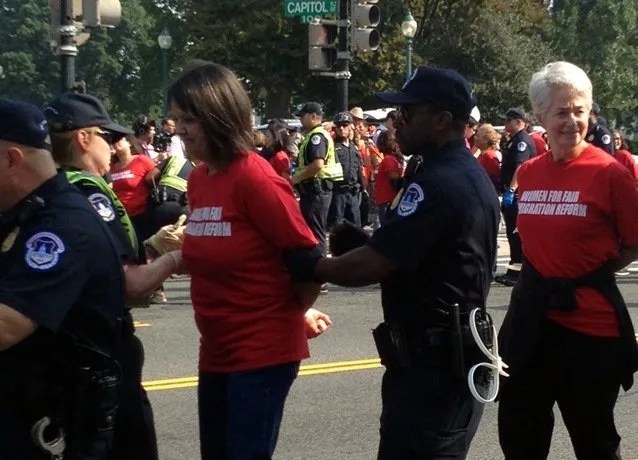
In September 2013, Heather Booth (far right) was one of more than 100 immigration rights protesters arrested after scores of them blocked traffic near the U.S. Capitol.


Today, opposition to the actions and conduct of President Donald Trump keeps rolling out in the street and on social media. The ugly firing of FBI Director James Comey has ignited new outrage. But the question is whether all that energy can be harnessed for action beyond protest marches ― or if it will dissipate like the 2011 Occupy Wall Street movement.

That’s where Booth comes in.

The Trump era “is a perilous and inspiring time ― both are true,” she told HuffPost. “The peril can’t be overstated. I do think families will be ripped apart, people will unjustly be imprisoned, jobs will be destroyed. I think lives may be destroyed,” she said. “I fear for unjustified wars. I think the structure of democracy itself will be threatened, from simple protections of people’s health and safety to the ability to live a decent life. So … a time of great peril.”

“But …” She allowed herself a broad smile, offering a glimpse of the spirit that has powered uphill battles all these years. “I am incredibly heartened by the outpouring of people standing up to say, ‘You’re not going to do this. We are going to defend our lives, our families. Our democracy! And we are going to defend each other.’”

“If you stand together and organize,” Booth said, “you can change the world.”


This conviction goes way back. In the early 1950s, the sole African-American child in her first-grade class in Brooklyn, New York ― a boy named Benjamin ― was accused by a white student of having stolen her lunch money. The accuser and her friends crowded around Benjamin, pointing and taunting. Booth pushed her way into the circle, put her arm around Benjamin and just stood with him. (And, of course, the accuser then found her lunch money in her shoe.)

As an adolescent, Booth felt she didn’t fit in. She tried out for the cheerleading squad, but quit when she found out that more talented black girls had been turned away. She volunteered for the school chorus, but apparently had no aptitude for singing. At the Christmas pageant, she was asked to just silently mouth the words.

“I was insecure most of my life,” she said, “and in almost all situations felt I was not good enough, didn’t know enough.”

Even so, one day in her early teens, the would-be activist stood by herself in New York City’s Times Square handing out leaflets urging an end to the death penalty. It wasn’t pleasant. In the late 1950s, Times Square was a vile pit of hucksters, porn shops and addicts. One guy spit on her. Flustered, she kept dropping her leaflets. “I was really frightened,” she said.

The lesson she took from that experience, however, wasn’t that you had to stop protesting, but that you had to stop doing it alone. You had to draw others into the action. Get organized. Together you could achieve results even if you were scared and insecure.

Booth felt that power a few years later in Mississippi, where as a University of Chicago student, she spent the Freedom Summer of 1964 organizing for voter rights. That, too, was frightening and inspiring. “We were standing for something that mattered, that was bigger than ourselves, and if as an individual I didn’t know what I was doing, as a group we did know what we were doing,” she said. “And over time I could see that because of this, we were ending segregation.”

Some years later, as a young mother of toddlers on Chicago’s South Side, Booth gathered a group of working moms to form a neighborhood day care cooperative ― and found the idea blocked by the city’s byzantine licensing codes. So they began organizing other parents across the city, at church and synagogue meetings and other community forums.

“People flocked to us,” Booth recalled in a recent TEDx talk. “People gained confidence, found their voice, spoke about their love for their kids, the child care they needed, their vision for the future.”

They framed the conflict as loving mothers versus uncaring bureaucrats. The press noticed. Then Chicago’s politicians noticed. Within six months, she said the city had agreed to one-stop licensing, a licensing review board of parents and child care providers, and $1 million for new child care centers.

It starts where there is an injustice in the world. … And people say, ‘We need to do something about that. Let’s take some action.’Heather Booth

The potency of targeted, strategic organizing is a key idea taught at the Midwest Academy, which Booth started in 1973. She chose the name not for the academy’s location, Chicago, but because it sounded wholesome, a clean break from the strident rhetoric of the student left. “We didn’t want to be mean,” she explained.

Three core ideas guide the 25,000 activists who have trained at the academy: The goal of organizing must be concrete improvement in people’s lives. The organizing must help ordinary people develop their own sense of power. And activists should seek change that is systemic ― not just fixing the water supply in Flint, but giving people in Flint some oversight of the water system.

Among the academy’s teaching materials is a strategic planning chart to help organizers link a specific and achievable goal with available resources (money, allies, media contacts), the names of decision-makers whose support or acquiescence is needed, the tactics required to win over opponents, and the messaging to mobilize others to join in.

“Rather than saying, ‘Oh, this is awful, they’re giving money to the wealthiest and taking away our fundamental services, so let’s do a hands-around-the-Capitol’ ― well, that may be a good thing to do,” Booth said. “But can we do it in a way that builds our organization’s resources, brings in more people, maybe raises funds? And afterwards, let’s look at what worked and what didn’t work. What do we do next?”

As valuable as organizing is, Booth understands that it’s a tool for social progress, not the driving force behind it.

“It doesn’t start with training, although the training helps people be more effective,” she said. “It starts where there is an injustice in the world ― people living in fear that some family member will be deported who’s been here 20 years. And people say, ‘We need to do something about that. Let’s take some action.’”

After a police officer killed black teen Michael Brown, for instance, “there was an outpouring across the country. No one had to be told, ‘I can’t take it anymore.’ Not just ‘I can’t,’ but ‘we can’t.’ So it starts with people’s anger, love, fear, hate, concern and standing up to say, ‘It can’t continue like this.’”

Today, at a time when many feel powerless and despairing, Booth draws inspiration and energy from the protests that have been erupting since Trump’s inauguration. “We are gaining strength,” she observed.

“The size, the numbers, the beauty of the effort, how representative it is of America ― all of America ― the number of places it’s happening. And how beautifully nonviolent, peaceful and intense they are simultaneously.”

David WoodSenior Military Correspondent, HuffPost
Posted in Politics, Trump | 1 Comment

My Take On Comey

By Steven Lupo.

My Take On Comey: Republicans went ballistic, and rightfully so, when former President Clinton got on a plane and met with Attorney General Lynch, as there was an active criminal investigation into his wife’s emails. What would Republicans have done, if Obama had fired Comey; while Comey was conducting an active criminal investigation into Hillary Clinton’s emails?

Now the shoe is on the other foot.  Donald Trump’s campaign was under an active criminal investigation by Director Comey. Unlike the Obama administration, Trump fires the man investigating him and his team. Even a partisan must admit how terrible this looks, no? It appears to be a cover-up, right?

Trump admits to asking Comey, three times, if he was personally under investigation. The answer is irrelevant. A sitting president was clearly attempting to influence an active criminal investigation, into *his* campaign’s activity. How would Republicans have reacted if Bill Clinton and AG Lynch stated that they spoke of the investigation into Hillary’s emails? The Republicans would have, rightfully, gone apocalyptic.

I try to ignore all the lies from Trump and his surrogates about *why* Trump did what he did. In stead, let’s focus on *what* Trump actually did.

Posted in Uncategorized | 2 Comments

Working-Class Trump Voters Open to Appeals


Working America: Front Porch Focus Group Report.  AFL-CIO

100 Days into the Trump Era, Working-Class ‘Searchers’ Who Voted for Him Are Having Doubts, Open to Appeals.

Everyone who is canvassing this year (2017) should read this report!  Here is the summary:

Face-to-face conversations with 976 working-class swing voters in Ohio reveal half of Trump swing voters differ with him on one or more issues, shows the importance of direct outreach

We have come away with evidence that many of Donald Trump’s swing voters can be moved with a progressive message. This conclusion summarizes the lessons we learned during our 100 Days canvass, and offers some thoughts on how progressives can reach out to working-class voters.

Working-class swing voters are open to progressive ideas — if they hear them. Our canvassers found that with door-to-door contact and a persuasive message, we can cut through the rightwing megaphone that has all but drowned out progressive voices in so many working-class homes.

When talking to voters, tell them something they don’t know. Don’t tell them that what they know is wrong. This classic insight helped shape our outreach efforts. Our canvassers found that it didn’t work to dispute Fox News’ talking points on well-worn issues such as the ACA.Rather, offering new information about Trump’s policies broke through and showed just how out of step they are with the needs of working people.

We can’t assume that the 2012 Obama voters who swung to Trump in 2016 will automatically swing back if he disappoints them. Trump’s working-class base may already be eroding in his first 100 days, but their declining support for Trump won’t inevitably lead to growing support for progressives. We saw in our canvass that many Trump swing voters are deeply disenchanted with politics. That’s why they cast a ballot for him in the first place. If Trump fails them — and progressives don’t offer an authentic alternative — they are very likely to give up on politics in upcoming election cycles.

This canvass focused on swing voters, but to win in 2018, Democrats will need to do better with both swing and base voters. A perfect storm hit Ohio Democrats in 2016. Base turnout dropped at the same time that swing voters abandoned them. In Ohio’s urban counties, where the base is strongest, Hillary Clinton received 162,000 fewer votes than Barack Obama did in 2012. And in the nonurban counties, where so many swing voters live, Clinton got 272,000 fewer votes than Obama. Given those numbers, progressives can’t afford to ignore either base or swing voters.

Ultimately, to win in Ohio and elsewhere, progressives need to reach out at all times to our base — to communities of color, millennials and women — as well as the white working-class voters open to a progressive agenda. That is how we’ll take back vital battleground states and elect a Congress and a president who truly represent the interests of all working families.

Posted in Canvassing, GOP, Politics, Trump, Uncategorized | Tagged , , , | Comments Off on Working-Class Trump Voters Open to Appeals