Have the Plague? Me Neither. Thank Science!

Thoughts on the March for Science  (By David and Rebecca Friedman, St. James)

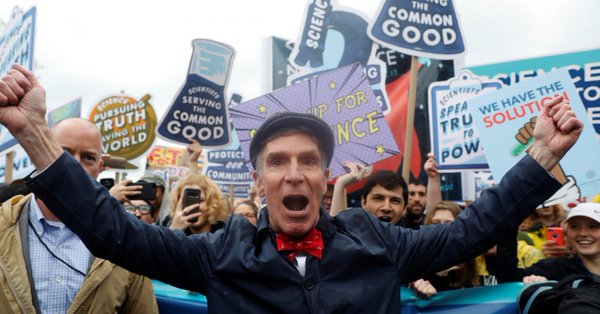
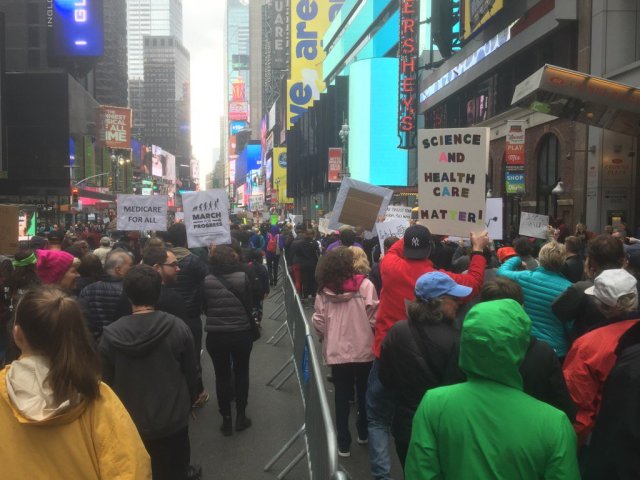
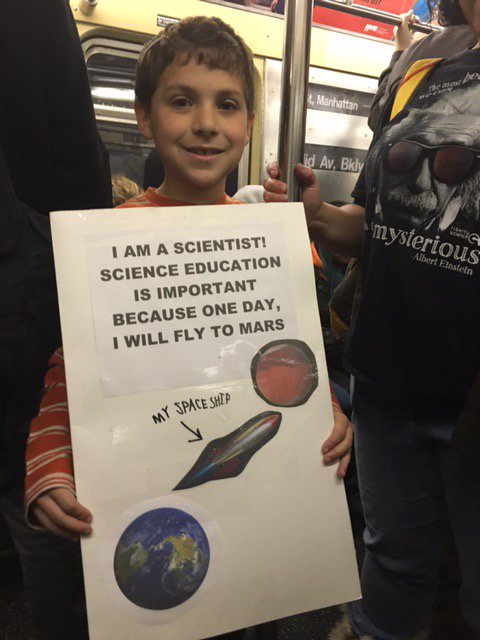
I joined tens of thousands of peaceful protesters on a rainy April Saturday at the Washington monument to “March for Science” along Constitution Avenue.  In spite of the weather, both meteorological and political, there was a festive feeling to the march.  The crowd delighted in each other, in the colorful and whimsical outfits representing every branch of science, and in the clever, nerdy signs making much-needed points about its value and practice.  “What do we want?  Evidence–based science. When do we want it? When it’s peer-reviewed.”  As a chant it scans awkwardly, but as a sign it makes a crucial point.

So what exactly was accomplished?  From the right there was grumbling that the whole enterprise was an effort to “politicize” science.   How ironic that those who glorify Western Civilization should so fundamentally misunderstand its greatest achievement: the scientific method.  The foundation of the scientific method is the premise that truth is determined by empirical data, not by subjective thoughts, opinions, or ideas.  What we want to be true or think to be true is not only irrelevant, it is harmful because it obscures what we are after – scientific truth.  All scientific experiments or observations attempt to filter out subjective “noise” as much as technically possible.  If the observed facts contradict our theory, it is our theory that must be discarded, not the facts.

It’s the feeling shared by thousands and thousands of scientists that the continuing quest for scientific truth is being replaced by a phony debate between conflicting “opinions” (e.g., evolution vs creationism, climate science vs climate change denial) that led them to overcome their natural reticence and turn out in the rain to make a “political” statement.  We’ve seen this kind of phony debate before.  For years and years, the tobacco industry hotly denied that there was “scientific proof” that cigarettes cause cancer and other deadly diseases.  Now we laugh at such claims.  But meanwhile, thousands of preventable deaths occurred due to stunted preventative measures.  We’ve seen it before, but never so firmly entrenched and with the power to do such widespread damage.

For years the Republican party has frantically tried to rein in the scientists at the EPA and subject them to the dictates of “industry experts”.  Now with the Trump administration in power, they are able to do just that.  Don’t like the finding of peer-reviewed scientists that even tiny levels of exposure to the pesticide chlorpyrifos could hinder the development of children’s brains?  Simple – just discard the finding, which is precisely what Scott Pruitt did last month.  Could this have anything to do with the fact that chlorpyrifos is manufactured by Dow Chemical, and the $1 million dollars Dow gave to the Trump inaugural committee?

The centerpiece of the Trump administration’s efforts to ignore peer-reviewed science is its push to undo the Obama Clean Power Plan. The argument for this exercise in magical thinking is that fracking more oil, mining more coal to burn, building more pipelines carrying in bitumen from Canada will lead to more jobs.  Aside from the problem that this argument is false, as anyone who has experienced a fossil fuel boom and bust cycle knows, and as other nations hustling to build a renewable energy industry also know, it is also irrelevant.  The science of climate change is very clear.  The Laws of Physics will have their way, and we ignore them at our own peril.  Once the powerful energy of human-induced global warming is fully unleashed we will not be able to oppose it, any more than the strongest swimmer can fight his way out of a rip tide without drowning.

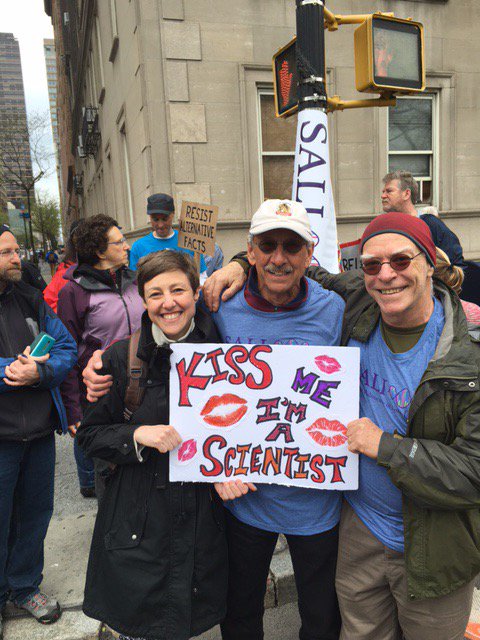
One of the signs at the march read “Have the Plague? Me Neither. Thank Science!”  If our planet is to survive the strain our prolific species is placing upon it, by adopting smarter and more efficient ways of living, the best hope is science.  Objective, peer-reviewed science, free of political interference and economically-driven wishful thinking.  In Washington D.C. and in hundreds of locations around the world scientists and non-scientists alike were sending a timely warning: that if we poke out our eyes and stop up our ears and refuse to see and hear what science tells us, it is ourselves (as well as thousands of innocent creatures) that we are dooming.


Posted in climate change, Environment, EPA, science, Uncategorized | Comments Off on Have the Plague? Me Neither. Thank Science!

National Monuments Threatened

Posted on April 26, 2017 by B Colbath.

Zinke could target any site he deems lacked ‘outreach’

Jennifer Yachnin, E&E News reporter

Published: Wednesday, April 26, 2017

President Trump today triggered the clock on an Interior Department review of the boundaries of dozens of national monuments — requiring a report within 120 days assessing the status of millions of federally managed acres — but which land will be included in that evaluation has yet to be finalized.

The president signed an executive order today mandating the review of all national monuments larger than 100,000 acres that have been established since 1996 (Greenwire, April 26).

Interior Secretary Ryan Zinke told reporters at a White House press briefing last night that the review would likely include between 24 and 40 monuments.

According to a list provided by Interior, it encompasses the 24 monuments either managed or partially managed by the department that meet the criteria for automatic review: having both the necessary size and having been created or expanded in the designated time period.

Additional sites will be considered based on input from state and local leaders. The executive order directs the Interior secretary to include any monuments he determines have been created or expanded “without adequate public outreach and coordination with relevant stakeholders.”

Such sites could include the Katahdin Woods and Waters National Monument in Maine, which covers about 88,000 acres.

Maine Gov. Paul LePage (R) attended the signing of the executive order at Interior headquarters today. He’s also set to testify about the monument’s designation before the House Natural Resources Subcommittee on Federal Lands next week.

“I think it was a horrible, horrible decision and it should be reversed if it can,” LePage told the Portland Press Herald earlier this week, noting the state Legislature voted against it and criticizing the monument for limiting timber harvests (Greenwire, April 25).

More than 50 monuments have been created since 1996, including the larger sites tallied by Interior as well as cultural monuments like the Stonewall National Monument in New York and the Freedom Riders National Monument in Alabama.

Trump’s executive order today is bookended by a pair of sites that have been the focus of criticism by Utah state and federal Republican lawmakers, the Grand Staircase-Escalante National Monument created by President Clinton and the Bears Ears National Monument established by President Obama late last year.

“The view from the Potomac is a lot different than the view from the Yellowstone or the Colorado. Too many times, you have people in D.C. who have never been to an area, never grazed the land, fished the river, driven the trails or looked locals in the eye, who are making the decisions, and they have zero accountability to the impacted communities,” Zinke said today. “I’m interested in listening to those folks. That’s what my team and I will be doing in the next few months.”

Zinke said he would travel to Utah in early May and visit the Bears Ears region, The Salt Lake Tribune reported.

Natural Resources Chairman Rob Bishop (R-Utah) praised the president’s directive, asserting that it would correct “long-standing abuses of the Antiquities Act,” the 1906 law that allows the nation’s commander in chief to set aside federal lands of cultural or historical value.

“It was created with noble intent and for limited purposes, but has been hijacked to set aside increasingly large and restricted areas of land without public input,” Bishop said in a statement.

Similarly, Thomas Pyle, president of the Institute for Energy Research and former leader of Trump’s Energy Department transition team, praised the order by arguing it would open more federal land to potential energy leasing.

“President Trump’s executive order shows that his administration remains committed to unleashing America’s energy potential,” Pyle said. “While energy production has surged on state and private lands over the past decade, production on federal lands has lagged far behind. This disparity is largely due to the previous administration’s keep-it-in-the-ground tactics, including President Obama’s abuse of the Antiquities Act.”

Monuments under review

National monument Location Year Acreage
Papahānaumokuākea Marine Pacific Ocean 2006/2016 89,600,000
Marianas Trench Marine Pacific Ocean 2009 60,938,240
Pacific Remote Islands Marine Pacific Ocean 2009 55,608,320
Rose Atoll Marine American Samoa 2009 8,609,045
World War II Valor in the Pacific Hawaii, Alaska, California 2008 4,038,400
Northeast Canyons & Seamounts Marine Atlantic Ocean/Massachusetts 2016 3,144,320
Grand Staircase-Escalante Utah 1996 1,700,000
Mojave Trails California 2016 1,600,000
Bears Ears Utah 2016 1,353,000
Grand Canyon-Parashant Arizona 2000 1,014,000
Basin and Range Nevada 2015 703,585
Organ Mountains-Desert Peaks New Mexico 2014 496,330
Sonoran Desert Arizona 2001 486,149
Upper Missouri River Breaks Montana 2001 377,346
Berryessa Snow Mountain California 2015 330,780
Giant Sequoia California 2000 327,769
Gold Butte Nevada 2016 296,937
Vermilion Cliffs Arizona 2000 279,568
Rio Grande del Norte New Mexico 2013 242,555
Carrizo Plain California 2001 204,107
Hanford Reach Washington 2000 194,450.93
Canyons of the Ancients Colorado 2000 175,160
Sand to Snow California 2016 154,000
Ironwood Forest Arizona 2000 128,917

Source: Department of the Interior.

But Democratic lawmakers have vowed to challenge the administration’s review — which requires a report on Bears Ears in 45 days and on all other sites within 120 days — particularly if the final report recommends the rescission or reduction of any monument.

“Any effort by President Trump to undermine the Antiquities Act, shrink or even eliminate some of the most iconic American places will be met with fierce opposition,” said Sen. Martin Heinrich (D-N.M.), who serves on the Energy and Natural Resources Committee.

He added: “I, for one, won’t stand for this un-American action. I urge the American people to make their voices heard to stand up for our nation’s conservation legacy, our obligation to respect tribal sovereignty and for the places that make us who we are as Americans.”


Posted in Environment, National Parks & Monuments, Uncategorized | Comments Off on National Monuments Threatened

The YUGE job losses Trump is ignoring: retail workers

Originally posted in Daily Kos

Image 4-25-17 at 4.31 PM

Malls across the U.S., like this mall in Milford, Connecticut, are growing emptier and emptier. Which is bad news for those employed by the mall’s stores.

This is not a good time to have a job in the retail industry.

If you’ve been to a shopping mall recently, you may have noticed that many storefronts are empty. Stores that are still open aren’t crowded, and there are plenty of spaces in the parking lot.

About one in every 10 American workers works in the retail industry, and one out of every three retail employees works part time. A retail job is the first job experience for about one-third of Americans, so cutbacks block entry into the job market. According to the Bureau of Labor Statistics, 15.9 million people worked in the U.S. retail industry in January 2017, but that number has been shrinking. Since October 2016, 89,000 retail workers have lost their jobs. The most recent BLS jobs report in early April showed that 30,000 retail workers lost jobs in March—about equal to the number of retail jobs lost in February. The March decrease alone was enough to lower the job growth numbers to just 98,000. The two-month job loss was the worst retail job loss since the Great Recession in 2009.

Donald Trump loves to whine about jobs lost in the disappearing coal industry and in manufacturing. He brags that he will bring back coal and factory jobs—a promise he’s unlikely to keep, even as his executive orders weaken industry regulations. But lost retail jobs hit America much harder, and he’s silent about those. Those 89,000 people who lost retail jobs are more than the entirety—53,000—of those employed in the coal industry. While the coal, manufacturing, and retail industries have all suffered losses because of globalization and technological advances, the job losses aren’t always equal. Department stores have lost 18 times more workers than coal mining since 2001. Linda McMahon, the former World Wresting Entertainment CEO who now heads the Small Business Administration, is more concerned about trashing regulations than measuring the impact of retail job loss.

When retail workers lose their jobs, that affects a lot more than the workers—it affects their families and their communities. The cascading downward spiral means fewer dollars in families’ pockets, fewer dollars spent at other stores, fewer stores to spend money at, and fewer dollars to buy food and to pay mortgages and rent. An estimated two-thirds of the U.S. gross domestic product comes from retail consumption. So store closings and openings can indicate how well the U.S. economy is doing overall.

Overall, BLS numbers show that nearly half of all retail workers are female, and nearly 75 percent of the work force in clothing stores is female. Some 12 percent of all retail employees are African American, six percent are Asian American, and 17 percent are Latino. Those percentages are much higher than percentages in the same demographic groups holding jobs in the coal industry and in manufacturing, which is much more white and male.

But those women and minorities aren’t being interviewed by the news media as the people the economy left behind.

A recent story in The Atlantic laid out three possible reasons why retail job losses remain hidden under the political and media radar: geography, demographics, and nostalgia.

How has the retail bloodletting been so much quieter than the decline in mining and manufacturing? There are several plausible explanations. First, mining and manufacturing jobs are geographically concentrated. Sixty percent of coal-mining jobs are in just four states: West Virginia, Kentucky, Pennsylvania, and Wyoming. Retail is spread more evenly across the country, so there are “mining towns,” which politicians can visit and photographers can capture and where the pain runs especially deep, in a way there are not “mall towns.” Second, as SlateChief Political Correspondent Jamelle Bouie tweeted, the demographics of a job can determine its political salience. Coal mining is still 95 percent white and 95 percent male. Department store workers are 40 percent minority and just 40 percent male. The emphasis on work that is white, male, and burly may represent an implicit bias against the working class of the modern service economy, which is more diverse and female. Third, mining and manufacturing jobs feed into a national nostalgia for the mid-century economy, with its unionized workforce, economic growth, and high pay for men without much education.

A story from Slate by that same Jamelle Bouie makes the same argument:

In terms of attention, [coal miners] punch far above their weight class. They constitute a small portion of the American workforce, and yet, elite journalists devote countless words to their lives and communities, while politicians use them and their priorities as a platform for performing authenticity. For those in and around politics, one’s connection to “real America” is often judged by one’s proximity to these workers and their concerns. Which raises a question: Why them and not those retail workers who face an equally (if not more) precarious future? …

Retail work in malls and shopping centers and department stores is largely work done by women. Of the nearly 6 million people who work in those fields in stores like Sears, Michaels, Target, J.C. Penney, and Payless, close to 60 percent are women. … A substantial portion of these workers—roughly 40 percent across the different kinds of retail—are black, Latino, or Asian American. …

Work is gendered and it is racialized. What work matters is often tied to who performs it. It is no accident that those professions dominated by white men tend to bring the most prestige, respect, and pay, while those dominated by women—and especially women of color—are often ignored, disdained, and undercompensated.

Many of us likely had a retail job at some point in our lives. Maybe we worked at a corner mom-and-pop shop or worked weekend and evening shifts at a store in a nearby mall. My own experience was peddling popcorn behind the candy counter at a mall multiplex. The pay was barely above minimum wage, but at least I got to see movies for free.

Sears Roebuck and Co. used to be the biggest name in retail. It advertised itself as the store “where America shops.” It once had a booming catalog business that sold mail-order house kits and was where much of America bought appliances and tools. Now, with competition from big-box stores (also not doing well) and online shopping, Sears is closing stores and might be on the verge of collapse: The company lost $2 billion in 2016, and sales dropped 10.3 percent in the fourth quarter, when many stores finally sell enough to be in the black. According to an NPR story:

Despite its merger with Kmart in 2005, Sears has consistently lost millions of dollars each quarter.

The retailer has closed hundreds of stores, slashed jobs and sold off key assets like the Lands’ End clothing line and its legendary Craftsman brand — although both brands continue to be sold at Sears. Independent retail analyst Sucharita Mulpuru says these changes haven’t worked.

“There are just so many onerous forces relating to competition,” she says. “I think that no matter what they do, they are fighting a losing battle.”

And what of Sears workers? The generous employee discount program is gone, replaced with a “point system.” Some 250 employees at Sears’ corporate offices were laid off last year, and 150 openings went unfilled. If you worked in sales and your store closed, you’re out of luck.

Of course, Sears isn’t alone. In a trend a story in Business Insider dubs the “retail apocalypse,” more than 3,500 stores are expected to close in the next few months of 2017. It’s being described as “one of the biggest waves of retail closures in decades.”

Chart on retail store closings

This might have been avoided if malls weren’t overbuilt to begin with. The Business Insider story reports that the United States “has 23.5 square feet of retail space per person, compared with 16.4 square feet in Canada and 11.1 square feet in Australia, the next two countries with the most retail space per capita.” When a major anchor store in a mall closes, smaller stores are soon to follow. “Nearly a third of shopping malls are at risk of dying off as a result of store closures,” the story added. What do those workers do then?

Retail workers aren’t highly paid. Some, especially those in higher-end clothing stores, are paid on commission. They don’t have pensions or 401(k) plans, and they don’t earn enough to save for retirement. As the Bureau of Labor Statistics reports, the annual median salary for a retail employee was $22,040 in 2015, and the annual median hourly wage was $10.60.

And they’re not getting very many raises, either. As an AP story puts it: “Average hourly earnings for retail employees, including managers, has inched up just 1.1 percent over the past year, compared with a 2.7 percent average increase for all U.S. workers.”

There are unions that represent retail workers, but they don’t have much power—or membership. The Retail, Wholesale, and Department Store Union is a semi-autonomous subsidiary of the United Food and Commercial Workers union. But union membership for retail workers has dropped from a high of 15 percent of all retail workers in the 1970s to less than five percent today—one of the lowest rates of unionization in the entire economy.

The bottoming out of the retail market and retail jobs isn’t surprising to anyone who orders merchandise online. E-commerce has grown faster than delivery of packages by drones. According to a story in The New York Times:

Between 2010 and 2014, e-commerce grew by an average of $30 billion annually. Over the past three years, average annual growth has increased to $40 billion. …

This transformation is hollowing out suburban shopping malls, bankrupting longtime brands, and leading to staggering job losses. …

The job losses in retail could have unexpected social and political consequences, as huge numbers of low-wage retail employees become economically unhinged, just as manufacturing workers did in recent decades.

Even Black Friday, the retail sales extravaganza on the day and weekend after Thanksgiving when stories traditionally showed profits, has seen decreases. Figures for 2016 showed that 99 million people shopped in brick-and-mortar stores, 3 million fewer than in 2015. Online shopping, on the other hand, went up, even as people didn’t wait for Cyber Monday: 108 million people shopped online over the Thanksgiving weekend, about 5 million more than the previous year.

As retail workers in brick-and-mortar stores have lost jobs, hiring has picked up in online warehouses for companies like Amazon. But there are too few of those jobs to make up the difference, and many of those jobs are quickly getting automated.

“Until now, retail workers—unlike the car-making and coal-mining industries—have made little political splash,” said a story on Axios Media. “Look for that to change.”

Posted in economy, Employment, jobs, Uncategorized | Tagged , , , | 1 Comment

Dr. Vivek H. Murthy, 19th U.S. Surgeon General

Thanks to Sue Hornik and Mike Anthony for providing this indirectly, from Facebook.

April 21, 2017 – Dr. Vivek H. Murthy, 19th U.S. Surgeon General, on the Opportunity to Serve and Lessons Learned
– Facebook Post: https://www.facebook.com/ DrVivekMurthy/posts/ 251023231970308)
Two years and four months ago, I was honored to be sworn in as the 19th Surgeon General of the United States. For the grandson of a poor farmer from India to be asked by the President to look out for the health of an entire nation was a humbling and uniquely American story. I will always be grateful to our country for welcoming my immigrant family nearly 40 years ago and giving me this opportunity to serve.
During my tenure, I was blessed to have an extraordinary team of dedicated public servants who became my colleagues and friends. I was also fortunate to find thousands of dedicated partners in the community from schools and hospitals to faith groups and mayors. Together, we called our country to action to address the addiction crisis in America through the nation’s first Surgeon General’s Report on Alcohol, Drugs, and Health and by urging more prevention, treatment, and humanity in our approach to this chronic illness. We sent letters to millions of health care professionals urging them to join our campaign to Turn the Tide on the opioid epidemic. We issued a report on e-cigarettes and youth, launched a national effort to get Americans walking, and started a community conversation on food insecurity. We partnered with Elmo, the cast of Mom, and Top Chef to inform the country about vaccines, addiction, and healthy eating. And we worked with thousands of Commissioned Corps officers to protect our nation from Ebola and Zika and to respond to the Flint water crisis, major hurricanes, and frequent health care shortages in rural communities. I am exceedingly proud of what our team and our officers have done to bring help and hope to people all across America.
It is important to know that the 6,600 officers in the US Public Health Service Commissioned Corps are one of our nation’s greatest assets. Each and every day, our officers wake up ready to serve their country in over 800 locations, responding to natural disasters, countering disease outbreaks, and advancing prevention and treatment in communities. During the last few years, the Corps became my family. I will always remember their dedication and the warmth with which they welcomed me. And I will never stop advocating for them.
While I had hoped to do more to help our nation tackle its biggest health challenges, I will be forever grateful for the opportunity to have served. The role of the Surgeon General is, traditionally, to share wisdom with others, but it was I who learned so much by listening to your stories in town halls and living rooms. In a remote fishing village in Alaska, a church in Alabama, an American Indian reservation in Oklahoma, a school in Virginia, and in so many other places, I watched the grit and grace with which our fellow Americans live their lives.
Here are some of those lessons which I will keep with me:
1. Kindness is more than a virtue. It is a source of strength. If we teach our children to be kind and remind each other of the same, we can live from a place of strength, not fear. I have seen this strength manifest every day in the words and actions of people all across our great nation. It is what gives me hope that we can heal during challenging times.
2. We will only be successful in addressing addiction – and other illnesses – when we recognize the humanity within each of us. People are more than their disease. All of us are more than our worst mistakes. We must ensure our nation always reflects a fundamental value: every life matters.
3. Healing happens when we are able to truly talk to and connect with each other. That means listening and understanding. It means assuming good, not the worst. It means pausing before we judge. Building a more connected America will require us to find new ways to talk to each other.
4. The world is locked in a struggle between love and fear. Choose love. Always. It is the world’s oldest medicine. It is what we need to build a nation that is safe and strong for us and our children.
This journey would not have been possible without my incredible family. My wife Alice is my hero. Her resilience, optimism, and love have lifted me up and helped me soar. Our baby boy has been my constant source of inspiration to help create a better world. My mother and father have given me everything and to them I owe everything. And my sister has been an enduring source of support and affection from the time I was born.
As my colleague Rear Admiral Sylvia Trent-Adams takes over as Acting Surgeon General, know that our nation is in capable, and compassionate hands.
Thank you, America, for the privilege of a lifetime. I have been truly humbled and honored to serve as your Surgeon General. I look forward to working alongside you in new ways in the years to come. Our journey for a stronger, healthier America continues.

April 23, 2017- Dr. Vivek H. Murthy, 19th U.S. Surgeon General, on the End of His Term

I have been deeply touched by the expressions of kindness I have received from people around the country and around the world in the last 36 hours. Thank you from the bottom of my heart. Many have asked why I chose not to resign as Surgeon General when I was asked to do so. My reason was simple: because I would never willfully abandon my commitment to my Commissioned Corps officers, to the American people, and to all who have stood with me to build a healthier and more compassionate America. While that decision to stand on principle resulted in my termination prior to the end of my four-year term, I know that the Office of the Surgeon General is greater than any one person and its mission must continue. The new Acting Surgeon General, Rear Admiral Sylvia Trent-Adams, is the right person to step into this role. She has dedicated the past 30 years to our nation serving in the Army and in the U.S. Public Health Service. Her deep wealth of experience is matched only by the immense size of her heart. I know she will serve with distinction.


Posted in Health Care, Uncategorized | Tagged | Comments Off on Dr. Vivek H. Murthy, 19th U.S. Surgeon General

Tom Price in a Nutshell

From Kirsten Gillibrand, United States Senator

Received April 25, 2017

Dear David,

Thank you for contacting me regarding your concerns about the nomination of Congressman Tom Price for Secretary of the U.S. Department of Health and Human Services (HHS). I share your concerns and that is why I voted against his confirmation. Congressman Price’s record raises serious concerns about his fitness to serve as Secretary of HHS and his commitment to achieving quality, affordable health coverage for all Americans, especially our nation’s most vulnerable populations.

The Department of Health and Human Services oversees key agencies like the Centers for Medicare & Medicaid Services (CMS), the Centers for Disease Control and Prevention (CDC), the Food and Drug Administration (FDA), and the National Institutes of Health (NIH). These agencies are tasked with administering the Medicare and Medicaid programs, responding to disease outbreaks, reviewing the safety and efficacy of drugs and medical devices, and funding biomedical research, respectively, among many other significant federal activities to protect the health and well-being of Americans in all 50 states, D.C., and the U.S. territories.

We need a Secretary of Health and Human Services whose primary goal is to improve our public health and our health care system. Congressman Price has not shown that he is committed to that goal. He has made very clear that he wants to repeal the Affordable Care Act, which would take health insurance away from nearly three million New Yorkers and tens of millions of Americans across the country. He has repeatedly voted to limit women’s access to family planning services, including defunding Planned Parenthood, even though millions of women rely on family planning services for contraception care, cancer screenings, infertility services, and screenings for STDs, including hundreds of thousands of women in New York. He has said that he wants to turn Medicare into a “voucher” system, which would increase out-of-pocket health care costs for seniors and individuals with disabilities. He wants to raise the Medicare eligibility age to 67, which would force Americans who thought they were getting ready to retire to stay on the job for two more years just to keep their health insurance. Finally, Congressman Price wants to slash Medicaid funding, which would leave millions of low-income Americans with nowhere to go when they get sick.

In addition to my significant concerns about Congressman Price’s health policy positions, I am also very disturbed by ethical questions around his investment decisions while serving in Congress. Shortly after Congressman Price bought thousands of dollars of stock in a medical device company, he introduced legislation to delay a federal regulation that financial analysts expected would negatively affect the medical device company. I have called on the Securities and Exchange Commission to conduct an investigation into this matter. Recent reports have identified additional instances where Congressman Price purchased stock in health care or pharmaceutical companies, and then introduced legislation that would benefit those companies.

I cannot support a nominee who wants to take health care away from millions of women, seniors, children, and low-income Americans, and I cannot support a nominee who would put his own financial interests above the best interests of the American public. For these reasons, I voted against the confirmation of Congressman Tom Price for Secretary of Health and Human Services.

Thank you again for writing to express your concerns, and I hope that you keep in touch with my office in the future. For more information on this and other important issues, please visit my website at http://gillibrand.senate.gov and sign up for my e-newsletter.

Sincerely,  Kirsten Gillibrand

Posted in ACA, AHCA, Health Care, Medicaid, science, Uncategorized | Comments Off on Tom Price in a Nutshell

The Fingerprints of Global Warming on Extreme Weather Andrea Thompson

When climate scientists examine whether the warming of the Earth has made extreme weather events such as heatwaves or downpours more likely, they generally do it on a case-by-case basis. But a group led by Stanford climate scientist Noah Diffenbaugh has aimed to develop a more global, comprehensive approach to investigating how climate change has impacted such extremes.

With a new framework they developed, Diffenbaugh’s team found that heat records were made both more likely and more severe for about 80 percent of the area of the globe with good observational data. For precipitation records, that percentage was about half.

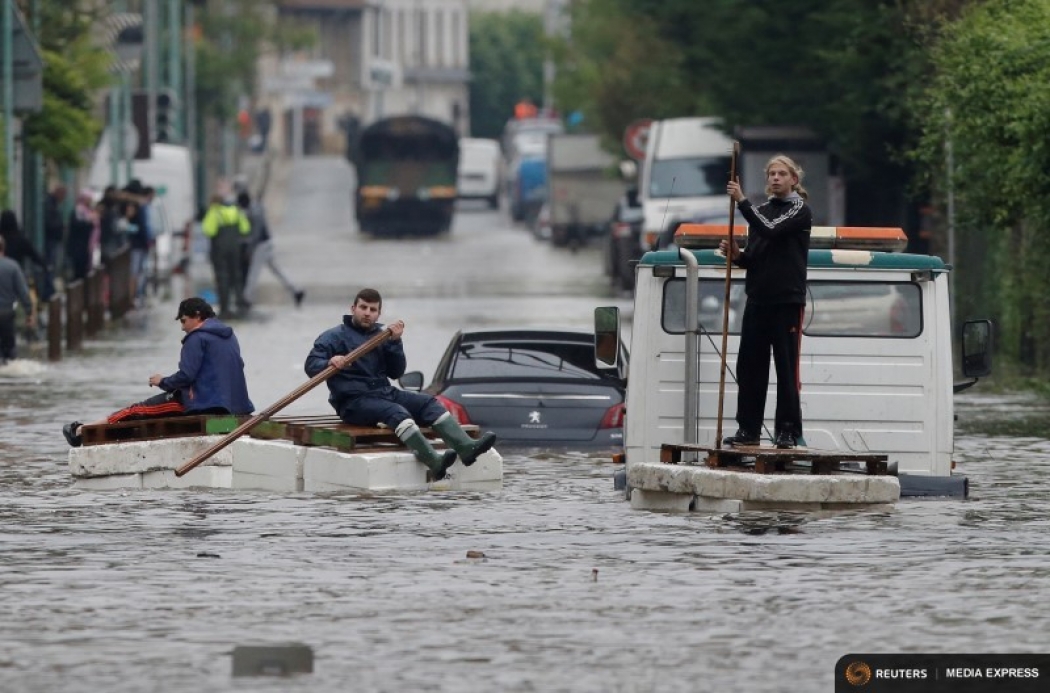
Residents who refused to be evacuated sit on makeshift boats during evacuation operations of the Villeneuve-Trillage suburb of Paris on June 3, 2016.

The team also examined a few particular events, finding, for example, that warming was clearly linked to the record-low summer Arctic sea ice extent of 2012.

Given the findings of previous so-called attribution studies as well as long-term warming trends, those results aren’t surprising, but they do show how much human-caused global warming has affected weather extremes already, the study authors and outside experts said.

And while several outside researchers quibbled with some aspects of the study, they said it provided a new tool that could help researchers more easily and uniformly probe what ingredients of a particular extreme event exhibit a climate change signal.

“The overall message — that changes in extremes worldwide can be attributed to human-induced climate change — is not new, but this paper adds another piece of relevant evidence to bolster that conclusion,” Peter Stott, a UK Met Office climatologist who conducted the 2003 study that kicked off the attribution sub-field, said in an email.

The idea behind extreme event attribution studies is to gain a better handle on how warming is changing the risk of different types of extreme weather in different areas. Because extremes have some of the biggest impacts on people, infrastructure and the economy, understanding how those risks are changing can help government officials and businesses better plan for the future.

Most of these studies, though, are generally case studies of specific events, often ones that happen in scientists’ backyards. While informative, they lead to what scientists call “selection bias,” meaning they aren’t taking in the full scope of how warming is affecting extreme weather.

Diffenbaugh and his colleagues, who have done several attribution case studies, particularly on the California drought, sought to get a broader view by using existing attribution methods to look at particular climate measures across a broader swath of the planet. These included the hottest day, hottest month, driest year and the wettest five-day period.

The results, detailed Monday in the journal Proceedings of the National Academy of Sciences, show that heat records in 80 percent of the study area were more likely affected by climate change than not, Diffenbaugh said.

This suggests that the world is not quite at the point where every single record-setting heat event has a discernable climate change influence, “but we are getting close,” he said.

For both the driest year and wettest five-day period, “about half the area exhibits an influence of global warming, and that is substantial,” even though it is less than for heat, Diffenbaugh said.

The higher percentage for extreme heat makes sense given the clearer line between warming and temperature; that extreme heat events are expected to occur more often and be more severe is one of the more robust outcomes of warming.

On the other hand, “precipitation is just a noisier quantity,” making it harder to pick out the climate change signal in some areas, Adam Sobel, a Columbia University climate scientist who wasn’t involved in the study, said in an email.

But that “doesn’t mean the influence isn’t there — all we can say is that it hasn’t clearly risen above the noise, but the noise is large so it is reasonable to expect that it will emerge in time,” he said.

The biggest influence from climate change was seen on heat and dry extremes in the tropics, “a combination that poses real risks for vulnerable communities and ecosystems,” Diffenbaugh said in a statement.

Sydneysiders take refuge from sweltering conditions alongside apartments at Sydney’s North Cronulla Beach during a heatwave along Australia’s east coast on Feb. 11, 2017.

The downside to the approach the team used is that the measures they used aren’t always the most relevant for the actual impacts on the ground, which is what people most care about and what attribution case studies try to address, Friederike Otto, of Oxford University’s Environmental Change Institute, said. Otto, who works with Climate Central’s own real-time attribution effort, also would’ve liked to see the study use more than one climate model.

While the new approach is useful “to gain confidence in real-time attribution,” allowing teams to place what they find in a larger context, “it doesn’t replace the actual attribution study in any way,” she said.

Diffenbaugh agreed and said that the team is working to develop ways to use their approach to look at the climate influence on particular impacts, such as the relationship between high temperatures and crop yields or coral bleaching.

He also said that his team’s framework can better help scientists look at how climate change is impacting the various ingredients that combine to cause extreme events, rather than focusing on just one aspect as many have to-date. For example, they found that warming had made a certain atmospheric pattern that led to a deadly heatwave in Russia in 2010 more common and more severe.

Conversely, while previous studies showed that changes in such atmospheric patterns made a major downpour and flooding event in Boulder, Colo., in 2013 less likely, the warming and moistening of the atmosphere would increase its likelihood.

The hope is that the framework is a step toward doing more real-time attribution studies and making analyses more consistent from study to study. Stott, who is working on a similar effort, said that this study does help move things in that direction.

This approach is “one brick in the wall and there are a lot of really smart people working hard on different aspects of this,” Diffenbaugh said. “We’re building a strong foundation for being able to ask these questions and answer them in a scientifically valid way.”


Posted in Uncategorized | Comments Off on The Fingerprints of Global Warming on Extreme Weather Andrea Thompson

Question for Lee Zeldin

By CHRIS CANGELERI

I attended a “community forum”‘ held by Lee Zeldin at Suffolk Community College Riverhead campus today. It was a highly controlled event. Attendees had to show ID proving residence in CD1 and were corralled through a gauntlet of law enforcement who seemed to be there for the intimidation factor. We were told that video or picture taking would be forbidden, but the powers that be backed off with a little push back on 1st Amendment freedoms.
The questions were collected on cards and presented by a moderator who didn’t actually read the questions, but provided his own interpretation of them.
No one was allowed to directly engage with Mr. Zeldin. I never got the chance to present my question. So I submit it here in hopes that Mr. Zeldin will respond.

Donald Trump ran on a promise of “draining the swamp” in Washington, but has appointed a cabinet chock full of rich white Goldman Sachs executives, former CEOs and the most inexperienced, incompetent team imaginable. He has assigned top security clearances to white nationalists, and wholly unqualified family members, and essentially delegated the presidency to his son-in-law.

He has gutted virtually every department from State to the EPA and has appointed people to head those departments who have demonstrated a willingness to undermine and destroy the agencies they are now charged with running.

He has extensive business interests in foreign countries that present obvious conflicts with U.S. interests.

There is mounting evidence that his campaign actively colluded with Russia to influence our election, activity that may very well have continued into his administration.

He is playing a dangerous game of chicken with North Korea that puts the lives of literally tens of millions of people in the region at risk.

At least two of his key campaign advisors, Paul Manafort and Mike Flynn have had to register retroactively as foreign agents. Others have been identified as “foreign assets” to Russian intelligence operations. He, and his associates are under investigation by multiple intelligence agencies. New information is being revealed almost daily that raise legitimate concerns about his administration’s ties to foreign interests and whether those ties represent national security risks.

He is using the office of the presidency to enrich himself and his family at the expense of US taxpayers, even as he refuses to release his tax returns.

The cost of secret service protection for Trump and his family has already reached unprecedented levels as they saddle taxpayers with the costs of their extravagant lifestyles and business trips.

Trump is currently pushing for Congress to approve funding for his border wall as part of the upcoming continuing resolution to keep our government operational. What makes you think he will ever get Mexico to reimburse us? How will his so-called Border Tax help ordinary Americans?

Mr. Zeldin, I know it was important to you that Republicans got to fill the Supreme Court seat stolen from President Obama so they could advance their corporate agenda and further entrench power attained through some of the worst gerrymandering and voter suppression this country has ever seen.

So, my question is:

Is there no depth of corruption, conflicts of interest, nepotism and outright incompetence to which the Trump administration can sink that would lead you to take a stand against him? What would it take for you to not only demand that Trump release his tax returns, but to sign onto legislation forcing him to do so in the name of national security? Are you a partisan or an American?

Please answer the question without any reference to Hillary Clinton. She is not president and any comparisons would be hypocritical false equivalence.

I await your response. Chris Cangeleri, Manorville


Comment: well summarized!

Posted in Uncategorized, Zeldin | Comments Off on Question for Lee Zeldin

Lee Zeldin’s Town Hall Meetings

With only 1-2 days notice ‘Slippery Lee’ held town hall meetings at 3 different locations on Sunday April 23rd.  I attended the meeting in Riverhead at the Eastern Campus of Suffolk County Community College.  There were over 200 in attendance.

I call him Slippery Lee because he professes to be pro-environment, pro- social security,  pro-medicare/medicaid, pro-science, even pro-investigating Russian hacking of the election, etc., while voting the other way.  The format of the meeting I attended was ‘written questions only’, and all questions read by the moderator, John Kennedy.  There was no opportunity to ask a follow-up question or point out that Zeldin’s position often does not match up with his votes on many of the issues discussed.  Very frustrating.

My friend Marge Debowy from Brookhaven town took careful notes.  She was at the Town Hall meeting in Farmingville:

Ted & I went to Lee Zeldin’s Town Hall meeting yesterday.  It was very well attended and very tightly controlled in regard to getting into the venue (they had us show our driver’s licenses!)  We could not ask him questions directly.  We had to fill out a card with the question.  Only some of the questions were answered.  What he had to say was mostly predictable.  He spoke about Cabinet vacancies, and that Trump needs to fill them.

Zeldin believes that Putin is a meddler.  Zeldin said that he will work with anyone in Congress.  He said Trump wants to cut funding to the L.I. Sound, Sea Grants, and make more environmental monetary cuts as well.  Zeldin said that he doesn’t like the current plan for ACA because businesses must pay ACA taxes and carry insurance.  He said that he supports public schools and does not like Betsy DeVos.  He spoke about Veterans Affairs, particularly the Northport VA. He said that he tried to get a project request for Northport VA, but it was not available.

Zeldin supports Trump in regard to “The Dreamers”

Zeldin said that Trump should divulge his tax returns.

Zeldin said that he is concerned about our waterways (Mastic Peninsula) and sewers there.

Zeldin addressed Planned Parenthood, saying that there is a proposal to work on it this week, but we don’t know what the plan is.

Zeldin spoke about Medicare .  He wants to protect the commitment that must be kept for those of us who are part of it now.  He believes that a reintroduction of a 6 month extension for Medicare, Homecare and healthcare throughout the U.S. should be done.

Zeldin said that he believes that gun control is important but he opposes the “Safe Act”.

Zeldin said that he wants funding for scientific research particularly at Stony Brook U. and Brookhaven Labs. He also supports STEM programs in K – 12 classrooms.

Zeldin believes that climate change is real.

Zeldin spoke about the MacArthur Amendment that has not yet been filed.  This is more of an issue to other States than ours. The amendment would allow States to make their own decision about what must be included in a Health Care policy.

Last but not least…Zeldin doesn’t support the building of a Mexican/U.S wall.

The topics overlapped with those discussed in Riverhead.  But perhaps the answers were a bit different?  In regard to the Mexican wall, Zeldin discussed a more detailed approach claiming that both natural and man-made barriers already existed in many places and did not need further fortification, but in other places, there might be a need for a wall.

Read more about these town halls in the news media:

Newsday


Posted in Health Care, Uncategorized, Zeldin | Comments Off on Lee Zeldin’s Town Hall Meetings

Ignoring Science can be Dangerous

C-Bu8VlXUAACZc0

W99XRNce

C-B6dSSXYAQaMsw

C-COXOCW0AUOqE6

There has been a public trend to treat scientific issues as no more than partisan issues.   Either you feel or believe that global warming is man-made or not. Either you feel or believe that immunizations are dangerous for your kids or not. This attitude is wide-spread and belies a fundamental misunderstanding of what science actually is and how the scientific method works.

Judith Weis has authored a very nice “Guestwords” OpEd in the East Hampton Star: “Why We March for Science” published on 4/20/2017. Judith S. Weis is professor emerita in the department of biological sciences at Rutgers University in Newark.

This is timely, in view of the March for Science held in Washington DC and at numerous locations across the globe on Saturday 4/22/17.

The scientific method is incompatible with wishful thinking and preferred outcomes of an experiment. The review process for publication is rigorous. To a great extent, the scientific community has been able to police itself when there are instances of misconduct. One example is the Wakefield study published in the British journal The Lancet in 1998 and retracted in 2010. The study had insinuated a link between MMR vaccines and autism based on a study of faulty design and an author who carefully selected his cases and who was funded by lawyers acting for parents who were involved in lawsuits against vaccine manufacturers. Wakefield eventually lost his license to practice medicine.

Science is self-policing in that errors are eventually unearthed and faulty claims exposed. While the Wakefield story became a resolved matter for scientists, the damage done in the non-scientific world lingers on to this day, as the fear of vaccines remains strong.

As Weis puts it: “Many in the general public don’t understand fundamental science and may deny findings of legitimate research because the findings don’t agree with their beliefs or opinions… people’s hesitation to accept scientific findings may come from not only lack of knowledge about the research, but from confusion about the level of uncertainty in science. Uncertainty has been exploited by various industries and politicians to confuse the public about scientific knowledge, as demonstrated by the tobacco companies’ propaganda throughout several decades, during which time thousands of people died of tobacco-related illnesses. The same phenomenon goes on in the field of climate science; the climate deniers and petrochemical industries learned from the tobacco companies.”

“Scott Pruitt, the Environmental Protection Agency administrator, not only doubts that humans and CO2 cause climate change, he also has rejected the advice of his scientific staff about the risks caused by the pesticide chlorpyrifos… The administration’s proposed budget has severe cuts to environmental research programs at NASA, the National Oceanic and Atmospheric Administration, and the E.P.A., and moderate cuts in the National Institutes of Health budget that funds biomedical research.”

In case you are wondering what the NIH does, take for example funding for the discovery of the HIV virus and how it causes AIDS. Based on these basic discoveries drugs have been developed and pharma companies have thrived. I would argue that NIH-funded research is the single largest engine for discoveries that drive the biomedical industry which represents over 10% of the US economy.   America is already losing biomedical research leadership to Asia. This trend is bound to accelerate with the policies of our current administration.

Posted in ACA, Environment, EPA, science, Uncategorized | Comments Off on Ignoring Science can be Dangerous

Lee Zeldin’s Drug Crisis: Billions, or Millions ?

Regarding the drug epidemic, the  CDC (Center for Disease Control) has pointed out 2 trends: A 15-year increase in overdose deaths involving prescription opioid pain relievers and a recent surge in illicit opioid overdose deaths, driven largely by heroin. Prescription drug abuse, according to the CDC accounts for one death every 19 minutes in the United States.

Within New York State, Suffolk County led all counties in heroin overdoses last year. Contrary to what you might expect, drug overdose deaths affect primarily young white males between 20-35 years of age. African Americans and Latinos are less frequently affected.

Here are some sobering remarks from Jeffrey Reynolds, president and CEO of the Family and Children’s Association in Mineola. He said the crisis shows no signs of abating. “Carfentanil has not yet appeared here; we’ll know when it arrives because we will immediately see more fatalities. I say ‘yet’ because 15 years ago we warned about the burgeoning prescription pill crisis and it happened. Ten years ago we warned of the impending heroin crisis and it happened. Four years ago, we warned about the emergence of fentanyl after it appeared in several other regions; low and behold, that drug is now killing more Long Islanders than heroin.” He continued: “There are barriers to treatment including insurance company discrimination… There aren’t nearly enough supports for people in early recovery, but then we blame them for a relapse rate that approaches 75 percent. We are watching the problem worsen and the death toll climb, but we haven’t taken the bold or sustained action necessary to turn the tide. That’s why, unless we do something differently, 2017 promises to be a whole lot worse.”

After an East Hampton teen overdosed recently at a house party, the community has vowed to come together to seek solutions. According to the Patch, Congressman Zeldin took part in a community roundtable hosted by Vida Abundante in East Hampton.  Zeldin discussed “his work in Congress to combat heroin and opioid abuse, including his support of the Comprehensive Addiction and Recovery Act, or CARA, which, he said, would provide “billions to combat the heroin and opioid epidemic” as also stated in a 2016 press release.

Interestingly, President Obama signed the bipartisan Comprehensive Addiction and Recovery Act (CARA) into law on July 22, 2016.  CARA is a sweeping bill that came together over the course of several years with input from hundreds of addiction advocates. Its provisions address the full continuum of care from primary prevention to recovery support, including significant changes to expand access to addiction treatment services and overdose reversal medications. It also includes criminal justice and law enforcement provisions.

This bill, however, does not provide automatic federal funding. Republican leadership has maintained that funding must be appropriated through regular order. They have repeatedly pledged to fund the programs authorized in CARA. Advocates are urging Congress to deliver on this promise. As recently as March 2017 families are still lobbying congress for funding!

So what about those 8.3 billions of dollars promised by Zeldin? About 37 Million was the amount for 2016. In September 2016, a spokeswoman for the Office of Management and Budget echoed Capitol Hill Democrats’ understanding of the bill. She said $7 million would be available through Dec. 9, 2016.   Sounds like millions, not billions.

In addition, our current government is still trying to sabotage Obamacare and with it Medicaid expansion. Medicaid is critical for professional substance abuse therapy and counseling for drug addiction!

Are Republicans like Zeldin involved in a cynical ploy to mislead the families of the victims? Has CARA become a political football? One staffer writes: “Every single Democrat voted for CARA, so you’d think they [Republicans] would support quick implementation of the law rather than mocking attempts to do so,” …“It shows they care more about politics than actually helping people suffering from addiction.”

Lee Zeldin was NOT one of 23 representatives who recently signed a letter to Pres. Trump requesting full funding for CARA.

I note that Lee Zeldin has been our representative since 2014 and the drug epidemic has gotten much worse under his watch. We need more than words. We need actions.

Posted in ACA, AHCA, American Health Care Act, Health Care, Medicaid, Uncategorized, Zeldin | Comments Off on Lee Zeldin’s Drug Crisis: Billions, or Millions ?