GOP rep says no need for Planned Parenthood, women can simply get birth control at the grocery store

Posted on DailyKos

Rep. Glenn Grothman

This man is in charge of health care for women. Let that sink in for a minute.

In this exchange, a constituent asks Rep. Grothman why he supports defunding Planned Parenthood. She reminds him ZERO federal dollars go toward abortion services and warns him not to use that as an excuse. Rep. Grothman isn’t quite sure what Planned Parenthood does, but he is sure women can just hop on down to the grocery store and get the same services. Rep. Grothman’s response and similar responses from his all-white, all-male Republican colleagues in the House are precisely why we need more women in office. Women’s lives and their futures depend on it.

Thanks to Kaili Joy Gray at ShareBlue for the transcript.

GROTHMAN: You look at every city, and you can get birth control in, I would guess, in Neenah—

WOMAN: You would guess?

GROTHMAN: … uh six or ten different places. In pharmacists [sic], in many grocery stores, not to mention you can get it in a variety of clinics.

WOMAN: I’ve never gotten a prescription from a grocery store.

GROTHMAN: My guess is, in a city the size of Neenah … there have to be six or eight clinics where you can get birth control.

WOMAN: But what about rural communities?

GROTHMAN: I don’t respond to questions out of the blue. But I will say this: If you look at where all the Planned Parenthood clinics are in the state of Wisconsin, they are usually in more urban areas. I looked one time and got a list of all the clinics, Planned Parenthood clinics, in the state of Wisconsin. I don’t think there were any that I’m aware of, just pursuing it, in which you would say the village was so small that they didn’t have any other health care providers. I mean, they’ll throw that out, but if you look, it is usually in larger areas.

Posted in AHCA, Birth Control, Planned Parenthood | Comments Off on GOP rep says no need for Planned Parenthood, women can simply get birth control at the grocery store

“Suit up, show up and, mostly, shut up”

http://www.newsday.com/opinion/columnists/lane-filler/talking-past-each-other-at-a-town-hall-1.13528299

Posted in Uncategorized, Zeldin | Tagged | Comments Off on “Suit up, show up and, mostly, shut up”

Zeldin Slams The East Hampton Star

Representative Lee Zeldin appears to be following Trump’s lead by disparaging news outlets that criticize him. http://easthamptonstar.com/Letters-Editor/2017420/Letters-Editor-042017

Journalistic Standards

Wainscott

April 17, 2017

Dear David,

On a recent WLNG call-in radio show, Congressman Lee Zeldin responded to a caller as follows:

“I have reached the point where I don’t read anything anymore that The East Hampton Star prints. . . . It’s just crazy . . . it’s just not journalism. . . . It’s a very biased partisan agenda there.”

Representative Zeldin, like the president whose policies he unwaveringly supports, assails this press outlet simply because its editorial and letters-to-the-editor pages sometimes reflect disapproval of his votes and policies. If the 132-year-old, award-winning newspaper of record for the Town of East Hampton is “not journalism,” what does Mr. Zeldin think of the thousands of his constituents who rely on it for local news and editorial content? Not much, evidently.

On the other hand, Mr. Zeldin appears unbothered by the website Breitbart News, notorious for its misogynistic and racist content. Although mentioned or covered in no fewer than 34 Breitbart articles, Representative Zeldin has not commented on its obvious lack of journalistic standards. For our congressman, the measure of a newspaper’s quality seems to be the extent to which it agrees with him.

If Congressman Lee Zeldin can’t tolerate criticism and disagreement, he should abandon politics and find another line of work. Come 2018, let’s hope the voters make that decision for him.

Yours truly,

AMY TURNER


Posted in East Hampton, Uncategorized, Zeldin | Tagged | Comments Off on Zeldin Slams The East Hampton Star

Zeldin says he supports veterans, but they may suffer under AHCA bill

Although Representative Lee Zeldin of NY01 often touts his unwavering support for veterans, this week he voted for the House health care bill that could result in millions of veterans losing their tax credits and many finding themselves in high-risk pools because PTSD is considered a preexisting condition. Thus Zeldin’s pattern continues: say one thing, do another.  http://www.sacbee.com/news/politics-government/article148917219.html

Trump promised to work for vets, but they could lose big under House health care bill

http://www.sacbee.com/news/politics-government/article148917219.html

Posted in ACA, AHCA, American Health Care Act, Congress, Health Care, Medicaid, Uncategorized, Zeldin | Tagged , | Comments Off on Zeldin says he supports veterans, but they may suffer under AHCA bill

The Trump tax agenda: A gift to the super-rich

The Brookings Institute

Vanessa Williamson  Thursday, May 4, 2017

Just shy of the 100-day mark, the Trump Administration released a 233-word memo proposing major changes to federal tax policy. Promoted as a “tax plan,” the document has been criticized as “devoid of details,” “less a plan than a wish list,” and “something you might see as a first draft of a campaign white paper.”

As a policy document, the Trump Administration plan is a small step above scrawling “more money for rich people” on a cocktail napkin.

Let’s be real. As a policy document, the Trump Administration plan is a small step above scrawling “more money for rich people” on a cocktail napkin. Actually, that napkin would have the advantage of honesty; the Trump memo repeatedly claims the goal of helping middle-class families, and then presents a deficit-exploding set of handouts to the wealthiest people in America.

Nonetheless, some of the proposals included in it are likely to appear in tax bills debated by the Republican Congress. So here’s what you need to know.

It’s an enormous tax cut for rich people (and specifically, President Donald J. Trump).

Despite early promises from Treasury Secretary Mnuchin, the tax plan is a very large tax cut for the wealthy. Basically all of the measures described in any specificity in the memo are tax cuts at the top.

First, Trump would lower the top marginal rate from 39.6 percent, which currently applies to income over $470,000 for a married couple, to 35 percent. (Bizarrely, the Trump Administration could not answer where the new brackets they propose would kick in, but in any case, the new rates are lower at the top.)

Second, the Trump tax memo calls for the elimination of the Alternative Minimum Tax, a policy intended to keep very wealthy Americans from using special provisions to drop their tax responsibilities to near zero. As I noted a few weeks ago, without the AMT, Donald Trump would have paid an effective income tax rate of a mere 3 percent in 2005.

Third, the Trump Administration is seeking the repeal of a 3.8 percent tax that helped pay for the Affordable Care Act, charged on investment income over $250,000 for a couple. This would serve the president’s dual goals of benefiting the wealthy in society while significantly weakening the fiscal solvency of Obamacare.

Fourth, there is the new 15 percent rate for “pass-through” income, described by one observer as the “loopholiest of loopholes” and by another as a gift to “people with creative accountants.” This policy would also be hugely beneficial to President Trump’s own businesses. (When Trump was running for president, he promised to eliminate the “carried interest loophole” that gives hedge fund executives an enormous special break on their taxes; he did not explain at the time that his solution would be to eliminate that loophole by putting an immensely larger loophole around it.)

Finally, it promises to repeal the estate tax, which affects no one but multimillionaires and billionaires, who would now be able to pass their wealth on to their heirs untaxed. Annually, less than five thousandhouseholds—about 0.2 percent of estates—end up owing estate taxes.

The net effect of these measures is highly regressive. The limitations of the Trump tax document makes a precise calculation impossible, but the outline resembles the Trump campaign tax plan, under which the wealthiest 1 percent of Americans received nearly half the benefits.

It’s an enormous, but vaguely described, tax cut for corporations.

According to the Trump memo, corporations should get an enormous tax reduction to 15 percent, a number substantially lower even than the 20 percent proposed by Representative Paul Ryan, and based on misleading claims that the U.S. business tax rate is “the highest in the world.” Beyond these two points, Trump’s memo devolves into vague generalities. The plan calls for moving to a “territorial tax system” with none of the necessary details to assess such a proposal; it mentions a “one-time tax” on trillions of dollars held overseas, but does not say at what rate that tax would be imposed; and it promises to “eliminate tax breaks for special interests,” with no clarity on what qualifies as a special interest.

It’s not good for anyone else.

While the super-rich clearly come out ahead, upper-middle-class people might actually end up paying more under the Trump plan, despite an increase in the standard deduction, if various deductions benefitting high earners were to be rolled back as the Trump memo implies. But the real cost to most Americans would not be at tax time; it would be in rising inequality, lost public investment and a weakened economy.

The Trump plan is dominated by large and top-heavy tax cuts which multiple studies have shown do not commonly encourage strong economic growth or job creation but do incentivize larger executive salaries and increase economic inequality. The idea that growth will be so great as to offset the cost of the tax cuts is widely discredited, the equivalent of “magic beans” or “fool’s gold.”

What the plan will undoubtedly do is knock an enormous hole in the budget. The Committee for a Responsible Federal Budget estimated that the Trump proposal would increase the deficit by $3 to $7 trillion dollars over the next ten years. These numbers are more or less in keeping with the Tax Policy Center’s 2016 assessment of the Trump campaign tax proposal.

Running up a huge deficit will put the squeeze on public spending. Huge tax cuts limit the options for public investments in scientific research, education, health, infrastructure, and other critical priorities. Already, the Wall Street Journal has featured an opinion piece calling for increasing the Social Security eligibility age to “offset revenue loss from Trump’s tax cuts.”

This is the real cost of the Trump tax cut to most families. On average, the middle 20 percent of earners are paying less than 3 percent of their incomes in federal income tax. (That might be why “tax relief” is not a priority for most Americans; only 11 percent of Americans rate the amount the pay in taxes as the thing that bothers them most about taxes. That is compared to 57 percent of people who were bothered most by the idea that wealthy people don’t pay their fair share.)

Instead of a small tax break, most Americans would benefit vastly more from new public investments in education, health care, and housing, all of which have become vastly more expensive in recent decades. Handouts to those at the top mean those investments will be much harder to afford.

The Trump Administration’s 100 Days of tax policy amounts to a single memo, but it tells us almost everything we need to know. It is both lazy and uninformed, with a veneer of generalities regarding aid to the middle class and policy specifics that would personally enrich the president.

Posted in Congress, Politics, Tax Reform, Trump | Comments Off on The Trump tax agenda: A gift to the super-rich

HOW MUCH DOES A POLITICIAN COST? A GROUNDBREAKING STUDY REVEALS THE INFLUENCE OF MONEY IN POLITICS.

Posted On The Intercept.com

An ingenious new Roosevelt Institute study on the influence of money on politics begins with an incredible story about how the world actually works:

In the spring of 1987, Paul Volcker’s second term as chair of the Federal Reserve was running out. Volcker had first been appointed by Jimmy Carter in 1979, and was willing to stay for another four years if President Reagan asked. While Volcker had used high interest rates to engineer a crushing recession at the start of Reagan’s first term, he then allowed the economy to expand rapidly just in time to carry Reagan to a landslide reelection in 1984.

Yet Reagan wanted to replace him. Why?

The study’s authors, Thomas Ferguson, Paul Jorgensen, and Jie Chen, report that they learned the answer from a participant in the key White House meeting on Volcker’s fate.

The main opposition to reappointing Volcker came from Reagan’s treasury secretary James Baker. As the study puts it, Baker did not like Volcker’s “skepticism about financial deregulation,” specifically his opposition to attempts to repeal the Glass-Steagall Act.

Glass-Steagall, passed at the beginning of Franklin D. Roosevelt’s presidency in the depths of the Great Depression, separated commercial and investment banking. Allowing banks to combine the two activities had created enormous conflicts of interests and incentivized manic recklessness that helped cause 1929’s financial Armageddon.

But banks had loathed Glass-Steagall ever since, because the fewer economy-destroying risks they could take, the lower their profits. By 1987 they were making progress in their long war to push Congress to repeal it. And while Fed chairs of course can’t vote themselves, many politicians take their cues from them on complex financial issues.

According to the Roosevelt study, that was why Volcker had to go:

Baker’s

was startlingly direct: Possible repeal of Glass-Steagall was the signature issue used by investment bankers, led by then-Goldman Sachs executive Robert Rubin, to raise money for the Democratic Party from their cohorts on Wall Street. Getting rid of Glass-Steagall, Baker explained, would alter the balance of power between the two major parties by depriving the Democrats of a central revenue stream.

So Volcker was replaced by Alan Greenspan, who gleefully supported the elimination of Glass-Steagall in 1999 — as did Robert Rubin, who became treasury secretary under Bill Clinton. Coincidentally or not, within a decade Wall Street had inflated the biggest bubble in world history in an attempt at mass suicide, saved only by trillions of dollars of government support. They were too big to fail, while millions of regular Americans turned out to be just the right size to fail.

As horrifying as this tale is, few normal people would be surprised by any of it. A 2015 New York Times poll found that 87 percent of Americans believe the campaign finance system either needs “fundamental changes” or should be “completely rebuilt.” Politicians themselves will tell you that their world is ruled by money. And the super-wealthy obviously believe money translates into power, since they continue pouring it into politics.

Strangely, almost the only human beings who think that money doesn’t warp politics are academic political scientists who study it. The Roosevelt study quotes a previous paper summarizing the “scholarly consensus” as being that “candidate spending has very modest to negligible causal effects on candidate vote shares.”

The Roosevelt authors go to extraordinary lengths to demonstrate to their colleagues that the sky is, in fact, blue. The study uses all the tools of academic scholarship in impressively creative ways, and will convince anyone who can be convinced by rationality and evidence.

First of all, the study explains, “exceptions, additions, and loopholes have proliferated around the rules governing legal contributions and expenditures. Congress has many times enacted rules that appeared to close off gushing torrents of money while in fact opening new ones.” The system is now “worthy of Gogol: a maze of bureaucratic spending and expenditures” that are exceedingly difficult to track.

The Roosevelt authors went to the effort of capturing as much of it as possible — and found that academic examinations of this subject miss as much as 50 percent of the money being spent on elections.

It’s also tough to legitimately measure how money could translate into congressional votes. Legislation often is thwarted by small numbers of politicians in committees, too few to create a good data set. In the Senate, few votes are ever taken, with most of the action going on beneath the surface. And there’s a continuous churn of elected officials, making it hard to find an inflection point in the decisions of any one individual.

The Roosevelt study therefore focuses on an issue where politicians were repeatedly forced to go on the record — House votes on the Dodd-Frank financial reform bill — and Democratic representatives who were representing the same district over several terms and would seemingly have little reason to change their minds.

Dodd-Frank was passed in 2010. After the GOP took control of the House in the midterm elections that year, representatives voted five times from 2013 to 2015 to weaken key provisions of the law in ways that big banks desperately desired.

There would be no discernible legitimate reason for Democratic representatives who’d supported Dodd-Frank to begin with to later defect from their party and vote along with Wall Street. Many did, however.

Why? Well, no one can say what was in their hearts, at least until we hear from someone like James Baker. But what the Roosevelt study demonstrates is that “for every $100,000 that Democratic representatives received from finance, the odds they would break with their party’s majority support for the Dodd-Frank legislation increased by 13.9 percent. Democratic representatives who voted in favor of finance often received $200,000-$300,000 from that sector, which raised the odds of switching by 25-40 percent.”

Intriguingly, Democratic representatives leaving the House after the 2014 elections were particularly likely to support Wall Street against Dodd-Frank. In an interview, Ferguson characterized their votes as “applications for employment.”

The study also looks at any connections between money from the telecom industry and a crucial 2006 House vote on net neutrality. For every $1,000 a representative received from corporations supporting net neutrality, like Google or Netflix, they were 24 percent more likely to vote for it. For every $1,000 from companies opposing it, they were 2.6 percent more likely to vote against.

For most people, the Roosevelt study — which is genuinely fascinating and, unusually for an academic paper, worth reading just for the quality of its writing — will confirm what they already sensed. Ferguson said he hopes it will also help “end the discussion” in academia on whether money matters in politics.

But while it should do that in a rational world, this is likely over-optimistic. Consider the fact that, no matter what the real world evidence has shown, academic economists continue pumping out studies about the desperate importance of cutting the taxes of billionaires. H.L. Menken explained that phenomenon almost 100 years ago:

To what extent is political economy, as professors expound and practice it, a free science, in the sense that mathematics and physiology are free sciences?

… When one comes to the faculty of political economy one finds that freedom as plainly conditioned, though perhaps not as openly, as in the faculty of theology. And for a plain reason. Political economy, so to speak, hits the employers of the professors where they live. It deals, not with ideas that affect those employers only occasionally or only indirectly or only as ideas, but with ideas that have an imminent and continuous influence upon their personal welfare and security, and that affect profoundly the very foundations of that social and economic structure upon which their whole existence is based. It is, in brief, the science of the ways and means whereby they have come to such estate, and maintain themselves in such estate, that they are able to hire and boss professors.

Likewise, those who hire and boss professors of political science love to hear that money makes no difference in politics. And no matter how hard academics like Ferguson, Jorgensen, and Chen work, and how much real world evidence they pile up, many other professors will likely continue making that case indefinitely.

Posted in Congress, Ethics, Politics | Comments Off on HOW MUCH DOES A POLITICIAN COST? A GROUNDBREAKING STUDY REVEALS THE INFLUENCE OF MONEY IN POLITICS.

HOUSE GOP JUST VOTED TO SLASH MEDICAID — WHICH PAYS FOR 60 PERCENT OF PEOPLE IN NURSING HOMES

Posted on The Intercept

THE AMERICAN HEALTH CARE ACT, which squeaked through the House of Representatives on Thursday, is terrible for many Americans in many ways. But what’s gotten almost no attention is the horrendous effect it could have on Americans in nursing homes.

Daniel Webster, a Republican representative from the 11th Congressional District in central Florida, acknowledged this when he announced he would vote for the AHCA.

“I have been very concerned about Florida’s Medicaid-funded nursing home beds,” Webster said. “These are critical to the access some of our senior population has to our nursing homes.”

Webster explained he was only willing to vote yes because President Donald Trump, Vice President Mike Pence and the House of Representatives’ GOP leadership promised that they would find some way to deal with the potential disaster created by the bill. It will now go to the Senate, and if some version of it is passed there, will then have to be reconciled with the House bill for a final vote.

Many middle-class Americans are unaware that the huge cost of nursing home care – which in some areas can run over $100,000 a year — is not covered by Medicare. Those who need it and cannot pay for it themselves can generally receive coverage from Medicaid, though they usually must spend down all their savings first.

When all is said and done, Medicaid pays the bills for over 60 percent of nursing home residents — people who cannot care for themselves and without Medicaid would have literally nowhere to go.

But the AHCA slashes $880 billion dollars from Medicaid spending over the next ten years, or about one-sixth of the $5 trillion it would otherwise cost the federal government. (While these seem like enormous numbers, the U.S. economy is so big that even $5 trillion will be just about two percent of the gross domestic product over the next decade.)

The bill accomplishes these cuts in part by changing Medicaid from an entitlement, in which the federal government automatically provides states with funding based on the needs of their population, to either a block grant or a per capita allocation (at the state’s choice).

The amount states will receive per capita will be set at the average cost for recipients in 2016. It then will increase at the Consumer Price Index’s rate of medical inflation until 2020, when it will begin going up at the CPI medical rate plus one percent. While this sounds reasonable, it will inevitably have serious consequences over the next 20 years due to the aging of the baby boom generation.

This year someone born in 1950 will turn 67 years old, and probably doesn’t need nursing home care. In 2037 they will turn 87, and will be far more likely to do so.

Nursing care is one big reason Medicaid recipients over 85 cost the program 2.5 times more than those who are between the ages of 65 and 74. If Medicaid were to remain an entitlement, states would automatically receive increased federal funds to cover these greater costs as baby boomers age. Under the AHCA, the per-capita payments to states will increase far too slowly to cover them.

Precisely how much of a catastrophe the AHCA could be is impossible to say as of now, since Republicans passed the bill without first having it scored by the Congressional Budget Office. But there’s little question it will be disastrous if anything like it becomes law. This didn’t matter to Republicans in the House. The question now is whether it will matter at all to Republicans in the Senate.

Posted in AHCA, American Health Care Act, Health Care, Medicaid | Comments Off on HOUSE GOP JUST VOTED TO SLASH MEDICAID — WHICH PAYS FOR 60 PERCENT OF PEOPLE IN NURSING HOMES

TRUMP ADMINISTRATION FIGHTS IN COURT TO PREVENT TOP CIA OFFICIAL FROM TESTIFYING ON TORTURE

Posted on Intercept.com

MORE THAN EIGHT YEARS after President Obama formally ended the CIA’s torture program, the Trump administration is fighting to block the CIA’s new deputy director from providing a deposition about her role in pioneering the agency’s most abusive torture techniques.

The Trump administration appointed Gina Haspel as deputy director of the CIA in February, attracting criticism from human rights advocates due to her former role in abusive interrogations. The move was interpreted as a public sign of the administration’s approval for some of the CIA’s most brutal abuses after the 9/11 attacks.

Haspel is being called to provide a deposition by James Mitchell and John “Bruce” Jessen — two contract psychologists who made tens of millions of dollars for their work shaping the CIA’s torture program. The ACLU is suing Mitchell and Jessen on behalf of three former CIA detainees — one of whom died in captivity in 2002 after being beaten and doused with cold water.

Lawyers for Mitchell and Jessen claim that everything the psychologists did was authorized by the CIA, and that Haspel would confirm that if the court ordered her to give a deposition. Lawyers are also seeking numerous documents, and a deposition from James Cotsana — a retired CIA official whom Mitchell and Jessen identified as their direct supervisor.

Haspel ran a secret prison in Thailand in 2002, part of the CIA’s global network of “black sites.” That prison — codenamed “DETENTION SITE GREEN” by Senate investigators — was the site of the CIA’s first prisoner interrogations after the 9/11 attacks, and Haspel supervised them. She later took part in covering up the abuses, helping to destroy 92 videotapes of interrogations against the Senate’s wishes.

The Senate torture report does not mention Haspel by name, but details the role of the prison’s station chief in the horrific torture of detainee Abu Zubaydah, who the CIA waterboarded until he became “completely unresponsive, with bubbles rising through his open, full mouth.”

Mitchell and Jessen were the ones who waterboarded Zubaydah, and described the interrogation as “a template for future interrogations of high-value captives” in a cable to the CIA. Zubaydah’s interrogation was held up as a model, and similar techniques were used on many of the 119 detainees the CIA had in its custody.

In a hearing before a district court in Washington state on Friday, the government said that deposing Haspel and Cotsana would reveal “state secrets,” and that despite media reports, the government could not confirm or deny Haspel and Cotsana’s role in the program.

Dror Ladin, a staff attorney for the ACLU, argued that there’s no need to depose Haspel and Cotsana because it would not affect Mitchell and Jessen’s responsibility for torture. “It’s never been a defense in a torture or a war crimes case to say ‘I was following instructions,’” said Ladin. “This case has never been about that. It was about the design of the program, its testing on Abu Zubaydah, the use of those techniques on our clients.”

For more than a decade, the Bush and Obama administrations have used the state secrets privilege to block numerous lawsuits against government agencies and the architects of the torture program. To this day no victim of CIA torture has ever obtained compensation for their treatment.

The lawsuit against Mitchell and Jessen is the first torture lawsuit the Department of Justice did not try to block in its entirety. Although the government is not a direct party to the case, it is paying Mitchell and Jessen’s legal fees. Knowing they could face legal liability for their actions, the CIA provided Mitchell and Jessen with a multi-million dollar indemnification contract in 2007 – meaning that if they were sued for their actions, taxpayers would foot the bill.

Posted in CIA, Torture, Trump, Uncategorized | Comments Off on TRUMP ADMINISTRATION FIGHTS IN COURT TO PREVENT TOP CIA OFFICIAL FROM TESTIFYING ON TORTURE

NY Congressman Asks Reporter To Explain The Health Care Bill He Just Voted For

HUFFINGTON POST — POLITICS

05/05/2017 10:23 am ET | Updated 18 hours ago

He admitted he didn’t actually read the bill.

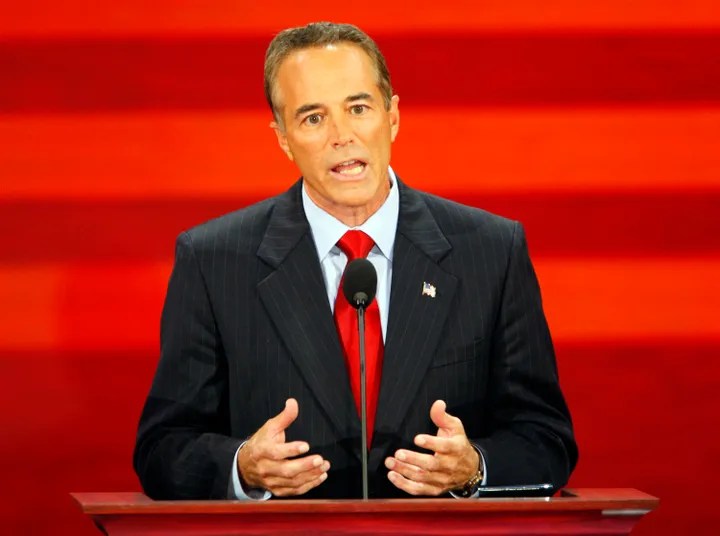
A congressman who voted for the Republican health care bill despite not having read it needed a reporter to explain it to him.


Rep. Chris Collins (R-N.Y.) on Thursday told CNN he hadn’t read the American Health Care Act, but that his staff had briefed him on its contents. But pressed later by The Buffalo News, Collins seemed to not be aware of how it actually affects his constituents.


HARRY E. WALKER/MCT VIA GETTY IMAGES
Rep. Chris Collins (R-N.Y.) admitted he wasn’t aware of some of the cuts in the GOP health care bill he voted for Thursday.


“Explain that to me,” Collins said after the reporter pointed out that New York stands to lose billions in federal funding for its Essential Plan, an Obamacare provision meant for low-income people who don’t qualify for Medicaid. The plan serves thousands of people in his own district, according to The Buffalo News.


He then admitted that he wasn’t aware of the cut in the first place.


In March, Collins enraged critics of the legislation, which is Republicans’ most serious attempt to repeal and replace Obamacare, by saying Congress needed to pass the bill before lawmakers could tell their constituents what’s in it.


Anyone who actually read the bill before the vote (like HuffPost’s Jeffrey Young!) would have seen that it stands to kick millions of people off insurance and slash key protections for those with pre-existing conditions.

Posted in AHCA, American Health Care Act, Congress, Health Care, Medicaid | Comments Off on NY Congressman Asks Reporter To Explain The Health Care Bill He Just Voted For

State Department Promotes Ivanka Trump’s Book In Another Ethics Blunder

HUFFINGTON POST — POLITICS

05/04/2017 04:55 pm ET | Updated 22 hours ago

C’mon, folks. Not pushing the Trumps’ private business is not that hard.

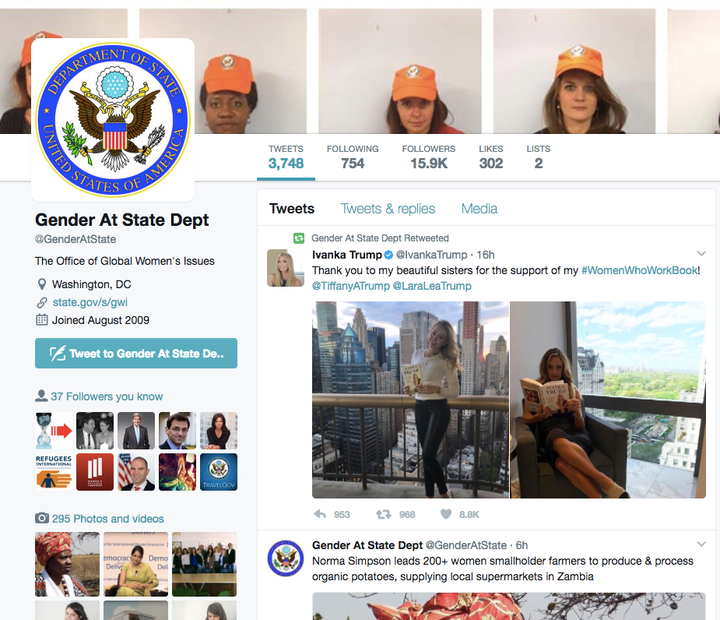
A State Department office retweeted Ivanka Trump’s post promoting her new book on Wednesday, likely violating a federal rule that bars the use of public office for private gain.


A federal government employee “shall not use his public office for his own private gain, for the endorsement of any product, service or enterprise, or for the private gain of friends, relatives, or persons with whom the employee is affiliated in a nongovernmental capacity,” according to the Code of Federal Regulations (5 CFR 2635.702, to be specific).

Trump, who serves as a White House special counselor, had already canceled her book tour last month to avoid breaking the ethics rules around self-promotion.


“Out of an abundance of caution and to avoid the appearance of using my official role to promote the book, I will not publicize the book through a promotional tour or media appearances,” the first daughter announced on Facebook.


Trump has continued to use her personal Twitter account to promote her book, Women Who Work, after reportedly consulting with the Office of Government Ethics. But that advice would not cover @GenderAtState, the official account run by the State Department’s Office of Global Women’s Issues.

LAURA BASSETT


Voice of America, a news outlet funded by the U.S. government, also raised eyebrows on Wednesday by posting an article to its website and Twitter feed entitled, “In New Book, Ivanka Trump Gets Serious About Women at Work.”


This is not the first time the Trump administration has been accused of improper self-promotion. The Office of Government Ethics scolded the White House in March for refusing to punish presidential aide Kellyanne Conway after she promoted Ivanka Trump’s clothing line. In April, the State Department had to delete a blog post that appeared to promote Mar-a-Lago, Donald Trump’s private club in Palm Beach, Florida.

“This administration, perhaps because these people have never served in government before, perhaps because Trump’s transition team decided not to pay for an ethics training about endorsing products and services, has made lapse after lapse after lapse,” said Alex Howard, deputy director of the Sunlight Foundation (and a former HuffPost reporter).

“The historic moment we’re in where the first family’s business and public businesses have been mixed like this with no divestment from them means that this kind of blurring is novel,” Howard added. “It’s inevitable that there’s going to be some mistakes that are made, particularly when the consequences for people at the highest levels of government seem to be fairly negligible.”


A spokesperson for the State Department did not immediately respond to a request for comment.

Posted in Ethics, Ivanka Trump, Trump | Comments Off on State Department Promotes Ivanka Trump’s Book In Another Ethics Blunder