To our fellow Jews, in the United States, in Israel, and around the world:
We know that, up to now, some of you have made an effort to reserve judgment on the question of whether or not President Donald Trump is an anti-Semite, and to give him the benefit of the doubt. Some of you voted for him last November. Some of you have found employment in his service, or have involved yourself with him in private business deals, or in diplomatic ties.
You have counted carefully as each appointment to his administration of an avowed white supremacist, anti-Semite, neo-Nazi or crypto-fascist appeared to be counterbalanced by the appointment of a fellow Jew, and reassured yourself that the most troubling of those hires would be cumulatively outweighed by the presence, in his own family and circle of closest advisors, of a Jewish son-in-law and daughter.
You have given your support to the President’s long and appalling record of racist statements, at worst assenting to them, at best dismissing them as the empty blandishments of a huckster at work, and have chosen to see the warm reception that his rhetoric found among the hood-wearers, weekend stormtroopers, and militias of hate as proof of the gullibility of a bunch of patsies, however distasteful.
You have viewed him as a potential friend to Israel, or a reliable enemy of Israel’s enemies.
You have tried to allay or dismiss your fears with the knowledge that most of the President’s hateful words and actions, along with those of his appointees, have targeted other people — immigrants, Black people, and Muslims — taking hollow consolation in how open and shameless his hate has been, as if that openness and shamelessness guaranteed the absence, in his heart and in his administration, of any hidden hatred for us.
The President has no filter, no self-control, you have told yourself. If he were an anti-Semite — a Nazi sympathizer, a friend of the Jew-hating Klan — we would know about it, by now. By now, he would surely have told us.
Yesterday, in a long and ragged off-the-cuff address to the press corps, President Trump told us. During a moment that white supremacist godfather Steve Bannon has apparently described as a “defining” one for this Administration, the President expressed admiration and sympathy for a group of white supremacist demonstrators who marched through the streets of Charlottesville, flaunting Swastikas and openly chanting, along with vile racist slogans, “Jews will not replace us!” Among those demonstrators, according to Trump, were “a lot” of “innocent” and “very fine people.”
So, now you know. First he went after immigrants, the poor, Muslims, trans people and people of color, and you did nothing. You contributed to his campaign, you voted for him. You accepted positions on his staff and his councils. You entered into negotiations, cut deals, made contracts with him and his government.
Now he’s coming after you. The question is: what are you going to do about it? If you don’t feel, or can’t show, any concern, pain or understanding for the persecution and demonization of others, at least show a little self-interest. At least show a little sechel. At the very least, show a little self-respect.
To Steven Mnuchin, Gary Cohn, and our other fellow Jews currently serving under this odious regime: We call upon you to resign; and to the President’s lawyer, Michael D. Cohen: Fire your client.
To Sheldon Adelson and our other fellow Jews still engaged in making the repugnant calculation that a hater of Arabs must be a lover of Jews, or that money trumps hate, or that a million dollars’ worth of access can protect you from one boot heel at the door: Wise up.
To the government of Israel, and our fellow Jews living there: Wise up.
To Jared Kushner: You have one minute to do whatever it takes to keep the history of your people from looking back on you as among its greatest traitors, and greatest fools; that minute is nearly past. To Ivanka Trump: Allow us to teach you an ancient and venerable phrase, long employed by Jewish parents and children to one another at such moments of family crisis: I’ll sit shiva for you. Try it out on your father; see how it goes.
Among all the bleak and violent truths that found confirmation or came slouching into view amid the torchlight of Charlottesville is this: Any Jew, anywhere, who does not act to oppose President Donald Trump and his administration acts in favor of anti-Semitism; any Jew who does not condemn the President, directly and by name, for his racism, white supremacism, intolerance and Jew hatred, condones all of those things.
To our fellow Jews, in North America, in Israel, and around the world: What side are you on?
We were all horrified by the violence in Charlottesville instigated by white supremacists. One innocent woman was killed. Two police officers died in a helicopter crash after they were called into action.
As I said this weekend, I grieve for the victims and for the Charlottesville community. But I also grieve and pray for our country. Because in the year 2017, we still have neo-Nazis and white nationalists spouting racism and inciting violence. This is inimical to everything we stand for.
No, Mr. President, there are not two sides to this. There is only truth. And the truth is that when racism and violence win, we all lose. Our nation loses.
People across the country are speaking out. The CEO of Minnesota’s 3M resigned from the President’s council over it, as did CEOs across the country. And now that council has been disbanded.
So let us stand together, defending our own rights and those of our fellow citizens. Let us seek not just common ground, but higher ground. Americans have stood together shoulder to shoulder for justice before and won, many times over. Our country is the stronger for it.
As Mayor Mike Signer of Charlottesville has said, “When I think of torches, I want to think of the Statue of Liberty. When I think of candlelight, I want to think of prayer vigils.” Our country is so much better than this. This is not just a moment to overcome. It is a moment to tell the world what America truly stands for.
Thank you,
Amy
Posted inUncategorized|Comments Off on This is Leadership
The Department of Justice has requested information on visitors to a website used to organize protests against President Trump, the Los Angeles-based Dreamhost said in a blog post published on Monday.
Dreamhost, a web hosting provider, said that it has been working with the Department of Justice for several months on the request, which believes goes too far under the Constitution.
DreamHost claimed that the complying with the request from the Justice Department would amount to handing over roughly 1.3 million visitor IP addresses to the government, in addition to contact information, email content and photos of thousands of visitors to the website, which was involved in organizing protests against Trump on Inauguration Day.“That information could be used to identify any individuals who used this site to exercise and express political speech protected under the Constitution’s First Amendment,” DreamHost wrote in the blog post on Monday. “That should be enough to set alarm bells off in anyone’s mind.”
When contacted, the Justice Department directed The Hill to the U.S. attorney’s office in D.C. The U.S. attorney’s office declined to comment but provided the filings related to the case.
The company is currently challenging the request. A hearing on the matter is scheduled for Friday in Washington.
“In essence, the Search Warrant not only aims to identify the political dissidents of the current administration, but attempts to identify and understand what content each of these dissidents viewed on the website,” the company’s general counsel, Chris Ghazarian, said in a legal argument opposing the request.
The web provider published a search warrant issued by the Superior Court of the District of Columbia that asks for records and information related to the website and its owner, along with information that could be used to identify subscribers of the website.
This includes “names, addresses, telephone numbers and other identifiers, e-mail addresses, business information, the length of service (including start date), means and source of payment for services (including any credit card or bank account number), and information about any domain name registration.”
The warrant, dated July 12, says that authorities will seize any information constituting violations of D.C. code governing riots that involve individuals connected to the protests on Inauguration Day.
More than 200 people were indicted on felony rioting charges in connection with the protests in Washington on Jan. 20.
Zeldin’s bizarre bifurcation of responses to Charlottesville continues. Yesterday he went back to his original position defending Trump and blaming both sides. That weak response is also the one on his website press release page, his official Facebook page and his official Twitter feed. He condemns the KKK and Nazism by name, before going on to blame the violence on both sides: but only on his personal Facebook page and in a letter sent to select donors and the Shelter Island Reporter (now also on the “in the news” section of his website).
Trying to show donors he’ll condemn anti-Semitism, while keeping his core Trump-supporting rightwing supporters happy by calling out both sides?
Don’t take your eye off the ball! With all the distractions from the WH its easy to forget: healthcare is still in serious jeopardy. Here is why. …and where exactly does Lee Zeldin stand? Still with 45? DP
Whether lawmakers are done with efforts to repeal the ACA or not, some important changes for healthcare could be on the horizon.
At least one part of the healthcare industry is still looking to Washington D.C. after the flurry of activity last month, if only for one action. In addition to the highly public failure to pass major healthcare legislation before leaving town for a month, Congress and President Donald Trump also left the Affordable Care Act (ACA) exchange markets in a dangerous flux by not taking action on the cost-sharing reduction (CSR) payments for insurers.
It’s not clear whether Congress will continue to take up Republican healthcare legislation to repeal the ACA when it returns. Even within the party, senators are singing different tunes, while President Donald Trump continues to pressure lawmakers to get an ACA repeal bill on his desk. A bipartisan group with members from both chambers has a few ideas, but the majority of lawmakers appear ready to move on. Regardless, they will still have to take up reauthorization of the Children’s Health Insurance Program (CHIP) in September, potential reigniting some debates around the ACA.
If GOP leaders do declare ACA repeal off the table for this year, its opponents will look to the executive branch for efforts to weaken the law and its effects. Here’s what to look out for.
Cost-sharing reduction payments
Payers have been begging for assurance that CSRs will continue to be paid, but the White House and Congress have so far refused. The result has been many payers pulling out of the exchange markets or reducing their footprints, as well as premium hikes of 30% or more. Just last week, Anthem announced it is pulling out of the Nevada and Virginia exchange markets and reducing its participation in Georgia.
Not paying the CSRs would increase federal spending, because the higher premiums will require higher premium subsidies for the 84% in the exchangeswho qualify for help. That’s not to mention the 30,000 or more who would have no insurance options.
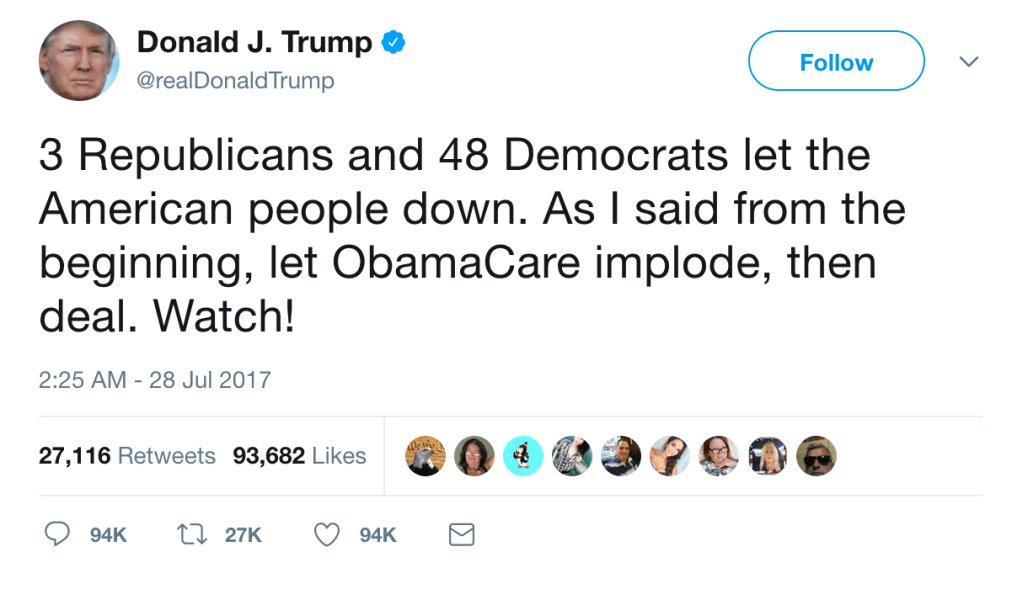
Trump hasn’t been shy about his plan to halt any efforts that stabilize the exchange markets (like CSRs) in an effort to sabotage the ACA and force unwilling Democrats to cooperate on a repeal bill. Others in the GOP, however, have been reluctant to hurt constituents with such an overtly political play.
America’s Health Insurance Plans has said it is imperative the CSRs are funded. “These benefits are essential to making coverage and care affordable for American families who receive them,” the organization said. “Clarity and commitment to this funding is needed to eliminate confusion and anxiety for consumers.”
It may soon be too late for CSR payments to matter for next year. Payers must sign their contracts with HealthCare.gov by Sept. 21. The CMS and some states have tried to give insurers more flexibility because of the uncertainty by pushing back rate filing deadlines. Connecticut said it will allow payers to refile their rates if the CSR payments are eliminated, and California allowed them to file two sets of rates, one of which assumes no CSRs.
Weakening the ACA
Trump’s threat to “let Obamacare implode” may go beyond refusing to shore up the exchange markets. His administration has already pulled advertising and promotion of the exchanges, and is being investigated by the Government Accountability Office for pushing the GOP healthcare bills in official HHS communication channels. Immediately after his inauguration, Trump signed a wide-ranging executive order instructing federal agencies to “exercise all authority and discretion available to them to waive, defer, grant exemptions from, or delay any provision or requirement” of the ACA that imposes a fiscal or regulatory burden.
No major changes have resulted from the order so far, but it could be used to roll back benefit requirements for preventive care, contraception and mental health services.
HHS Secretary Tom Price could also make changes that weaken the ACA’s individual mandate. Repealing the mandate would mean 15 million fewer Americans would have coverage by 2026 and result in premium increases of about 20%, according to the Congressional Budget Office. Watering down the requirement instead of ditching it completely would have less drastic results, but there would still be an impact.
Price could create more exemptions for the mandate or attempt to force the Internal Revenue Service to stop enforcing it. Either of these actions would add turmoil to the exchanges markets and undermine the efforts of the ACA.
Reauthorizing CHIP
Those watching health legislation in Congress are eyeing CHIP reauthorization as a possible vehicle for changes to the ACA. Lawmakers will be hesitant, though, as CHIP is a successful program with bipartisan support.
The program, which turned 20 years old this past weekend, covered nearly 9 million children in fiscal 2016. CHIP coverage is more affordable than employer-sponsored or marketplace coverage, while children covered under CHIP are more likely to have a usual source of care and regularly attend well-child visits, according to the Medicaid and CHIP Payment and Access Commission, which recommends Congress extend CHIP funding through 2022.
The commission estimates more than a million children would lose coverage if CHIP loses funding.
Bipartisan legislation and state waivers
A bipartisan group of about 40 members of the House is proposing some relatively small changes to the ACA that have received support from both sides of the aisle in the past. The plan is to put them in a bill that would also immediately fund the CSRs.
Their suggestions include exempting smaller businesses from the employer mandate, a fund states can go to for help covering people with high care costs and more flexibility and guidance for states looking to apply for ACA waivers. Another possible measure is repeal of the medical device tax.
Their proposal is to change the employer mandate by having it apply only to businesses with 500 or more employees, instead of the current requirement for businesses with 50 or more workers. Analysis from the Urban Institute and Rand Corporation has shown the employer mandate has little effect on the number of people who have coverage, partly because nearly all businesses with at least 50 employees offered coverage even before the mandate went into effect.
The ACA has always given states the option of applying for a waiver that allows them to eschew essential health benefits and other requirements — as long as they can prove their plans will cover the same number of people with coverage that is just as comprehensive and affordable. HHS under President Barack Obama was careful in ensuring that state proposals met those guidelines, but current HHS Secretary Tom Price has said he wants to encourage more waivers and will be less strict with approvals of those waivers and Medicaid demonstration waivers.
With this in mind, some recent proposals have included aspects that would have previously been rejected. Last week, Maine applied for a Medicaid demonstration waiver that includes work requirements and asset testing. Those measures are likely to restrict access to coverage for people with low incomes.
Many of the options available for Congress and the executive branch could roil the industry, but some bipartisan options could provide much needed clarity. Summer is usually pretty quiet in Washington D.C., but this year has not been business as usual. Healthcare leaders would be wise to be ready for new developments with the ACA and beyond.
From Huffington Post — By Lydia O’Connor, Daniel Marans
Trump Condemned Racism As ‘Evil.’ Here Are 16 Times He Embraced It.
It took more than 48 hours, but President Donald Trump finally denounced the white supremacist groups whose rally in Charlottesville, Virginia, this past weekend sparked deadly violence.
But his Monday proclamation that “racism is evil” means little coming from a man who largely has not backed away from the racism upon which he built both his campaign and his real estate business.
Not only did Trump’s condemnation pale in comparison to those from lawmakers on both sides of the aisle, celebrities and even the maker of the tiki torches used at the rally, but it also came after he blamed “many sides” for the violent protest.
Throughout his campaign and after his election, HuffPost kept running lists of examples of Trump’s racism dating as far back as the 1970s. We’ll continue to document those incidents here as they happen.
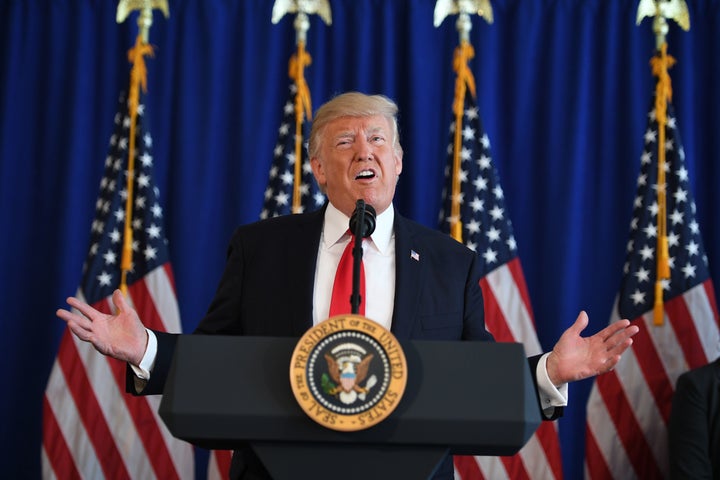
Trump speaks to the press about protests in Charlottesville on Saturday at Trump National Golf Club in Bedminster, New Jersey.JIM WATSON VIA GETTY IMAGES
Some of his top advisers and cabinet picks have histories of prejudice
Since winning the election, Trump has picked top advisers and cabinet officials whose careers are checkered by accusations of racially biased behavior.
Steve Bannon, Trump’s chief strategist and senior counselor, was executive chairman of Breitbart, a news site that Bannon dubbed the “home of the alt-right” ― a euphemism that describes a loose coalition of white supremacists and aligned groups. Under Bannon’s leadership, Breitbart increased its accommodation of openly racist and anti-Semitic writing, capitalizing on the rise of white nationalism prompted by Trump’s campaign.
Retired Lt. Gen. Mike Flynn ― who worked as Trump’s national security adviser until resigning in February amid revelations that he discussed U.S. sanctions against Russia with that country’s ambassador ― has drawn scrutiny for anti-Muslim comments he has made over the years. In February, Flynn tweeted that “fear of Muslims is rational.” Over the summer, he said that there is a “diseased component inside the Islamic world” that is like a “cancer.” Flynn has defended Trump’s past proposal of banning Muslim immigration and suggested he would be open to reviving torture techniques like waterboarding.
In addition, Trump has nominated Sen. Jeff Sessions (R-Ala.) to be attorney general of the United States. The Senate refused to confirm Sessions as a federal judge in 1986 amid accusations that he’d made racially insensitive comments, including that the only reason he hadn’t joined the Ku Klux Klan was because members of the extremist group smoked marijuana. Civil rights groups condemned Trump’s nomination of Sessions, while leading white nationalists celebrated it.
And Steve Mnuchin, who Trump tapped to serve as Treasury secretary, faces allegations of profiting from racial discrimination. As a hedge fund manager, Mnuchin purchased a troubled mortgage bank, sped up its foreclosure rate and sold it for a killing several years later. Along the way, Mnuchin’s bank came under fire from housing rights groups for racist practices like lending to very few people of color and maintaining foreclosed-upon properties in neighborhoods that were predominantly black and brown less than in white neighborhoods.
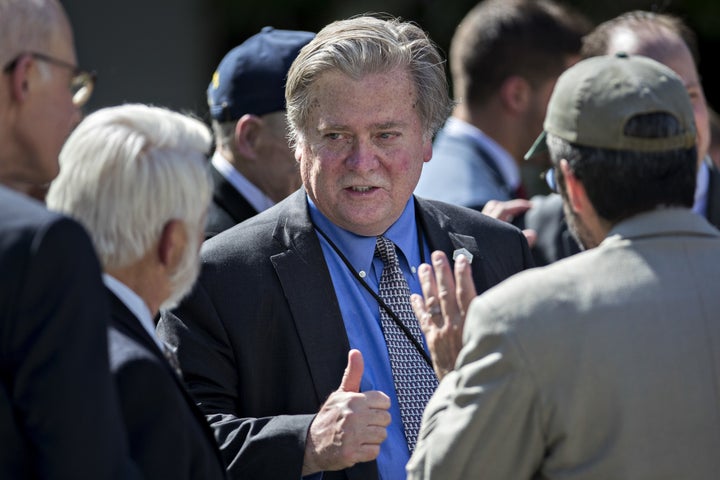
BLOOMBERG VIA GETTY IMAGES
Steve Bannon, chief strategist for President Donald Trump.
Trump denied responsibility for the racist incidents that followed his election
While the hate speech and racist violence emboldened by his campaign only escalated after his win, Trump downplayed the incidents and half-heartedly denounced them.
There were nearly 900 hate incidents across the U.S. in the 10 days following the election, a report released last month by the Southern Poverty Law Center found. Those attacks include vandals drawing swastikas on a synagogue, schools, cars and driveways; an assailant beating a gay man while saying the “president says we can kill all you faggots now”; and children telling their black classmates to sit in the back of the school bus.
In nearly 40 percent of those incidents, the SPLC found, people explicitly invoked the president-elect’s name or his campaign slogans.
The Council on American-Islamic Relations and the Anti-Defamation League have also tracked significant growth in racist and bigoted attacks.
“We’ve seen a great deal of really troubling stuff in the last week, a spike in harassment, a spike in vandalism, physical assaults. Something is happening that was not happening before,” ADL national director Jonathan Greenblatt told The New Yorker.
Despite those findings, Trump insisted on CBS’ “60 Minutes” the Sunday after his election that there had only been “a very small amount” of racist incidents.
“I am so saddened to hear that,” Trump said when asked about the racist incidents. “And I say, ‘Stop it.’ If it helps, I will say this, and I will say right to the camera: ‘Stop it.’”
He also accused the media of overstating the attacks. “I think it’s built up by the press because, frankly, they’ll take every single little incident that they can find in this country, which could’ve been there before ― if I weren’t even around doing this ― and they’ll make it into an event, because that’s the way the press is,” he said.
Trump’s denouncement of hate-fueled violence was relatively mild, especially compared to the zeal with which he routinely attacks other targets ― like, say, “Saturday Night Live,” or the cast of “Hamilton,” who addressed Vice president-elect Mike Pence at a recent performance in New York that Pence attended.
“[Trump] hits the news media when he thinks there’s a story that’s unfair, he tweets when he is outraged about something in the media,” CNN host Wolf Blitzer said last month, after Trump criticized the cast of “Hamilton” for singling out Pence, whom the audience also booed. “But he doesn’t seem to go out of the way to express his outrage over people hailing him with Nazi salutes.”
He launched a travel ban targeting Muslims
In an executive order since blocked by the courts, Trump restricted Syrian refugees and travel by immigrants from seven Muslim-majority countries.
While White House Press Secretary Sean Spicer later insisted that it was “not a Muslim ban,” Trump said the day he signed it that he would prioritize helping Syrian Christians and made an exception for admitting refugees who are religious minorities in those countries.
Trump has characterized people from that region of the world as being “terror-prone,” despite there having been zero fatal terrorist attacks on U.S. soil since 1975 by immigrants from the seven targeted countries: Iran, Iraq, Libya, Somalia, Sudan, Syria and Yemen.
A blanket ban on travel from those countries and anti-Muslim bigotry in general is “essentially an extension of the fear and vilification of not only Muslims but everyone perceived to be Muslim that’s been taking place for centuries,” Khaled Beydoun, a law professor at the University of Detroit who also works with the Islamophobia Research and Documentation Project at the University of California, Berkeley, explained to Vox.
He attacked Muslim Gold Star parents
Trump’s retaliation against the parents of a Muslim U.S. Army officer who died while serving in the Iraq War was a low point in a campaign full of hateful rhetoric.
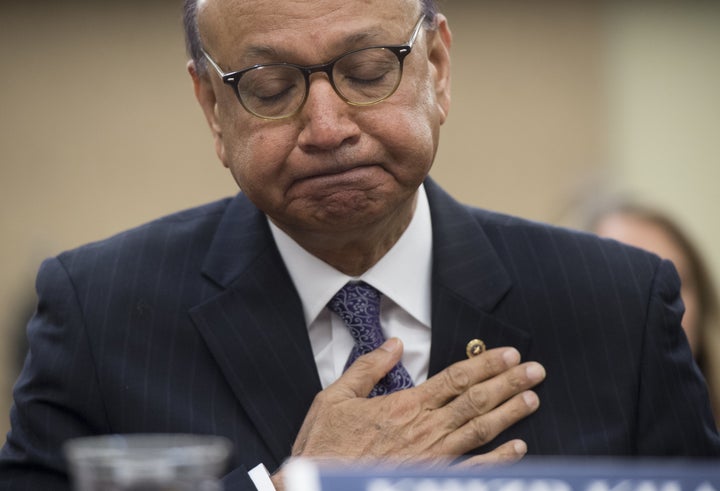
Khizr Khan, the father of the late Army Captain Humayun Khan, spoke out against Trump’s bigoted rhetoric and disregard for civil liberties at the Democratic National Convention on July 28. It became the most memorable moment of the convention.
SAUL LOEB VIA GETTY IMAGES
Khizr Khan, a Goldstar father, speaks on Feb. 2 about Trump issuing an executive order to ban travelers from seven countries.
“Let me ask you, have you even read the U.S. Constitution?” Khan asked Trump before pulling a copy of the document from his jacket pocket and holding it up. “I will gladly lend you my copy.” Khan’s wife, Ghazala, who wears a head scarf, stood at his side during the speech but did not speak.
In response to the devastating speech, Trump seized on Ghazala Khan’s silence to imply that she was forbidden from speaking due to the couple’s Islamic faith. “If you look at his wife, she was standing there. She had nothing to say. She probably, maybe she wasn’t allowed to have anything to say. You tell me,” Trump said in an interview with ABC News that first appeared on July 30.
“Walking onto the convention stage, with a huge picture of my son behind me, I could hardly control myself. What mother could?” she wrote. “Donald Trump has children whom he loves. Does he really need to wonder why I did not speak?”
He claimed a judge was biased because “he’s a Mexican”
In May 2016, Trump implied that Gonzalo Curiel, the federal judge presiding over a class action suit against the for-profit Trump University, could not fairly hear the case because of his Mexican heritage.
“He’s a Mexican,” Trump told CNN. “We’re building a wall between here and Mexico. The answer is, he is giving us very unfair rulings — rulings that people can’t even believe.”
Curiel, it should be noted, is an American citizen who was born in Indiana. As a prosecutor in the late 1990s, he went after Mexican drug cartels, making him a target for assassination by a Tijuana drug lord.
BLOOMBERG VIA GETTY IMAGES
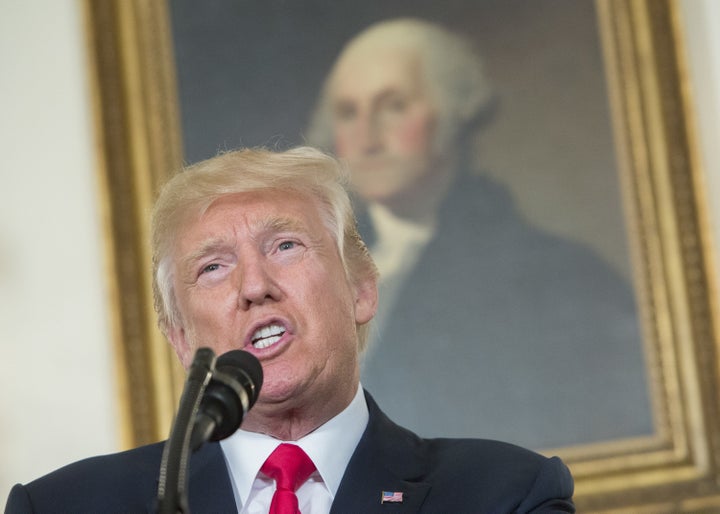
Trump delivers a statement in the Diplomatic Reception Room of the White House in Washington, D.C., on Aug. 14.
Even members of Trump’s own party slammed the racist remarks. “Claiming a person can’t do their job because of their race is sort of like the textbook definition of a racist comment,” House Speaker Paul Ryan (R-Wis.) said, though he clarified that he still endorsed Trump.
The comments against Curiel didn’t sit well with the American public either. According to a YouGov poll released in June 2016, 51 percent of those surveyed agreed that Trump’s comments were not only wrong, but also racist. Fifty-seven percent of Americans said Trump was wrong to complain against the judge, while just 20 percent said he was right to do so.
When asked whether he would trust a Muslim judge in light of his proposed restrictions on Muslim immigration, Trump suggested that such a judge might not be fair to him either.
The Justice Department sued his company ― twice ― for not renting to black people
When Trump was serving as the president of his family’s real estate company, the Trump Management Corporation, in 1973, the Justice Department sued the company for alleged racial discrimination against black people looking to rent apartments in the Brooklyn, Queens and Staten Island boroughs of New York City.
The lawsuit charged that the company quoted different rental terms and conditions to black rental candidates than it did to white candidates, and that the company lied to black applicants about apartments not being available. Trump called those accusations “absolutely ridiculous” and sued the Justice Department for $100 million in damages for defamation.
Without admitting wrongdoing, the Trump Management Corporation settled the original lawsuit two years later and promised not to discriminate against black people, Puerto Ricans or other minorities. Trump also agreed to send weekly vacancy lists for his 15,000 apartments to the New York Urban League, a civil rights group, and to allow the NYUL to present qualified applicants for vacancies in certain Trump properties.
Just three years after that, the Justice Department sued the Trump Management Corporation again for allegedly discriminating against black applicants by telling them apartments weren’t available.
THE WASHINGTON POST VIA GETTY IMAGES
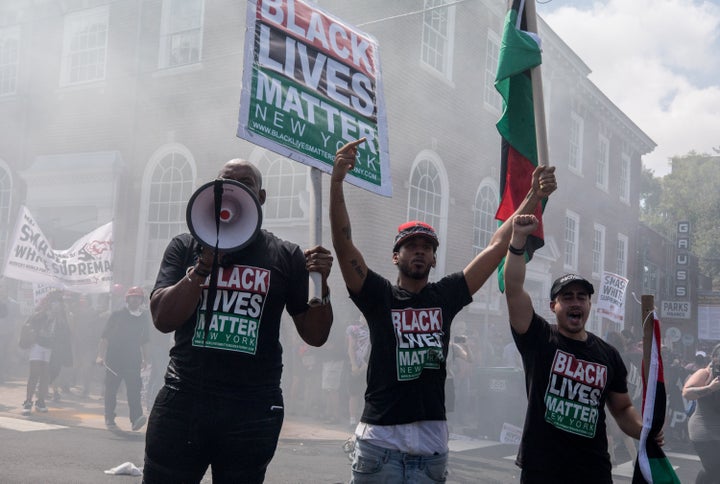
Black Lives Matter protestors stand in a fog of tear gas during clashes at the Unite the Right rally in Charlottesville, Virginia, on Aug. 12.
In fact, discrimination against black people has been a pattern throughout Trump’s career
Workers at Trump’s casinos in Atlantic City, New Jersey, have accused him of racism over the years. The New Jersey Casino Control Commission fined the Trump Plaza Hotel and Casino $200,000 in 1992 because managers would remove African-American card dealers at the request of a certain big-spending gambler. A state appeals court upheld the fine.
The first-person account of at least one black Trump casino employee in Atlantic City suggests the racist practices were consistent with Trump’s personal behavior toward black workers.
“When Donald and Ivana came to the casino, the bosses would order all the black people off the floor,” Kip Brown, a former employee at Trump’s Castle, told The New Yorker for a 2015 article. “It was the eighties, I was a teen-ager, but I remember it: they put us all in the back.”
Trump allegedly disparaged his black casino employees as “lazy” in vividly bigoted terms, according to a 1991 book by John O’Donnell, a former president of Trump Plaza Hotel and Casino.
“And isn’t it funny. I’ve got black accountants at Trump Castle and Trump Plaza. Black guys counting my money! I hate it,” O’Donnell recalled Trump saying. “The only kind of people I want counting my money are short guys that wear yarmulkes every day.”
“I think the guy is lazy,” Trump said of a black employee, according to O’Donnell. “And it’s probably not his fault because laziness is a trait in blacks. It really is, I believe that. It’s not anything they can control.” Trump told an interviewer in 1997 that “the stuff O’Donnell wrote about me is probably true,” but in 1999 accused O’Donnell of having fabricated the quotes.
Trump has also faced charges of reneging on commitments to hire black people. In 1996, 20 African-Americans in Indiana sued Trump for failing to honor a promise to hire mostly minority workers for a riverboat casino on Lake Michigan.
He refused to immediately condemn the white supremacists who advocated for him
Trump’s response to the Charlottesville chaos wasn’t the first time he appeared hesitant to condemn white supremacists.
Three times in a row on Feb. 28, Trump sidestepped opportunities to renounce white nationalist and former KKK leader David Duke, who’d recently told his radio audience that voting for any candidate other than Trump would be “treason to your heritage.”
When asked by CNN’s Jake Tapper if he would condemn Duke and say he didn’t want a vote from him or any other white supremacists, Trump claimed that he didn’t know anything about white supremacists or about Duke himself. When Tapper pressed him twice more, Trump said he couldn’t condemn a group he hadn’t yet researched.
By Feb. 29, Trump was saying that in fact he did disavow Duke, and that the only reason he didn’t do so on CNN was because of a “lousy earpiece.” Video of the exchange, however, shows Trump responding quickly to Tapper’s questions with no apparent difficulty in hearing.
It’s preposterous to think that Trump didn’t know about white supremacist groups or their sometimes violent support of him. Reports of neo-Nazi groups rallying around Trump go back as far as August 2015.
His white supremacist fan club includes The Daily Stormer, a leading neo-Nazi news site; Richard Spencer, director of the National Policy Institute, which aims to promote the “heritage, identity, and future of European people”; Jared Taylor, editor of American Renaissance, a Virginia-based white nationalist magazine; Michael Hill, head of the League of the South, an Alabama-based white supremacist secessionist group; and Brad Griffin, a member of Hill’s League of the South and author of the popular white supremacist blog Hunter Wallace.
A leader of the Virginia KKK who backed Trump told a local TV reporter in May, “The reason a lot of Klan members like Donald Trump is because a lot of what he believes, we believe in.”
Later that month, the Trump campaign announced that one of its California primary delegates was William Johnson, chair of the white nationalist American Freedom Party. The Trump campaign subsequently said his inclusion was a mistake, and Johnson withdrew his name at their request.
After the election, Spencer’s National Policy Institute held a celebratory gathering in Washington, D.C. A video shows many of the white nationalists assembled there doing the Nazi salute after Spencer declared, “Hail Trump, hail our people, hail victory!”
He questioned whether President Barack Obama was born in the United States
Long before calling Mexican immigrants “criminals” and “rapists,” Trump was a leading proponent of “birtherism,” the racist conspiracy theory that President Barack Obama was not born in the United States and is thus an illegitimate president. Trump claimed in 2011 to have sent people to Hawaii to investigate whether Obama was really born there. He insisted at the time that the researchers “cannot believe what they are finding.”
Obama ultimately got the better of Trump, releasing his long-form birth certificate and relentlessly mocking the real estate mogul about it at the White House Correspondents’ Association dinner that year.
But Trump continued to insinuate that the president was not born in the country. “I don’t know where he was born,” Trump said in a speech at the Conservative Political Action Conference in February 2015. (Again, for the record: Obama was born in Hawaii.)
In September, under pressure to clarify his position, Trump finally acknowledged that Obama was indeed born in the United States. But he falsely tried to blame Hillary Clinton for starting the rumors ― and tried to take credit for settling them himself with his racist pressure campaign. “Hillary Clinton and her campaign of 2008 started the birther controversy,” Trump said. “I finished it.”
He treats racial groups as monoliths
Like many racial instigators, Trump often answers accusations of bigotry by loudly protesting that he actually loves the group in question. But that’s just as uncomfortable to hear, because he’s still treating all the members of the group ― all the individual human beings ― as essentially the same and interchangeable. Language is telling, here: Virtually every time Trump mentions a minority group, he uses the definite article the, as in “the Hispanics,” “the Muslims” and “the blacks.”
In that sense, Trump’s defensive explanations are of a piece with his slander of minorities. Both rely on essentializing racial and ethnic groups, blurring them into simple, monolithic entities, instead of acknowledging that there’s as much variety among Muslims and Latinos and black people as there is among white people.
How did Trump respond to the outrage last year that followed his characterization of Mexican immigrants as criminals and rapists?
“I’ll take jobs back from China, I’ll take jobs back from Japan,” Trump said during his visit to the U.S.-Mexico border in July 2015. “The Hispanics are going to get those jobs, and they’re going to love Trump.”
The Hispanics are going to get those jobs, and they’re going to love Trump.Donald Trump, July 2015
How did Trump respond to critics of his proposal to ban Muslims from entering the U.S.?
“I’m doing good for the Muslims,” Trump told CNN last December. “Many Muslim friends of mine are in agreement with me. They say, ‘Donald, you brought something up to the fore that is so brilliant and so fantastic.’”
Not long before he called for a blanket ban on Muslims entering the country, Trump was proclaiming his affection for “the Muslims,” disagreeing with rival candidate Ben Carson’s claim in September 2015 that being a Muslim should disqualify someone from running for president.
“I love the Muslims. I think they’re great people,” Trump said then, insisting that he would be willing to name a Muslim to his presidential cabinet.
How did Trump respond to the people who called him out for funding an investigation into whether Obama was born in the United States?
“I have a great relationship with the blacks,” Trump said in April 2011. “I’ve always had a great relationship with the blacks.” Even when Trump has dropped the definite article “the,” his attempts at praising minority groups he has previously slandered have been offensive.
Look no further than the infamous Cinco de Mayo taco bowl tweet. Former Republican presidential candidate and Florida Gov. Jeb Bush (R) offered a good summary of everything that was wrong with Trump’s comment. “It’s like eating a watermelon and saying ‘I love African-Americans,’” Bush quipped.
In an apparent attempt to win favor with black and Latino voters in the final months of the campaign, Trump fell back on his penchant for stereotyping. At the first presidential debate in September, Trump claimed African-Americans and Latinos in cities were “living in hell” due to the violence and poverty in their neighborhoods. The previous month, speaking to an audience of white people, Trump asked “what the hell do [black voters] have to lose” by voting for him.
Trump’s treatment of longtime White House correspondent April Ryan during a February press conference left many wondering if Trump assumes all black people are friends with one another. When Ryan, a black reporter for the American Urban Radio Networks, asked Trump if he would hold meetings with members of the Congressional Black Caucus to help craft his urban development policy, he asked her to handle the introduction. “Well, I would. I’ll tell you what, do you want to set up the meeting?” Trump asked. “Do you want to set up the meeting? Are they friends of yours?” “No, I’m just a reporter,” Ryan replied.
He trashed Native Americans, too
In 1993, Trump wanted to open a casino in Bridgeport, Connecticut, that would compete with one owned by the Mashantucket Pequot Nation, a local Native American tribe. He told the House subcommittee on Native American Affairs that the Pequots “don’t look like Indians to me… They don’t look like Indians to Indians.”
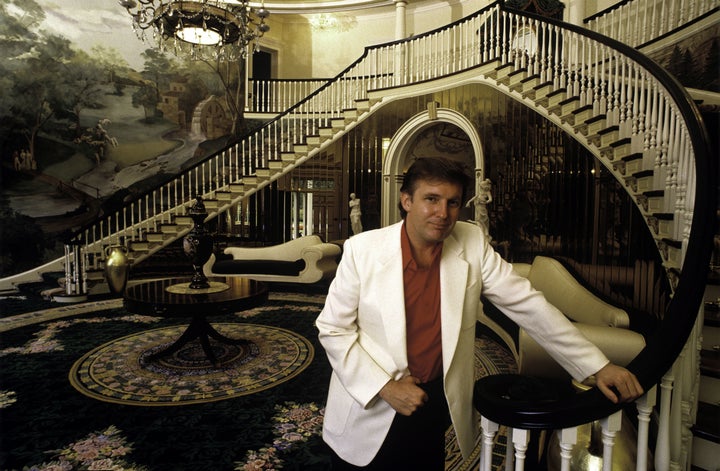
In the 1980s, Donald Trump was much younger, but just as racist as he is now.
He encouraged the mob anger that resulted in the wrongful imprisonment of the Central Park Five
In 1989, Trump took out full-page ads in four New York City-area newspapers calling for the return of the death penalty in New York and the expansion of police authority in response to the infamous case of a woman who was beaten and raped while jogging in Manhattan’s Central Park.
“They should be forced to suffer and, when they kill, they should be executed for their crimes,” Trump wrote, referring to the Central Park attackers and other violent criminals. “I want to hate these murderers and I always will.”
The public outrage over the Central Park jogger rape, at a time when the city was struggling with high crime, led to the wrongful conviction of five teenagers of color known as the Central Park Five.
The men’s convictions were overturned in 2002, after they’d already spent years in prison, when DNA evidence showed they did not commit the crime. Today, their case is considered a cautionary tale about a politicized criminal justice process.
He condoned the beating of a Black Lives Matter protester
At a November 2015 campaign rally in Alabama, Trump supporters physically attacked an African-American protester after the man began chanting “Black lives matter.” Video of the incident shows the assailants kicking the man after he has already fallen to the ground.
The following day, Trump implied that the attackers were justified.
“Maybe [the protester] should have been roughed up,” he mused. “It was absolutely disgusting what he was doing.”
Trump’s dismissive attitude toward the protester is part of a larger, troubling pattern of instigating violence toward protesters at campaign events, where people of color have attracted especially vicious hostility.
Trump has also indicated he believes the entire Black Lives Matter movement lacks legitimate policy grievances. He alluded to these views in an interview with The New York Times Magazine where he described Ferguson, Missouri, as one of the most dangerous places in America. The small St. Louis suburb is not even in the top 20 highest-crime municipalities in the country.
He called supporters who beat up a homeless Latino man “passionate”
Trump’s racial incitement has already inspired hate crimes. Two brothers arrested in Boston in August 2015 for beating up a homeless Latino man cited Trump’s anti-immigrant message when explaining why they did it.
“Donald Trump was right ― all these illegals need to be deported,” one of the men reportedly told police officers.
Trump did not even bother to distance himself from them. Instead, he suggested that the men were well-intentioned and had simply gotten carried away. “I will say that people who are following me are very passionate,” Trump said. “They love this country and they want this country to be great again. They are passionate.”
He stereotyped Jews and shared an anti-Semitic image created by white supremacists
When Trump addressed the Republican Jewish Coalition last December, he tried to relate to the crowd by invoking the stereotype of Jews as talented and cunning businesspeople.
“I’m a negotiator, like you folks,” Trump told the crowd, touting his 1987 book Trump: The Art of the Deal. “Is there anyone who doesn’t renegotiate deals in this room?” Trump said. “Perhaps more than any room I’ve spoken to.”
Nor was that the most offensive thing Trump told his Jewish audience. He implied that he had little chance of earning the Jewish Republican group’s support, because his fealty could not be bought with campaign donations.
“You’re not going to support me, because I don’t want your money,” he said. “You want to control your own politician.”
Ironically, Trump has many close Jewish family members. His daughter Ivanka converted to Judaism in 2009 before marrying the real estate mogul Jared Kushner. Trump and Kushner raise their three children in an observant Jewish home.
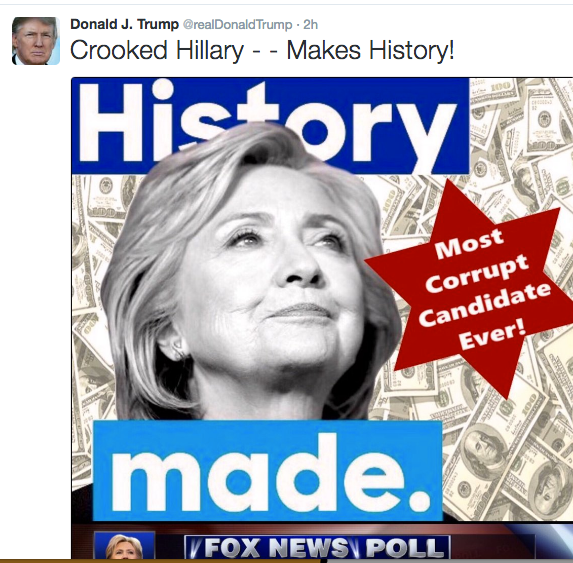
In July, Trump tweeted an anti-Semitic image that featured a photo of Hillary Clinton over a backdrop of $100 bills with a six-pointed star next to her face and the label “Most Corrupt Candidate Ever!”
“Crooked Hillary – – Makes History!” Trump wrote in the tweet
.
HUFFPOST
The religious symbol was co-opted by the Nazis during World War II when they forced Jews to sew it onto their clothing. Using the symbol over a pile of money is blatantly anti-Semitic and re-enforces hateful stereotypes of Jewish greed.
“The sheriff’s badge ― which is available under Microsoft’s ‘shapes’ ― fit with the theme of corrupt Hillary and that is why I selected it,” he said in a statement.
Mic, however, discovered that the image was actually created by white supremacists and had appeared on a neo-Nazi forum more than a week before Trump shared it. Additionally, a watermark on the image led to a Twitter account that regularly tweeted racist and sexist political memes.
He treats African-American supporters as tokens to dispel the idea he is racist
At a campaign appearance in California in June, Trump boasted that he had a black supporter in the crowd, saying, “Look at my African-American over here.”
“Look at him,” Trump continued. “Are you the greatest?”
Trump went on to imply that the media conceals his popularity among black voters by not covering the crowd more attentively.
“We have tremendous African-American support,” he said. “The reason is I’m going to bring jobs back to our country.” Ultimately, Trump won just 8 percent of the African-American vote, according to the NBC News exit poll.
It may not be surprising that Trump brought so much racial animus into the 2016 election cycle, given his family history. His father, Fred Trump, was a target of folk singer Woody Guthrie’s lyrics after Guthrie lived for two years in a building owned by Trump père: “I suppose / Old Man Trump knows / Just how much / Racial hate / He stirred up / In the bloodpot of human hearts.”
And last fall, a news report from 1927 surfaced on the site Boing Boing, revealing that Fred Trump was arrested that year following a KKK riot in Queens. It’s not clear exactly what the elder Trump was doing there or what role he may have played in the riot.
To affirm that vicious race-based violence is ‘not who we are’ is to erase our very recent, collective past. By JOSHUA ZEITZ August 13, 2017
“These people are not from here,” Rep. Thomas Garrett affirmed in the wake of an American Nazi and Klan rally that descended into smoke and violence in his Virginia congressional district on Saturday. “It blows my mind that this many racist bigots actually exist in this country.” White supremacists, he continued, do not reflect “who we are as Americans.”
It’s a little surprising that Garrett is surprised. Even as he spoke, a photograph circulated of the congressman meeting recently with Jason Kessler, a white supremacist from Charlottesville who organized the rally. The purpose of the meeting, Garrett’s office insisted, was unrelated to yesterday’s rally; the two men discussed a range of issues, including President Donald Trump’s anti-terrorism and immigration restriction initiatives.
To be fair, Garrett might not perceive the tight spectrum that runs between between racialist policies and white supremacist violence. He may also genuinely believe that aggrieved white men marching in lock step by torchlight do not reflect “who we are as Americans.” Indeed, many public figures on both the left and right—people like Sally Yates, Tim Kaine and Ana Navarro, whose anti-racist and anti-fascist credentials are unimpeachable—echoed this well-meaning sentiment.
But as the historian and New Yorker staff writer Jelani Cobb observed, “The biggest indictment of the way we teach American history is that people can look at #Charlottesville and say ‘This is not who we are.’” It is part of the myth of American Exceptionalism that blood and soil movements like Nazism are foreign to the United States—that jackbooted fascism of the variety that infects democratic institutions is an invasive weed that can be easily plucked out of our national garden.
To affirm that this is not who we are, one has to erase the history of American race relations from our very recent, collective past.
***
Politicians and pundits often invoke the idea of American Exceptionalism with little understanding of its origins. A woolly concept with roots that extend back to the era of colonial settlement, it views the United States as somehow immune from the forces of history. The term assumed prominence in the middle part of the 20th century, as social scientists working in the aftermath of two world wars attempted to understand why endemic social, economic and political divisions that drove a century of combat, ethnic cleansing and genocide in Europe were seemingly non-operative in the United States. Was it because America lacked a feudal past? Because it was a land with greater material bounty? Was it the leveling influence of the frontier that made us different?
The entire debate was an exercise in national innocence. In retrospect, it’s remarkable that some of the country’s best minds even stopped to ponder the question. To believe that the United States had been immune to the forces that produced blood-and-soil fascism, they had to write off a great deal of recent history.
By a conservative estimate, between 1890 and 1917 white Southerners lynched roughly three black people each week. “Back in those days, to kill a Negro was nothing,” a black man from Mississippi later recalled. “It was like killing a chicken or killing a snake.”
Many of these murders took place under cover of darkness, but many didn’t. So-called spectacle lynchings—like the execution of Sam Hose, who was burned alive by a large white mob in Georgia in 1898, or Luther Holdbert and his wife, whose fingers were chopped off one-by-one, and whose eyes were torn from their sockets in front of an admiring crowd of one thousand of their white neighbors before their death—were premeditated and well-attended acts of public amusement. They were announced in advance by newspaper advertisement. Day laborers and middle-class professionals traveled by specially chartered trains just to participate or bear witness.
“Some ladies were present,” a newspaper observed of a typical lynching in Mississippi in 1909. “A few were nursing infants who tugged at the mother’s breasts, while the mother kept her eyes on the gallows. She didn’t want to lose any part of the program she had come miles to see, and to tell the neighbors at home.”
This wasn’t just a story of Southern terror. It’s also the story of race riots that befell over three dozen cities, north and south, in 1919, usually triggered by organized white mob violence against black citizens, some of them fresh from military service in World War I and still donning uniforms.
In the same way that mid-century scholars ignored the homespun violence so prevalent in their recent history, today, well-meaning people on the left and right have glossed over resurgent American tendencies on display yesterday in Charlottesville. The pathetic specter of suburban white men donning camouflage uniforms and bearing long guns and clubs may conjure images of Berlin in 1932, but it should also invoke memories of the United States in the 1920s.
During the 1920s, roughly 5 million men, and 500,000 women, were at one time dues-paying members of the second Ku Klux Klan, an informal fraternal organization that also functioned in many communities as an extralegal citizens’ militia. Though many of its local chapters bore closer resemblance to the American Legion than to the shadowy band of vigilantes who terrorized the Southern countryside a half-century before, others were unusually violent—particularly the Texas Klan, headed by Hiram Evans, a former Dallas dentist with a burning hatred of the organization’s usual roster of victims: Jews, Catholics and African Americans. As early as 1921, a damning expose in the New YorkWorld chronicled a nationwide KKKterror campaign that included four murders, 41 beatings and 27 tar-and-feather parties.
The second Ku Klux Klan drew many—perhaps most—of its members from cities and metropolitan areas. Its rosters included a fairly even mix of small businessmen, professionals and manual workers. While all Klansmen were white Protestants, many attended mainline churches. Unlike the original Klan, which was a Southern phenomenon, the new organization drew from a cross-section of white Protestant America and was especially influential in Midwestern states like Indiana.
Like their predecessors of the 1860s, Klansmen were primarily concerned about maintaining white Protestant supremacy, but they also fashioned themselves as great moralists, often calling for more vigorous enforcement of Prohibition laws. In some cases, they stepped in to fill the void left by local police, as when they conducted highly publicized raids on private stills in Oklahoma and “arrested” 140 violators of anti-liquor laws.
Above all, they feared the corrosive effects of modern culture on traditional family values. An apparent rise in illicit sex and marital infidelity drove the Klan to undertake a bizarre, often sadistic, campaign of vigilante justice against men and women who most conspicuously flouted 19th-century social conventions. In Texas, Klansmen beat a man from Timpson who had separated from his wife and a lawyer from Houston who “annoyed” local girls. In Tenaha, they stripped, flogged and tarred and feathered a woman who stood accused of remarrying before filing for a proper divorce. In Grove Creek, Klan riders broke into the home of a recently divorced woman who was convalescing from an illness; they dragged her from bed, chopped off her hair and beat her male visitor senseless with a flail.
Naturally, the Klan particularly reviled “the revolting spectacle of a white woman clinging in the arms of a colored man.” But more pedestrian violations of Victorian propriety also vexed members of the order. In Evansville, Indiana, William Wilson, the teenaged son of the local Democratic congressman, remembered that Klan riders ruthlessly patrolled back roads in search of teenagers embroiled in petting parties or improper embraces. Armed with their National Horse Thief Detective Association badges—emblems of a 19th-century vigilante organization—the KKK “entered homes without search warrants” and “flogged errant husbands and wives. They tarred and feathered drunks. They caught couples in parked cars.” In an almost pornographic ceremony that was repeated dozens if not hundreds of times, Klan members hauled “fallen women” to remote locations, stripped them naked and flogged them.
Above all, the Klan’s advocacy of “100 percent Americanism,” racial purity and moral order were different but compatible parts of the same crusade against the most unsettling features of modern culture and society. At a parade in Texarkana, Arkansas, Klansmen carried various signs that spoke to the unity of the organization’s otherwise diverse interests:
LAW AND ORDER MUST PREVAIL.
COHABITATION BETWEEN WHITES AND BLACKS MUST STOP
BOOTLEGGERS, PIMPS, HANGERS-ON, GET RIGHT OR GET OUT.
WIFE-BEATERS, FAMILY-DESERTERS, HOME-WRECKERS, WE HAVE NO ROOM FOR YOU
LAW VIOLATORS, WE ARE WATCHING YOU. BEWARE.
GO JOY RIDING WITH YOUR OWN WIFE.
WE STAND FOR OLD GLORY AND 100% AMERICANISM
The ugliness on display in Charlottesville in 2017 is not foreign to American tradition. Neither are the interconnected grievances of would-be militiamen who entangle their racial resentments with morbid fears of same-sex marriage and transgender bathroom laws. They’re an absolutely American story. They’re part of who we’ve always been.
***
Violence in the service of preserving white Protestant supremacy is woven firmly into the fabric of our national history. In this sense, the violence in Charlottesville is an entirely American phenomenon. So is thesteady unraveling of democratic norms, civilities and institutions—the rise of fake news, the flagrant mendacity of White House spokespeople, political attacks on public education and universities, degradation of civic discourse and parliamentary procedure—that concerns so many opponents of the Trump administration. These phenomena, too, are of a piece with what happened yesterday in Virginia. In our not-so-distant past, the United States has willingly torched its democratic traditions in the service of enforcing white supremacy.
In Mississippi in the 1950s—the “Magnolia Jungle,” as a liberal newspaperman called it at the time—democracy was effectively non-operational. It’s not just the story of Emmett Till, a young black boy from Illinois, who, while visiting relatives, was brutally lynched. It’s the story of the White Citizens’ Councils, which claimed over 25,000 middle-class businessmen and professionals as members. Preferring methods of non-violent coercion, they besieged civil rights activists, black parents who attempted to enroll their children in all-white schools, and a small number of white clergymen and educators who opposed Jim Crow. Targets suddenly found their mortgages or business loans called in, insurance policies canceled, teaching jobs revoked.
For many white Mississippians, preserving racial privilege took precedent over enforcing democracy. A grand jury in Jones County demanded that the state screen library books to weed out those with subversive, pro-civil rights messages. The state chapter of the Daughters of the American Revolution demanded censorship of school curricula and materials. The Citizens’ Council worked actively to ban an educational film, The High Wall, that the Anti-Defamation League had produced. (The film didn’t concern race relations, strictly speaking; it highlighted prejudice against a white ethnic family in a predominately Protestant town. No matter: It was dangerous enough.)
White Mississippians also walled themselves off from real news. When Thurgood Marshall appeared on the Today Show in September 1955, the local NBC affiliate pulled the plug in mid-interview. The episode established a powerful precedent. In the coming years, national television news casts frequently went dark. “Sorry, Cable Trouble,” became a familiar screen filler.
Decades before Fox News, Sinclair Broadcast Group and Breitbart were accused as functioning as state media outlets for the Trump administration, the Hederman brothers—Robert and Thomas—operated the only two statewide daily newspapers in Mississippi. With a combined circulation of 90,000—formidable given the place and time—their outlets were heavy on white grievance and light on fact. “To read the Hederman press day after day,” wrote one contemporary, “is to understand what the people of the state believe and are prepared to defend.”
It wasn’t just Mississippi that traded civilization for white supremacy. In Virginia, the scene of Saturday’s riot, the legislature repealed the state’s mandatory school law in 1959 rather than comply with court-ordered de-segregation. Several jurisdictions, including Norfolk, Charlottesville, Warren County and Prince Edward County shuttered their elementary and high schools and handed out vouchers that white parents could use at private institutions. These private subsidies helped spur the rapid growth of segregated Christian schools that became a training ground for the newly awakened Religious Right.
***
If it’s historically inaccurate to claim this is not who we are, or who we have been, it’s essential to believe that this is not who we should be.
The white supremacy on display in Charlottesville is not a betrayal of American history. It is a return to our darker past. It’s crudely revanchist, it threatens the very core of our democracy and for the first time in a long time, it enjoys safe harbor and nurture in the highest corridors of power.
After the attack, our quick-thumbed president, never shy about denouncing enemies both real and imagined, couldn’t bring himself to denounce white supremacy.Couldn’t bring himself to denounce the Klan. Couldn’t even be moved to denounce Nazis.On Sunday, the White House released a statement denouncing white supremacists, but Trump himself still remains silent. He knows his base. Andas long as Steve Bannon, Stephen Miller, Julia Hahn, and Sebastian Gorka—all of whom have actively promoted and endorsed racialist ideology and policies—work in the West Wing, this is not a fringe movement. It is mainstream. It represents the governing philosophy of the governing party—the Republican party.
The country, and especially the GOP—which controls 34 governorships and majorities in both houses of Congress—stands at a crossroads. One road leads forward, and the other winds backward. We can return to being the kind of country we were in 1925 or 1955—the kind of country that knowingly sacrificed democratic norms and institutions to enforce white supremacy, often through violence and force—or we can join other advanced, civilized nationsin embracing the future. Many of these nations, particularly in Europe, are also contending with the rise of right-wing populist movements. But they are deeply aware of their past—a past that includes ethnic cleansing, genocide, and race laws—and arguably better positioned to deal with their present.
Part of making an informed decision is understanding our history.
Submitted to this blog by my friend Rajeev Pillay:
For want of any better options, one has to assume that even Kim Jong Un is rational.
That being the case, one can assume that he has a feeling of isolation and victimisation. Nuclear weaponry levels the field in any eventual negotiation. One has to therefore assume that there is no stopping him. He will accelerate his nuclear program – not slow it down or terminate it. He knows that to do so would be suicidal.
What should the US do? Would security guarantees for Kim’s regime (quite the opposite of Trump’s approach) persuade him to back off? Perhaps.
Next alternative is to allow him to develop his missile program and put in place a series of checks and balances and protocols to control their actual use – ideally with independent verification.
The final option is to take out his missile bases. One has to assume that his nuclear weapons are stored separately from his missiles (because of course he is rational, remember). As a consequence, taking out the missile batteries may not result in an apocalypse.
The problem is that the US has very little intelligence capacity on the ground to take this risky approach, so it is entirely likely that Kim would be able to get a couple of missiles off too. That is probably sufficient to eliminate Guam if not parts of Alaska.
No easy solutions, I’m afraid. Can we live with a nuclear N. Korea? We might have to at this point!
To anyone living on the East End it is apparent that tick-borne diseases are a health crisis. We need the federal government to provide funding on both the local and national level for this public health emergency. And yet the Trump administration’s proposed budget cuts funding to the National Institutes of Health by 20 percent (nearly $6 billion) and to the Centers for Disease Control and Prevention by 17 percent ($1.2 billion).
Lee Zeldin, we need you to stand up to your own party and demand that funding be increased to these entities. If we’ve seen anything over the past decades, it’s that diseases can be controlled, and in some cases eradicated, by the dedicated efforts of legislators who care enough to fight for funding so that researchers and physicians have the resources to tackle these problems.
CAROL DEISTLER, Springs
I checked the NIH funding forLyme disease for CD-1 versus the entire state of NY (in dollars x 1000), see below. * projected numbers are provided by the NIH but are subject to budget changes dictated by Congress.
2013
2014
2015
2016
2017
2018
NYS
1880
1766
2539
2207
stable*
decrease*
CD1
657
691
767
236
% CD1/NYS
0.34
0.39
0.30
0.10
Note the slippage in the share of NIH research dollars for CD-1 since Zeldin has been in office (2014). We have gone from 39% to 10% of state wide funding for Lyme Disease Research in CD-1. That is nothing to brag about.
Anyone who has ever volunteered to do some canvassing (or even phone banking) based on voter information, which ultimately comes from the BoE, knows how a very large number of entries are in error. The errors range from
is no longer at current address
address doesn’t exist
has different party registration than what is stated on the record
has changed their name
name not accurately spelled
recently deceased. etc.
In fact, maintaining accurate records is a “Sisyphus task” as you can easily imagine. Volunteers that go door-to-door have an important role. They report to the BoE that a given voter is no longer at the indicated address, for example. This is done electronically via voter data programs. The BoE should be constantly updating their info, but it takes them a long time…
I know a personal story regarding a mistake by immigration. A Swiss friend applied for citizenship but was denied based on a mistake regarding citizenship. They had confused birth place (in Africa) with citizenship (Swiss). Quotas for immigration, based on citizenship, have existed for a very long time. They differ depending on the country of origin. They are differently enforced depending on the political party in power. My friend, a green card holder in the US for 26 years, waited 10 years after applying for citizenship in part due to the clerical error. Good legal help was required (not available to everyone).
Why should you worry about NYS BoE sharing their voter info with the Trump administration’s task force on “voter fraud”?
Just imagine that you are a registered Republican. BoE however has erred and lists you as a “U” (unaffiliated), or even worse a “D” (Democrat). These are not fictitious examples! Perhaps, because your name sounds foreign or raises a red flag, Trump’s commission now flags you as a potential person having committed voter fraud and your right to vote is placed on hold… Ofcourse this shouldn’t happen to anyone, “R”, “U” or “D”. But voter fraud didn’t happen either. The “voter fraud” commission is all about disenfranchising targeted voters.
What is good for the goose is good for the gander. (please share with your Republican friends)
“The Commission’s first project is to assemble a national voter file and compare this information to data sets maintained by other federal agencies (including the Department of Homeland Security and the Social Security Administration) in order to discover the names of individuals that it believes are ineligible to vote.
To carry out this review, it initially gave all 50 states and the District of Columbia a deadline of July 14, 2017 to comply with a sweeping request for their residents’ voting and other personal data, including information regarding the quintessentially First Amendment-protected activities of voting history and party affiliation”
So, if you are on the Board of Elections List but for some reason not on the SS list or the Homeland Security list, you are in trouble. Which brings me back to errors! THESE LISTS ARE FULL OF ERRORS. How many errors?
That fatal mistake affects about 6,000 people a year, according to the Social Security Administration’s Office of the Inspector General. And that figure is actually lower than the estimated 12,000 inaccurately reported as dead in 2011, the last time the inspector general did an audit of the data.
“Recent data suggests that in 2010 well over 4,000 US citizens were detained or deported as aliens, raising the total since 2003 to more than 20,000,..”