Trump’s ‘election integrity’ group is waging war on the right to vote

The president’s commission lead by Kris Kobach, a champion of repressive voting laws, could do significant damage to hard-won voting rights

The Guardian

by in Los Angeles 


The Trump presidency is opening up a new battlefront in the intense and controversial war over American voting rights. After a decade of wrangling between Democrats who have sought to expand voting opportunities and Republicans who have invoked the specter of voter fraud to restrict them, the focus is now on purging registration lists – even at the risk of kicking large numbers of eligible voters off the rolls.

Both Trump’s justice department and his newly formed Presidential Commission on Election Integrity are involved in broad data collection and new policy proposals to “clean up” the voter rolls in ways that critics fear will have a disproportionate impact on blacks, Latinos and newly naturalized citizens.


The justice department (DoJ) has also begun issuing legal opinions to support states that have passed restrictive new voting rules, even when they appear to contradict existing federal law. Voting rights activists say these efforts are kicking voter suppression into a higher gear at a time when federal courts are ruling that a flurry of strict new voter ID laws in several Republican-run states discriminateagainst minority voters and college students.

“There are three major aspects of the voting process – getting registered, making sure you stay registered, and actually voting – and in all three areas we are seeing efforts to suppress the vote,” said Ezra Rosenberg, a voting rights specialist with the Lawyer’s Committee on Human Rights Under Law.

The commission, chaired by vice-president Mike Pence but spearheaded by its vice-chair, Kris Kobach, an ardent champion of repressive voting laws in his native Kansas, has made few public declarations of intent except to ask states in late June for exhaustive information on individual voters. The move led to immediate pushback from the states and from a former Department of Homeland Security chief who said the information could pose a cybersecurity threat.
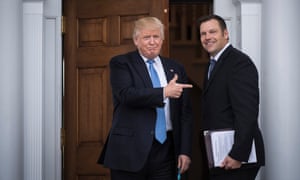
Donald Trump and Kris Kobach at the Trump National Golf Club in Bedminster, New Jersey.
Donald Trump and Kris Kobach at the Trump National Golf Club in Bedminster, New Jersey. Photograph: The Washington Post/Getty Images

The panel held a livestreamed session in July, but only just held its first fully public session last week. Kobach told reporters afterwards that the commission had received data from 20 states so far but was characteristically guarded, even coy, about what he intended to do with it. “[The commission] may make recommendations, or I think at this point there’s a high possibility the commission makes no recommendations and they just say, ‘Here’s the data. States, do with it what you want.’”

Still, voting rights experts and election lawyers are in little doubt what Kobach would like to do. He has made numerous public statements – including in a paid column he writes for Breitbart News – tantamount to a wish list. It includes:

  • A “proof of citizenship” requirement for voter registration, which was highly controversial and eventually struck down by the federal courts when Kobach tried it in Kansas ahead of the 2016 election.
  • An expansion of an interstate crosscheck system, despite evidence that it erroneously flags legitimate voters hundreds of times more often than it does actual fraudulent voters casting ballots in more than one state in the same election.
  • Comparing voter lists with a database of enrollees in a federal benefits programfor immigrants as a check against noncitizen voting, even though the database does not track citizenship.
  • A revision of the 1993 National Voter Registration Act (NVRA), which has repeatedly stood in the way of Kobach’s ambitions in the past.

Taken together, these measures would represent a significant assault on the right to vote and, to judge by Kobach’s record in Kansas, are likely to be tied up in court for years.

Especially frustrating to election managers – of both parties – and voting rights advocates is the fact that Kobach has asserted the existence of problems, like noncitizen voting, that are in fact passingly rare.

Justin Levitt, a former senior official in the DoJ’s civil rights division, now with the Loyola Law School in Los Angeles, said Kobach had in many cases picked up on legitimate issues and then twisted them to reach “a precooked but half-baked conclusion” about voter fraud on an epidemic scale.

“List maintenance is a little bit like surgery,” Levitt said in an interview. “When it’s done by people with skill and precision tools in a calm environment, it can be tremendously helpful, even life-saving. When it’s done sloppily by people who don’t know what they are doing on a shaky table in a hurry, it can be quite dangerous. What Kobach wants is surgery on a rickety table with a chainsaw.”

Kobach did not respond to an interview request from the Guardian.

To counter the mainstream studies dismissing many of Kobach’s assertions, his supporters have begun generating a research trail of their own. One rightwing thinktank called the Government Accountability Institute (cofounded by Steve Bannon with money from Robert and Rebekah Mercer) recently turned to data companies using questionable fuzzy matching to postulate the existence of more than 8,000 double voters in the 2016 election. (Only a handful of instances of actual double-voting have emerged, on a statistically insignificant scale.)

The study was then cited in an essay for the conservative National Review by Hans von Spakovsky, another member of the presidential commission and a longtime advocate of voter purge lists – including a notorious one he helped craft in Florida that was found by one county to be 95% inaccurate.
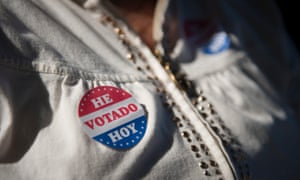
A voter wears her voting sticker outside a polling location for the 2016 US presidential election.
A voter wears her voting sticker outside a polling location for the 2016 US presidential election. Photograph: Tracie van Auken/EPA

In some instances, Kobach is pressing issues on which he has already fought and lost. Long before Donald Trump became president, he lobbied hard to use the Save database on immigrant benefits to police voter fraud. But his fellow secretaries discovered the organization’s records were not systematically updated and did not include any reliable mechanism to separate out individuals with the same name or to determine whether someone had obtained US citizenship.

“Within 10 minutes everyone on the call agreed it would not be a good idea,” said Denise Merrill, Connecticut’s elections chief and a past president of the National Association of Secretaries of State.

Kobach’s ambition to rewrite the NVRA was first revealed in closeups of a photograph of him carrying a briefing paper into a meeting with then president-elect Trump last December. The NVRA – often known as the Motor-Voter act because it enabled Americans to register to vote when renewing their driver’s licenses – sets strict rules for striking names off voter rolls.

That, however, has not stopped Indiana, the vice-president’s home state, from passing a law authorizing the removal of anyone flagged as a double-voter by the Crosscheck system without following the procedures laid out in the NVRA. That law is now being challenged in court.
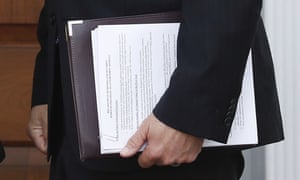
Prior to his meeting with Trump, Kris Kobach’s ‘Strategic Plan for First 365 Days’ was visible.
Prior to his meeting with Trump, Kris Kobach’s ‘Strategic Plan for First 365 Days’ was visible. Photograph: Carolyn Kaster/AP

Nor has it stopped Ohio from continuing to argue, despite a court injunction, that it should be allowed to initiate the removal process based on an individual’s failure to vote in two or more elections. The Obama-era justice department had previously opined that this violated the 1993 law. Now, under Trump, the DoJ has filed a new brief siding with Ohio – a maneuver that has shocked many election lawyers because they do not see any wiggle room in either the language or the law or the intent of the legislators who wrote it. The case is now headed to the supreme court.

It is far from clear how far Kobach will get with his agenda, especially given the scathing reception he has received so far. Earlier this month, an allegation that fraudulent out-of-state voters had swung both the presidential race and a close Senate race in New Hampshire last year prompted the Granite State’s entire congressional delegation to rise up in condemnation.

Still, it may have an impact on public opinion. Polls have consistently shown a majority of Americans believing what they hear from Republican politicians about voter fraud. That, in turn, has been used by Republican politicians as justification enough to push for new restrictive voting laws. In a prescient ruling issued more than a decade ago, the Missouri supreme court warned that “the tactic of shaping public misperception could be used in the future as a mechanism for further burdening the right to vote or other fundamental rights”.

Many observers point out that past presidential commissions on voting have been scrupulously bipartisan and recruited universally recognized experts in their fields. This one, by contrast, appears to be driven largely by one man on a mission to make what Rosenberg, the voting rights specialist, called “fallacious recommendations”.

Last week, an email obtained through a public records request showed that Spakovsky had originally opposed including “mainstream Republicans” or any Democrats at all, for fear that they would guarantee the commission’s “failure”.
That, in turn, suggests an issue of institutional abuse going against the 1972Federal Advisory Committee Act, over and above the concerns about voting integrity.

“There is no need for this commission to be looking into voter fraud,” said Rosenberg, whose group is suing the presidential commission over its work and its lack of transparency. “It should be trying to come up with ways to make it easier for people to vote, not harder for people to vote.”

Posted in GOP, Voter Fraud | Tagged , , | Comments Off on Trump’s ‘election integrity’ group is waging war on the right to vote

East Coast Republicans join Dems to lobby Trump against Atlantic oil exploration

McClatchyDC.com

SEPTEMBER 15, 2017 5:15 PM

Posted in Environment, EPA, GOP, Offshore Drilling, Trump | Comments Off on East Coast Republicans join Dems to lobby Trump against Atlantic oil exploration

The Seventeenth Amendment Is Under Attack By The Right

What is the 17th Amendment?

 The Seventeenth Amendment to the U.S. Constitution:

The Senate of the United States shall be composed of two Senators from each State, elected by the people thereof, for six years; and each Senator shall have one vote. The electors in each State shall have the qualifications requisite for electors of the most numerous branch of the State legislatures.

When vacancies happen in the representation of any State in the Senate, the executive authority of such State shall issue writs of election to fill such vacancies: Provided, That the legislature of any State may empower the executive thereof to make temporary appointments until the people fill the vacancies by election as the legislature may direct.

This amendment shall not be so construed as to affect the election or term of any Senator chosen before it becomes valid as part of the Constitution.

The 17th Amendment removed a firewall of privilege — which is why the Right doesn’t like it

But Does the Amendment  ‘Harm’ the States?

Just after the 2010 election, Justice Antonin Scalia decided to explain the parts of the Constitution he doesn’t like.

“The 17th Amendment has changed things enormously,” Scalia said. “We changed that in a burst of progressivism in 1913, and you can trace the decline of so-called states’ rights throughout the rest of the twentieth century.”

A sinister “burst of progressivism” is unconstitutional — and so, Andrew Napolitano of Fox News insists, is the 17th Amendment itself, because it was added “at the height of the progressive era, when the government started telling us how to live.”

Today, far-right dogma insists that popular election of senators marked the end of their mythical Great Republic. Former Sen. Zell Miller explained that “instead of senators who thoughtfully make up their own minds, as they did during the Senate’s greatest era of Clay, Webster and Calhoun, we now have many senators who are mere cat’s paws for the special interests.” George Will wrote in a 2009 column that “the Framers established election of senators by state legislators, under which system the nation got the Great Triumvirate — Henry Clay, Daniel Webster and John Calhoun — and thrived.”

Did the 17th Amendment in some way harm the states?  The answer depends on what you mean by state. If by “California,” say, you mean the people of California, the answer is clearly no. Senators are still elected by state, and still work hard to represent their states on Capitol Hill. Senators consult with governors and state governments and advocate for their interests on the floor. The state governments maintain effective lobbying presences in Washington, and, as a result, general federal statutes often include provisions exempting state governments from their provisions or permitting state governments a significant say in how federal programs are administered. But the legislators don’t call the shots: senators must closely attend to what their people want if they want re-election. And special interests spend freely to influence elections, but it’s harder to tip a hundred thousand votes than to buy a hundred politicians.

When the far right says the 17th Amendment harmed “the states,” they mean it harmed state governments. But the state governments are not “the state”; they are simply another institutional player in our complex federal scheme.  The “state,” properly considered, is the people of the state. Who is the best judge of the people’s interests — the state legislative majority or the people themselves?

Properly viewed, governments do not have “rights.” A right is a prerogative that an individual can exercise exactly as he wishes. When you exercise your right to free speech, you can say silly things, or smart ones, or you can just keep your mouth shut. You aren’t accountable to anyone for the decision.

How can a state government have “rights” in this sense?  Should state legislators have the “right” not to approve a budget because they don’t feel like it — or, for that matter, not to elect a Senator because it’s just not convenient this year? State governments, like the federal government, have powers, and they derive their just powers from the consent of the governed.  Appropriate state powers are actually protected by the Constitution, and by decisions of the Supreme Court. The federal government can offer incentives to state governments, but it cannot reach down and tell a state legislature what to do. Congress does not send representatives to vote in state legislatures; state governments should have no corresponding right to control Congress.

The popular clamor against the 17th Amendment is worth studying.  It shows that much of the “constitutionalism” being peddled to the people is highly selective, and much of the history that supports it, like Will’s fatuous yearning for the “Great Triumvirate,” is a pseudo-patriotic fable.

The real reason the Scalias, Millers, and Wills of this world favor repeal is simply this: a legislatively appointed Senate could be relied on to block progressive legislation. Left to themselves, those idiot people might have another “burst of progressivism.” Right-wing objections to senatorial election (like so much right-wing “constitutionalism”) are a disguised way of saying they want the Constitution to ensure their side never loses a vote.

To hell with that.

Posted in Congress, disenfranchisement, GOP | Tagged , , | Comments Off on The Seventeenth Amendment Is Under Attack By The Right

Your Coming Tax Increase

Your Coming Tax Increase

President Trump speaking about tax reform at an event in North Dakota on Wednesday. Credit Doug Mills/The New York Times

A 19th-century economist named Adolph Wagner made a prediction that came to be known as Wagner’s Law: As societies became wealthier, their taxes would rise. They would rise because people would want more of the services that government tended to provide better than the private market, like national security, education, medical care and a guaranteed retirement.

Wagner’s Law has proven truer than not, but there are still many people who would like to pretend otherwise. Specifically, they wish we could summon a country with a strong military, good schools, health care and comfortable retirements — but falling taxes. It’s a nice fantasy.

Yesterday, Larry Summers, the economist and former Treasury secretary, gave a lunchtime presentation in Washington laying out the statistics that debunk the falling-taxes fantasy. He effectively updated Wagner’s Law for the United States in 2017.

“With the same values and preferences, and the same basic attitude about government activity versus private activity,” Summers said, “you should expect government to be larger in the future than it has been in the past.”

There are four main reasons, he argued:

• One, society is aging, which calls for greater spending on retirees. The ratio of elderly Americans — those expected to be in the last 15 years of their lives — to all other Americans will rise about 50 percent from 2010 to 2030.

• Two, inequality has soared, with living standards stagnating for the middle class and poor. Taxes push back against inequality.

• Three, labor-intensive services, like education and medical care, have become more expensive, and they also tend to be the areas where the government spends money.

• Four, American military spending has not kept up recently with the spending by our main rivals, including China, Iran and Russia. This trend shouldn’t continue forever, Summers said.

I find his case compelling. Even if you disagree in one particular area — say, you favor more private-sector education, or a weaker military — the combined costs are so large that the argument holds up. That’s part of the reason that taxes on the wealthy should rise, and big tax breaks — like those for home ownership and employer health insurance — should be reduced.
I don’t mean to suggest that taxes should always be rising and that government will eventually take over the economy. Capitalism clearly has worked much better than any alternative. And there are times — for example, after a war or when a population is becoming younger — that taxes should fall. It’s also important to cut government where it’s wasteful.
But believing in capitalism is different from believing that government cannot grow. Modern capitalism depends on a well-functioning government. Capitalism has already grown a lot over the last century, across this country and much of the world, and the world is a vastly richer place than a century ago.
“If we want to maintain traditional American values,” as Summers said, “government will need to be significantly larger.”
For more details on the numbers, I recommend a new paper by Paul van de Water of the Center on Budget and Policy Priorities, which hosted Summers’s presentation. I first learned of Wagner’s Law from the writer Matt Miller.
In North Dakota yesterday, President Trump tried his best to summon a magical world in which life keeps getting better and taxes keep falling. His pitch “is divorced from reality,” Katrina vanden Heuvel says in The Washington Post. Richard Rubin of The Wall Street Journal called the speech a big step away from tax reform and toward a simple tax cut.
Remember: If Trump succeeds in cutting taxes for the wealthy, taxes for everyone else will eventually need to rise even more.
Posted in Tax Reform, Trump, Uncategorized | Tagged , , | Comments Off on Your Coming Tax Increase

Why do we have Employer-Sponsored Health Insurance?

04up-healthemployer-test-master768

At a community enrollment drive in the 1950s for Blue Cross and Blue Shield in Oklahoma, Ralph Rhoades, left, a manager who later became president of the plan, greeted a new member. Credit Courtesy of Blue Cross Blue Shield of Oklahoma

The basic structure of the American health care system, in which most people have private insurance through their jobs, might seem historically inevitable, consistent with the capitalistic, individualist ethos of the nation.

In truth, it was hardly preordained. In fact, the system is largely a result of one event, World War II, and the wage freezes and tax policy that emerged because of it. Unfortunately, what made sense then may not make as much right now.

Well into the 20th century, there just wasn’t much need for health insurance. There wasn’t much health care to buy. But as doctors and hospitals learned how to do more, there was real money to be made. In 1929, a bunch of hospitals in Texas joined up and formed an insurance plan called Blue Cross to help people buy their services. Doctors didn’t like the idea of hospitals being in charge, so some in California created their own plan in 1939, which they called Blue Shield. As the plans spread, many would purchase Blue Cross for hospital services, and Blue Shield for physician services, until they merged to form Blue Cross and Blue Shield in 1982.

Most insurance in the first half of the 20th century was bought privately, but few people wanted it. Things changed during World War II.

In 1942, with so many eligible workers diverted to military service, the nation was facing a severe labor shortage. Economists feared that businesses would keep raising salaries to compete for workers, and that inflation would spiral out of control as the country came out of the Depression. To prevent this, President Roosevelt signed Executive Order 9250, establishing the Office of Economic Stabilization.

This froze wages. Businesses were not allowed to raise pay to attract workers.

Businesses were smart, though, and instead they began to use benefits to compete. Specifically, to offer more, and more generous, health care insurance.

Then, in 1943, the Internal Revenue Service decided that employer-based health insurance should be exempt from taxation. This made it cheaper to get health insurance through a job than by other means.

After World War II, Europe was devastated. As countries began to regroup and decide how they might provide health care to their citizens, often government was the only entity capable of doing so, with businesses and economies in ruin. The United States was in a completely different situation. Its economy was booming, and industry was more than happy to provide health care.

This didn’t stop President Truman from considering and promoting a national health care system in 1945. This idea had a fair amount of public support, but business, in the form of the Chamber of Commerce, opposed it. So did the American Hospital Association and American Medical Association. Even many unions did, having spent so much political capital fighting for insurance benefits for their members. Confronted by such opposition from all sides, national health insurance failed — for not the first or last time.

In 1940, about 9 percent of Americans had some form of health insurance. By 1950, more than 50 percent did. By 1960, more than two-thirds did.

One effect of this system is job lock. People become dependent on their employment for their health insurance, and they are loath to leave their jobs, even when doing so might make their lives better. They are afraid that market exchange coverage might not be as good as what they have (and they’re most likely right). They’re afraid if they retire, Medicare won’t be as good (they’re right, too). They’re afraid that if the Affordable Care Act is repealed, they might not be able to find affordable insurance at all.

This system is expensive. The single largest tax expenditure in the United States is for employer-based health insurance. It’s even more than the mortgage interest deduction. In 2017, this exclusion cost the federal government about $260 billion in lost income and payroll taxes. This is significantly more than the cost of the Affordable Care Act each year.

Posted in ACA, AHCA, American Health Care Act, Health Care, New York Times, trumpcare, Uncategorized | Tagged , , , , , | 1 Comment

Zeldin and Cruz: Hurricane Hypocrites

September 8, 2017 3:27 PM
By Rita Ciolli, editor of the Editorial and Opinion pages of Newsday and amNewYork.
image

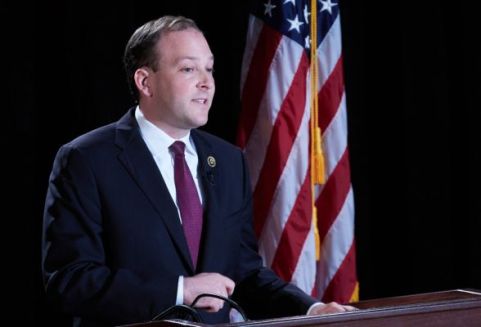
Rep. Lee Zeldin speaks at Suffolk Community College in Riverhead on Nov. 1, 2016. Photo Credit: Ed Betz

New Jersey Gov. Chris Christie is not letting Texas Sen. Ted Cruz forget that he voted against aid for those ravaged by superstorm Sandy, calling him a “hurricane hypocrite” now that he is asking for billions of dollars in disaster aid for Texas.
Rep. Peter King, the Seaford Republican, also has not let Cruz forget how he abandoned the New York region in its time of need, causing funding to be delayed for weeks.
“It was cruel, it was vicious, and something that I’ll never forget,” King said this week.
Republican Rep. Lee Zeldin won’t have to wait five years to have the hypocrite label slung at him. In a vote Friday morning, Zeldin — who represents the eastern end of Long Island, one of the most hurricane-vulnerable parts of the nation — was one of 90 House Republicans who voted against a $15.25 billion relief bill for victims of Hurricanes Harvey and Irma. Zeldin voted against the funding because it was tied to a three-month extension of the debt ceiling — part of a controversial deal to avoid a government shutdown. The deal, which President Donald Trump worked out with congressional Democrats, led fiscal conservatives like Zeldin into apoplexy. Zeldin later criticized “governing from crisis to crisis.”
While Zeldin remained pure in his ideology, the Democratic Congressional Campaign Committee saw a massive political blunder. It came out within minutes with an attack on Zeldin, hurling at him an interview he gave The Associated Press earlier this week. Referencing Sandy in 2012, Zeldin said, “People’s lives were hanging in the balance.” He pledged to help Texas, saying, “I am fully, completely committed to do whatever I can . . . to assist.”
Three days later, as Irma approaches Florida and Texas struggles to get back on its feet, Zeldin has followed Cruz into hypocrite hell.
Posted in Environment, Uncategorized, Zeldin | 1 Comment

Zeldin on the Shame List

2012:

Rep. Lee Zeldin, R-N.Y., was a state senator back in 2012 when Sandy hit.

“People’s lives were hanging in the balance,” he recalled, turning his attention to Texas. “I am fully, completely committed to do whatever I can … to assist.”

Zeldin added, “Regardless of whether you’re a fellow New Yorker or a Texan, we want to be as helpful as possible.”

2017:

As per Brad Johnson <info@climatehawksvote.com>: in the wake of tens of billions of dollars of damage from Hurricane Harvey, 107 members of Congress in the Senate and House—including 4 from Texas—voted “NO” on an aid package to help survivors in the Gulf and to keep FEMA funded.

Their excuse? They wanted to threaten a government shutdown. That’s right, these 107 #HarveyHeartless Republicans are so committed to cutting taxes for billionaire polluters and making the rest of America suffer that they’ll vote against disaster aid.


Here is the SHAME LIST:

The 17 GOP Senators who voted against Hurricane Harvey disaster relief:

Jeff Flake & John McCain of Arizona
James Risch of Idaho
Joni Ernst & Chuck Grassley of Iowa
Jerry Moran of Kansas
Rand Paul of Kentucky
Deb Fischer & Ben Sasse of Nebraska
James Lankford of Oklahoma
Pat Toomey of Pennsylvania
Lindsay Graham of South Carolina
Bob Corker of Tennessee
Mike Lee of Utah
Ron Johnson of Wisconsin
Michael Enzi of Wyoming

The 90 GOP Representatives who voted against Hurricane Harvey disaster relief:

Bradley Byrne (AL-01)
Martha Roby (AL-02)
Mo Brooks (AL-05)
Gary Palmer (AL-06)
French Hill (AR-02)
Bruce Westerman (AR-04)
Paul Gosar (AZ-04)
Andy Biggs (AZ-05)
David Schweikert (AZ-06)
Trent Franks (AZ-08)
Tom McClintock (CA-04)
Duncan Hunter (CA-50)
Scott Tipton (CO-03)
Ken Buck (CO-04)
Doug Lamborn (CO-05)
Matt Gaetz (FL-01)
Ted Yoho (FL-03)
Doug Collins (GA-09)
Jody Hice (GA-10)
Barry Loudermilk (GA-11)
Peter Roskam (IL-06)
Randy Hultgren (IL-14)
Darin LaHood (IL-18)
Jackie Walorski (IN-02)
Jim Banks (IN-03)
Todd Rokita (IN-04)
Luke Messer (IN-06)
Trey Hollingsworth (IN-09)
Lynn Jenkins (KS-02)
Kevin Yoder (KS-03)
Ron Estes (KS-04)
James Comer (KY-01)
Thomas Massie (KY-04)
Garland “Andy” Barr (KY-06)
Andy Harris (MD-01)
Bill Huizenga (MI-02)
Justin Amash (MI-03)
Tom Emmer (MN-06)
Ann Wagner (MO-02)
Blaine Luetkemeyer (MO-03)
Vicky Hartzler (MO-04)
Sam Graves (MO-06)
Billy Long (MO-07)
Jason Smith (MO-08)
Trent Kelly (MS-01)
George Holding (NC-02)
Virginia Foxx (NC-05)
Mark Walker (NC-06)
David Rouzer (NC-07)
Richard Hudson (NC-08)
Mark Meadows (NC-11)
Ted Budd (NC-13)
Don Bacon (NE-02)
Adrian Smith (NE-03)
Stevan “Steve” Pearce (NM-02)
Lee Zeldin (NY-01)
Brad Wenstrup (OH-02)
Jim Jordan (OH-04)
Warren Davidson (OH-08)
Michael Turner (OH-10)
James Renacci (OH-16)
Markwayne Mullin (OK-02)
Steve Russell (OK-05)
Scott Perry (PA-04)
Keith Rothfus (PA-12)
Marshall “Mark” Sanford (SC-01)
Jeff Duncan (SC-03)
Ralph Norman Jr. (SC-05)
Kristi Noem (SD-AL)
John “Jimmy” Duncan Jr. (TN-02)
Scott DesJarlais (TN-04)
Diane Black (TN-06)
Marsha Blackburn (TN-07)
David Kustoff (TN-08)
Sam Johnson (TX-03)
Jeb Hensarling (TX-05)
Joe Barton (TX-06)
Mac Thornberry (TX-13)
Chris Stewart (UT-02)
Robert Wittman (VA-01)
Bob Goodlatte (VA-06)
David “Dave” Brat (VA-07)
Morgan Griffith (VA-09)
Jaime Herrera Beutler (WA-03)
James Sensenbrenner Jr. (WI-05)
Sean Duffy (WI-07)
Mike Gallagher (WI-08)
Alex Mooney (WV-02)
Evan Jenkins (WV-03)
Liz Cheney (WY-AL)

If you want to write Lee Zeldin and give him a piece of your mind:  https://zeldin.house.gov/contact/email

Posted in Environment, Uncategorized, Zeldin | Tagged , , , , , | Comments Off on Zeldin on the Shame List

No one Above the Law, at Least in Israel

Sara Netanyahu Will Be Indicted For $100K Fraud Scheme


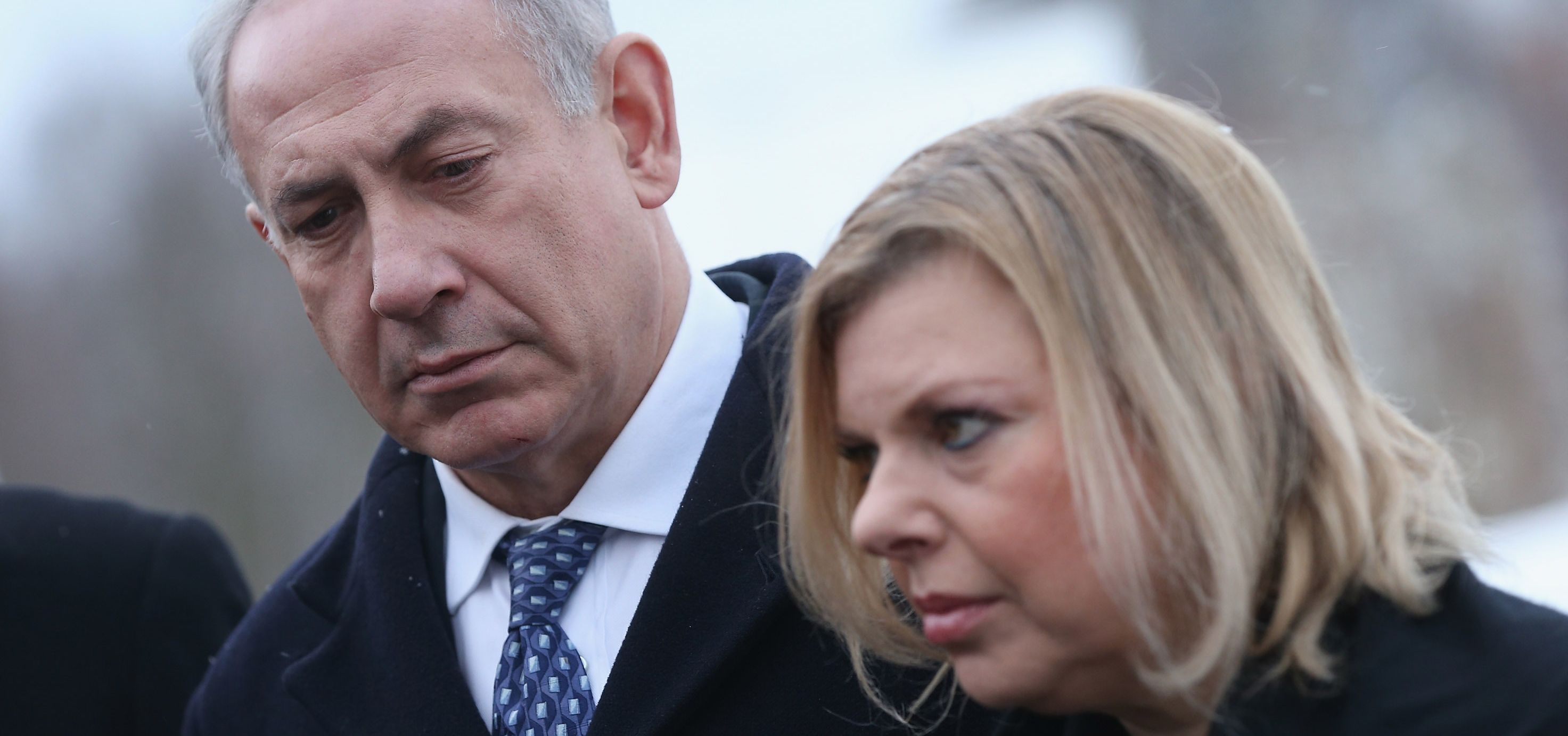
				Bibi and Sara Netanyahu.

The wife of Israeli Prime Minister Benjamin Netanyahu, Sara, will be indicted on four counts of fraud for allegedly diverting some $100,000 in public funds for her family’s personal use, Attorney General Avichai Mendelblit said.

Mendelblit gave Sara Netanyahu the news Friday, according to Army Radio.

“The attorney general examined the case evidence and reached the decision [to indict Sara Netanyahu] after consulting relevant sources, including the state prosecution and the Jerusalem District Prosecutor’s Office,” read a statement from the attorney general’s office Friday.

Benjamin Netanyahu’s office dismissed the indictment as “absurd and unfounded.”

“Sara Netanyahu is a brave and honest woman,” read a statement posted on his Facebook page. Any financial discrepancy at the Prime Minister’s Residence came from former housekeeper Menny Naftali, described in the statement as “problematic.”

The Netanyahus ended their statement Thursday by alleging that they were the target of an “obsessive” smear campaign.

The most serious of the four charges being brought against Sara Netanyahu involves the hiring of electrician Avi Fahima, a Likud Central Committee member. A committee charged with overseeing residence expenditures — and which included the Prime Minister’s Office legal adviser — ruled against the hiring of Fahima, but he was employed regardless.

Read more: http://forward.com/fast-forward/382172/sara-netanyahu-will-be-indicted-for-100k-fraud-scheme/


Does this sound familiar?


Posted in Courts, Ethics, GOP, israel, Russian connection, Trump, Uncategorized, Zeldin | Tagged , , , | Comments Off on No one Above the Law, at Least in Israel

DeVos to revamp Obama-era schools sexual assault policy

POLITICO 


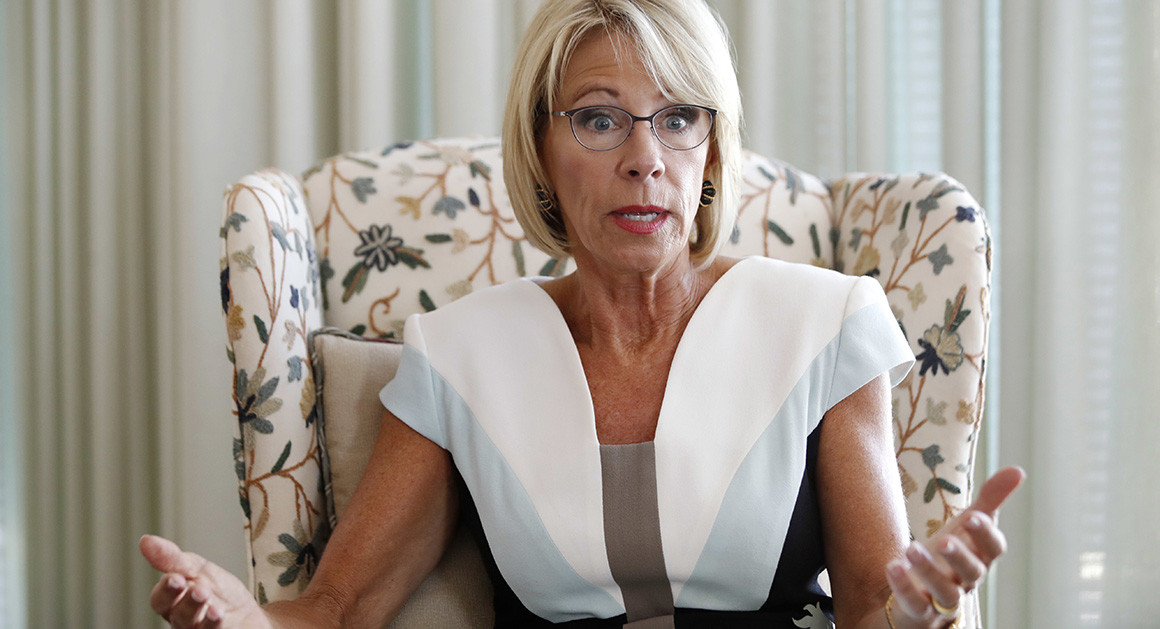
Education Secretary Betsy DeVos is pictured.
Education Secretary Betsy DeVos said the Trump administration will revamp the guidance through a rule-making process that likely will take months. | Jacquelyn Martin/AP

Education Secretary Betsy DeVos said Thursday that she will replace an Obama-era schools directive on sexual assault in an attempt to balance the rights of victims and the accused.

“The truth is that the system established by the prior administration has failed too many students,” she said during a half-hour speech at George Mason University, after which she took no questions. “Survivors, victims of a lack of due process and campus administrators have all told me that the current approach does a disservice to everyone involved.”

But the announcement drew howls of protest from womens’ groups and victims advocates, who said DeVos was making a false equivalence between victims and the accused.

“Schools are not getting it right sometimes — both for accused students and survivors,” said Neena Chaudhry, director of education at the National Women’s Law Center. “But the answer is not to change the law, but to help schools comply with it. Title IX already requires a fair process for both sides.”

The 2011 Obama guidance for the first time pushed school district, college and university leaders to combat sexual harassment, including sexual violence, saying the institutions were required to do so under Title IX, a federal law that prohibits sex discrimination. Women’s groups hailed that as a crucial step in cracking down on sexual violence on campuses. But critics said it trampled the rights of the accused.

The Trump administration will revamp the guidance through a rulemaking process that likely will take months, DeVos said during her speech, in which she blasted the guidance for having “weaponized the Office of Civil Rights to work against schools and against students.” She said the administration will give all sides a chance to offer opinions on how it should move forward.

“We will seek public feedback and combine institutional knowledge, professional expertise and the experiences of students to replace the current approach with a workable, effective and fair system,” DeVos said.

“This is not about letting institutions off the hook. They still have important work to do. ”

The far-reaching 2011 Obama-era guidance, issued in the form of a Dear Colleague Letter, was controversial from the start. It threatened a loss of funding to schools that failed to do enough to make students safe from sexual harassment, assault and rape. Critics said it pushed colleges to trample the rights of the accused. Among other things, the guidance pushed a lower standard of proof in campus disciplinary hearings than is used in criminal trials.

Many of those critics hailed DeVos’ announcement as “a really positive development.”

“I think it was a strong signal from the department that the current approach is unworkable and needs to be changed,” said Joe Cohn, legislative and policy director at the Foundation for Individual Rights in Education, a civil rights group that brought a court challenge to the 2011 guidance.

Chris Perry, deputy executive director of the group, Stop Abusive and Violent Environments, which represents people accused of sexual assault, said DeVos’ remarks show “the secretary is listening to folks.”

As an interim measure, the Education Department will issue temporary Title IX guidelines for school districts, colleges and universities as it works on a permanent replacement for Obama-era guidelines, agency spokeswoman Liz Hill said.

“The 2011 guidance will be replaced, and in the interim, the department will make clear to schools how to fulfill their current obligations under Title IX,” Hill said. “OCR (the Office for Civil Rights) will work directly with schools to provide support and technical assistance.”

Asked whether the department plans to rescind the 2011 letter before it writes a permanent policy, Hill said “we will not rescind the letter without interim guidelines in place for schools.”

The decision to launch a notice-and-comment process was long expected. DeVos said in July — after a series of meetings with sexual assault survivors, students accused of assault and college officials — that she would overhaul the policy. She told reporters at the time that “it’s clear that there are failings in this process. A system without due process protections ultimately serves no one in the end.”

Advocacy groups — including those representing both sexual assault survivors and students accused of assault — were not invited to attend Thursday’s announcement in person, despite meeting with DeVos on the subject in July.
Instead, DeVos delivered the announcement during a tightly controlled half-hour event at the university’s Arlington, Va., campus, sponsored by the university law school chapter of the Federalist Society, a conservative group. Shouts from protesters outside could be heard as she spoke.

Advocates for survivors of sexual assault said they felt they were given short shrift and noted that research has shown false claims of rape are rare. They said DeVos had indicated she would hold similar listening sessions in other parts of the country before making a decision.

Giving them just one meeting with the secretary “feels a little bit like paying lip service to the importance of having survivors in the room,” said Jess Davidson, managing director of End Rape on Campus.

“I think there’s been a really concerning false equivalence of the concerns of survivors and the accused throughout this entire process with the Department of Education,” Davidson said.

Sexual assault survivors rallied outside the university ahead of the announcement, urging DeVos to keep what they see as crucial protections in place.

“It’s really telling us that we don’t matter, that our pain is not relevant to people in power,” said Chessy Prout, 18. Prout said she was assaulted as a high school freshman and subsequently had to change schools.

Advocates slammed the speech afterward. “Don’t be duped by today’s announcement,” said Fatima Goss Graves, president and CEO of the National Women’s Law Center. “What seems procedural is a blunt attack on survivors of sexual assault. It will discourage schools from taking steps to comply with the law — just at the moment when they are finally working to get it right. And it sends a frightening message to all students: Your government does not have your back if your rights are violated. This misguided approach signals a green light to sweep sexual assault further under the rug.”

Complicating the issue for DeVos are comments made by her civil rights chief, Candice Jackson, who told The New York Times this summer that 90 percent of sexual assault claims stem from drunken and regretted sex. Another complication is President Donald Trump’s boast about groping women in the infamous “Access Hollywood” tape.

“Secretary DeVos decided today to continue a pattern of undermining survivors’ rights, once again showing a clear lack of understanding or empathy for the millions of students who have experienced sexual violence on campus,” Sen. Patty Murray, a Washington Democrat and ranking member of the Senate education committee, said in a statement.

But her announcement drew praise from at least one Republican lawmaker.

“The Department of Education is taking a positive first step in soliciting comments from stakeholders to get a better understanding of ways to better address the problem,” Oklahoma Sen. James Lankford said. “However, this is an issue where Congress must give the Department of Education clear statutory authority to properly regulate.”

Despite the administration’s plan to rewrite rules on Title IX, it’s unlikely that schools will immediately change policies that they spent the last six years writing — and sometimes rewriting — to remain in compliance with federal law.

“No school is going to go back to doing what they were doing before the 2011 guidance,” said Terry Hartle, senior vice president at the American Council on Education.

Posted in Discrimination, Education, Family Issues, Trump | Tagged , , , , | Comments Off on DeVos to revamp Obama-era schools sexual assault policy

Trump’s DACA decision could strip thousands in New York of Medicaid coverage

A DACA supporter is pictured. | Getty
When President Barack Obama created the DACA program in 2012, thousands of New Yorkers who were brought to the United States at a young age were suddenly eligible for Medicaid. | Alex Wong/Getty Images

The Trump administration’s decision to rescind the Deferred Action for Childhood Arrivals program could strip thousands of New Yorkers of their health insurance, a consequence unique to New York that could focus the debate in Albany when the Legislature returns in January.

Attorney General Jeff Sessions announced Tuesday that the Obama-era program, which granted legal status to approximately 800,000 children brought to the United States by their parents, would begin to unwind in six months.

That provides Congress a brief window to solve one of the nation’s most divisive issues. Should Congress fail, New York could face its own difficult choice: whether to continue providing Medicaid to the DACA population.

There are approximately 42,000 DACA recipients in New York. The vast majority are at risk for losing their job-based health insurance if they lose their legal right to work. The Department of Health could not say how many DACA recipients currently rely on Medicaid but estimates are between 5,000 and 10,000.

New York is one of the few states that provides health insurance to non-citizens, or people residing under the color of law (PRUCOL). That’s because of a 2001 Court of Appeals ruling that said denying Medicaid to any legal resident violated the equal protection clauses of the New York and U.S. constitutions. As a result, immigrants in New York who are not citizens, but are living in the state lawfully, are entitled to Medicaid.

When President Barack Obama created the DACA program in 2012, thousands of New Yorkers who were brought to the United States at a young age were suddenly eligible for Medicaid. It also allowed them to pay taxes.

Because the federal government does not recognize the state court’s decision, New York, which usually receives a 50 percent match for Medicaid expenses, pays the full cost for insuring these immigrants.

If they lose their DACA status and revert to being undocumented immigrants in the eyes of the law, they may also lose their right to Medicaid.

Elisabeth Benjamin, vice president of health initiatives for the Community Service Society and a co-founder of Health Care For All New York, said the status of these immigrants is unclear.

She pointed to Trump’s statement, which said these DACA recipients would not be a priority for Immigration and Customs Enforcement. That may mean they are still residing under the color of law because they are not under immediate threat of deportation.

It’s a bit of a legal stretch, but even if the law isn’t on her side, she said, Gov. Andrew Cuomo should continue to have the state Medicaid program cover DACA recipients.

“I would advocate they be covered under state-only Medicaid,” she said.

Will they?

“That’s the $64,000 question,” she said.

Cuomo’s office did not immediately say whether the state would extend coverage to DACA recipients who lost their protected status. The Department of Health did release a statement, saying Trump’s decision “not only displaces roughly 42,000 innocent New Yorkers whose young lives are intertwined in the very fabric of our communities, it jeopardizes access to affordable health care for hundreds of thousands of immigrants who call America home. New York State believes it has a legal and moral obligation to exhaust every available avenue to protect immigrants and their families by providing comprehensive access to health care, regardless of circumstance.”

Assemblyman Richard Gottfried, a Democrat from Manhattan and chair of the health committee, said the Assembly “will do whatever is necessary to fill gaps caused by federal action.”

“New York has for years provided health coverage for many undocumented immigrants using State-only dollars, including Child Health Plus coverage for children regardless of immigration status,” Gottfried said in an email. “We will not change this regardless of Federal policy.”

Presumably, this would mean helping to insure those who lose their employer-sponsored coverage and need Medicaid. In New York that would mean the state could potentially fund Medicaid for all 42,000 DACA-status immigrants.

Rep. Tom Reed, a Republican from western New York, said Trump was “very wise” to recognize that DACA is not something that can be done by executive order.

“That which is done by the pen can be undone by the pen,” said Reed, who favors a legislative solution that protects children brought here by their parents.

But if that effort fails, Reed had reservations about the state picking up the Medicaid tab, given its already sizable Medicaid budget, which Reed called “mind boggling.”

The problem, he said, is how to draw the line. How can the state award Medicaid to some undocumented immigrants but not all? And if it is offered to all, then how can the state afford to cover them?

“From my perspective, if Albany wants to do that, I’ll defer to the state,” Reed said. “But they really should let folks know what they are doing in terms of expanding the program.”

While the state might have to cover more people, Benjamin drew a distinction between the DACA population and other undocumented immigrants. The DACA group, she said, has already made themselves known to ICE, further bolstering the argument the state could make that they are residing under color of law, while other undocumented immigrants are not.

“It is the state who decides who is PRUCOL and who is not,” she said.

Posted in DACA, Health Care, immigration/deportation, Medicaid, NYS legislature, Trump | Tagged , , | Comments Off on Trump’s DACA decision could strip thousands in New York of Medicaid coverage