
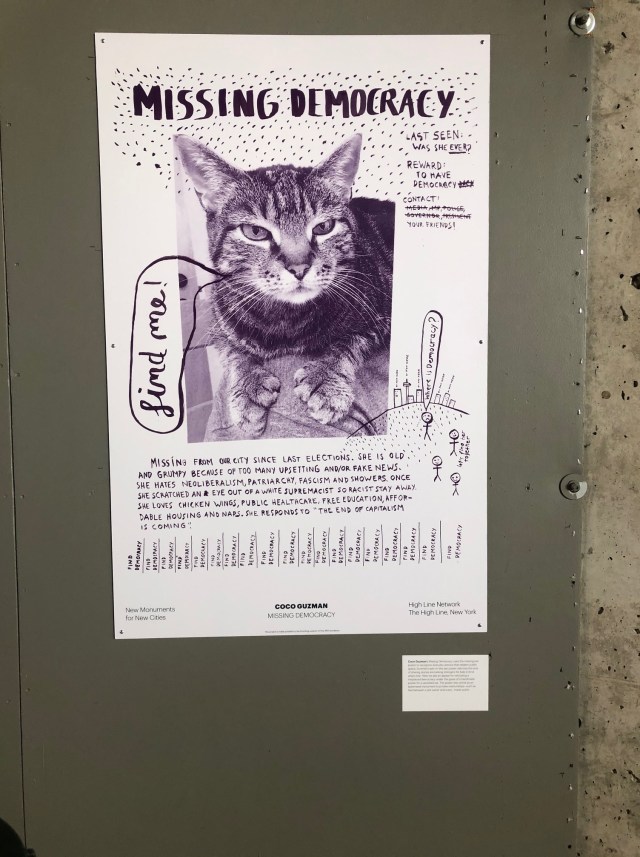
Found on a mural on the High Line (Chelsea, New York City)

FLORIDA – WISCONSIN – MICHIGAN – PENNSYLVANIA – ARIZONA
While the Democrats obsess over the primary, the GOP is focused on the Big Five states most likely to decide the 2020 general election: Wisconsin, Michigan, Pennsylvania, Florida, & Arizona.
We need to invest now in local groups in these Big Five states. They know how to organize their own communities. But they need our support – today, not next year.
Here is something you can do now: action button.
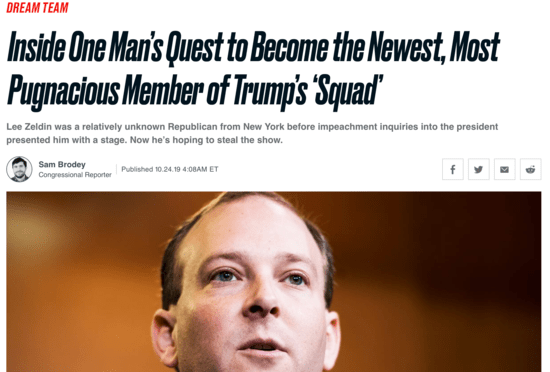
The Daily Beast: this is the Dems “golden opportunity” to beat Zeldin and calls Zeldin one of the Trump family’s “favorite congressmen,” a Trump “attack dog” “owned” by Freedom Caucus founder Representative Jim Jordan.
From The Daily Beast: “Democrats hoping to finally oust Zeldin realize that his political hopes will likely live or die on how impeachment plays. Perry Gershon, his 2018 Democratic opponent… is treating the impeachment push as a golden opportunity to argue that Zeldin is no longer in touch with his district.”
The Daily Beast is right – Lee Zeldin doesn’t care about repealing the SALT cap, bringing high-paying jobs to Long Island, or lowering prescription drug prices. He’s totally out of touch with our district.
The Daily Beast also notes Zeldin’s extremism compared to other Republicans, a key reason why we need to beat him in 2020: “The impeachment inquiry….has placed Republican members of Congress largely into two categories: those who are willing to concede discomfort with the president’s actions and those who are determined to show their loyalty and devotion. Few have embraced the latter mission more than Zeldin.”
We need to unseat an unhinged right-winger who has “gone off into crazy Trumpworld” and rally behind our campaign to make Long Island affordable, to achieve universal health coverage, and to protect our cherished water.
Perry Gershon
Rush $5 today to show Lee Zeldin we know he’s a willing enabler of Trump’s mob-rule presidency.
From ProPublica comes a shocking story. While things aren’t quite as bad where I live, I think the story is telling about what to expect in the future unless we somehow reform our healthcare system. (D. Posnett)

Ambulance > Judge > Jail
Welcome to Coffeyville, Kansas, where the judge has no law degree, debt collectors get a cut of the bail and Americans are watching their lives — and liberty — disappear in the pursuit of medical debt collection.
On the last Tuesday of July, Tres Biggs stepped into the courthouse in Coffeyville, Kansas, for medical debt collection day, a monthly ritual in this quiet city of 9,000, just over the Oklahoma border. He was one of 90 people who had been summoned, sued by the local hospital, or doctors, or an ambulance service over unpaid bills. Some wore eye patches and bandages; others limped to their seats by the wood-paneled walls. Biggs, who is 41, had to take a day off from work to be there. He knew from experience that if he didn’t show up, he could be put in jail.
…
Biggs, who is tall and broad-shouldered, with sun-scorched skin and bright hazel eyes, looked up as defendants talked, but he was embarrassed to say much. His court dates had begun after his son developed leukemia, and they’d picked up when his wife started having seizures. He, too, had been arrested because of medical debt. It had happened more than once.
Judge David Casement entered the courtroom, a black robe swaying over his cowboy boots and silversmithed belt buckle. He is a cattle rancher who was appointed a magistrate judge, though he’d never taken a course in law. Judges don’t need a law degree in Kansas, or many other states, to preside over cases like these. Casement asked the defendants to take an oath and confirmed that the newcomers confessed to their debt. A key purpose of the hearing, though, was for patients to face debt collectors. “They want to talk to you about trying to set up a payment plan, and after you talk with them, you are free to go,” he told the debtors. Then, he left the room.
The first collector of the day was also the most notorious: Michael Hassenplug, a private attorney representing doctors and ambulance services. Every three months, Hassenplug called the same nonpaying defendants to court to list what they earned and what they owned — to testify, quite often, to their poverty. It gave him a sense of his options: to set up a payment plan, to garnish wages or bank accounts, to put a lien on a property. It was called a “debtor’s exam.”
If a debtor missed an exam, the judge typically issued a citation of contempt, a charge for disobeying an order of the court, which in this case was to appear. If the debtor missed a hearing on contempt, Hassenplug would ask the judge for a bench warrant. As long as the defendant had been properly served, the judge’s answer was always yes. In practice, this system has made Hassenplug and other collectors the real arbiters of who gets arrested and who is shown mercy. If debtors can post bail, the judge almost always applies the money to the debt. Hassenplug, like any collector working on commission, gets a cut of the cash he brings in.
Across the country, thousands of people are jailed each year for failing to appear in court for unpaid bills, in arrangements set up much like this one. The practice spread in the wake of the recession as collectors found judges willing to use their broad powers of contempt to wield the threat of arrest. Judges have issued warrants for people who owe money to landlords and payday lenders, who never paid off furniture, or day care fees, or federal student loans. Some debtors who have been arrested owed as little as $28.
More than half of the debt in collections stems from medical care, which, unlike most other debt, is often taken on without a choice or an understanding of the costs. Since the Affordable Care Act of 2010, prices for medical services have ballooned; insurers have nearly tripled deductibles — the amount a person pays before their coverage kicks in — and raised premiums and copays, as well. As a result, tens of millions of people without adequate coverage are expected to pay larger portions of their rising bills.
The sickest patients are often the most indebted, and they’re not exempt from arrest. In Indiana, a cancer patient was hauled away from home in her pajamas in front of her three children; too weak to climb the stairs to the women’s area of the jail, she spent the night in a men’s mental health unit where an inmate smeared feces on the wall. In Utah, a man who had ignored orders to appear over an unpaid ambulance bill told friends he would rather die than go to jail; the day he was arrested, he snuck poison into the cell and ended his life.
In jurisdictions with lax laws and willing judges, jail is the logical endpoint of a system that has automated the steps from high bills to debt to court, and that has given collectors power that is often unchecked. I spent several weeks this summer in Coffeyville, reviewing court files, talking to dozens of patients and interviewing those who had sued them. Though the district does not track how many of these cases end in arrest, I found more than 30 warrants issued against medical debt defendants. At least 11 people were jailed in the past year alone.
With hardly any oversight, even by the presiding judge, collection attorneys have turned this courtroom into a government-sanctioned shakedown of the uninsured and underinsured, where the leverage is the debtors’ liberty.
Seated at the front of the courtroom, Hassenplug zipped open his leather binder and uncapped his fountain pen. He is stout, with a pinkish nose and a helmet of salt and pepper hair. His opening case this Tuesday involved 28-year-old Kenneth Maggard, who owed more than $2,000, including interest and court fees, for a 40-mile ambulance ride last year. Maggard had downed most of a bottle of Purple Power Industrial Strength Cleaner, along with some 3M Super Duty Rubbing Compound, “to end it all.” His sister had called 911.
Maggard took his seat. He had cropped red hair, pouchy cheeks and mud-caked sneakers. “The welfare patients are the most demanding, difficult patients on God’s earth,” Hassenplug told me, with Maggard listening, before launching into his interrogation: Are you working? No. Are you on disability? He was diagnosed with schizoaffective disorder, bipolar type, and anxiety. Do you have a car? No. Anyone owe you money you can collect? I wish.
They had been here before, and they both knew Maggard’s disability checks were protected from collections. Hassenplug set down his pen. “Between you and me,” he asked, “you’re never going to pay this bill, are you?”
“No, never,” Maggard said. “If I had the money, I’d pay it.”
Hassenplug replied, “Well, this will end when one of us dies.”
Though debt collection filings are soaring in parts of America, Hassenplug speaks with pride about how he discovered their full potential in Coffeyville long before. A transplant from Kansas City, he was a self-dubbed “four-star fuck-up” who worked his way through law school. He moved to Coffeyville to practice in 1980 and soon earned a reputation as a hard ass. He saw that his firm, Becker, Hildreth, Eastman & Gossard, hadn’t capitalized on its collections cases. The lawyers didn’t demand sufficient payments, and they rarely followed up on litigation, he said. Where other attorneys saw petty work, Hassenplug saw opportunity.
Hassenplug started collecting for doctors, dentists and veterinarians, but also banks and lumber yards and cities. He recognized that medical providers weren’t being compensated for their services, and he was maddened by a “welfare mentality,” as he called it, that allowed patients to dodge bills. “Their attitude a lot of times is, ‘I’m a single mom and … I’m disabled and,’ and the ‘and’ means ‘the rules don’t apply to me.’ I think the rules apply to everybody,” he told me.
He logged his cases in a computer to track them. First with the firm and later in his own practice, he took debtors to court, and he won nearly every time; in about 90% of cases nationally, collectors automatically win when defendants don’t appear or contest the case. Hassenplug didn’t need to accept $10 monthly payments; he could ask for more, or, in some cases, even garnish a quarter of a debtor’s wages. His fee was, and often still is, one-third of what he collects. He asked the court to summon defendants, over and over again. It was the judge’s contempt authority that backed him, he said. “It’s the only way you can get them into court.”
The power of contempt was originally the power of kings. Under early English rule, monarchs were considered vicars of God, and disobeying them was equivalent to committing a sin. Over time, that contempt authority spread to English courts, and ultimately to American courts, which use it to encourage compliance with the judicial system. There is no law requiring that a court use civil contempt when an order isn’t followed, but judges in the U.S. can choose to, whether it’s to force a defendant to pay child support, for example, or show up at a hearing. A person jailed for defying a court order is generally released when they comply.
When Casement took the bench in 1987, after passing a self-study exam, he didn’t know much legalese — he had never been in a courtroom. But attorneys taught him early on that the power of contempt was available to him to punish people who ignored his orders. At first, Casement could see himself in the defendants. “I was a much more pro-debtor aligned judge, much more sympathetic, much less inclined to do anything that I thought would burden them,” he told me. “And over the years, I’ve gradually moved to the other side of the fulcrum. I still consider myself very much in the middle, and I don’t know if I am or not.”
Once a bustling industrial hub, Coffeyville has a poverty rate that is double the national average, and its county ranks among the least healthy in Kansas. Its red-bricked downtown is lined with empty storefronts — former department stores, restaurants and shops. Its signature hotel is now used for low-income housing. “The two growth industries in Coffeyville,” Hassenplug likes to say, “are health care and funerals.”
Coffeyville Regional Medical Center is the only hospital within a 40-mile radius, and it reported $1.5 million in uncollectible patient debt in 2017. A nonprofit run in a city-owned building, the hospital accounts for the vast majority of medical debt lawsuits in the county — about 2,000 in the past five years. It also accounts for the majority of related warrants. Account Recovery Specialists Inc. handles its collections, and it does so for hospitals in most Kansas counties. Though the hospitals can direct ARSI and its contracted attorneys to tell judges not to issue warrants, hardly any have. The Coffeyville hospital’s attorney, Doug Bell, said that its only motivation is to continue to serve the area, and that Kansas’ decision to not expand Medicaid under the Affordable Care Act has had a “dramatic effect on the economic liability of small rural hospitals.”
Three nearby hospitals in this rural region have closed in the past several years, meaning ambulances make more trips. A half-hour from Coffeyville, Independence runs its ambulance service at about a $300,000 annual loss. Its bills were at the root of four arrests this year alone. Derek Dustman, who is 36 and works odd jobs, had been driving a four-wheeler when he was hit by a car and rushed to the hospital. Though he was sued for not paying his $818 ambulance bill, he didn’t have a license to drive to the courthouse. This spring, he spent two nights in jail. “I never in a million years thought that this would end with jail time,” he told me.
For years, Hassenplug has requested that the judge issue warrants on the ambulance service’s behalf. When I asked Lacey Lies, the city’s director of finance, if she ever considered telling him not to resort to bench warrants, she was puzzled. “You’re saying an attorney with no teeth?”
The first time Tres Biggs was arrested, in 2008, he was dove hunting in a grove outside Coffeyville. It had been just a year since his 6-year-old son Lane was diagnosed with leukemia, and Biggs watched him breathe in the fresh air, seated on a haybale under an orange sky. When a game warden came through to check hunting permits, Biggs’ friends scattered and hid. He wasn’t the running type, and he took Lane by the hand. The warden ran Biggs’ license. There was a warrant out for his arrest. Biggs asked a friend to take Lane home and crouched into the warden’s truck, scouring his memory for some misstep.
The last few years had been a blur. His wife, Heather, had quit her job as a babysitter to care for their son. Then, she got sick. Some days, she passed out or felt so dizzy she couldn’t leave her bed. Her doctors didn’t know if the attacks were linked to her heart condition, in which blood flowed backward through a valve. To provide for his wife, son and two other kids, Biggs worked two jobs, at a lumber yard and on construction sites. He didn’t know when he would have had time to commit a crime. He’d never been to jail. As he stared out the window at the rolling hills, his face began to sweat. He felt his skin tighten around him and wondered if he would be sick.
The warrant, he learned at the jailhouse, was for failure to appear in court for an unpaid hospital bill. Coffeyville Regional Medical Center had sued him in 2006 for $2,146, after one of Heather’s emergency visits; neither of his jobs offered health insurance. In the shuffle of 70-hour workweeks and Lane’s chemotherapy, he had missed two consecutive court dates. He was fingerprinted, photographed, made to strip and told to brace himself for a tub of delousing liquid. His bail was set at $500 cash; he had about $50 to his name.
His friend bailed him out the next morning, but at the bond hearing, the judge granted the $500, minus court fees, to the hospital. Biggs compensated his friend with a motorboat that a client had given him in exchange for a hunting dog. But it wasn’t long before the family received a new summons. In 2009, a radiologist represented by Hassenplug sued them for $380.
Some court hearings fell on days when Lane had treatment, at a hospital in Tulsa, an hour south. Heather refused to postpone his care. Lane’s condition was improving — in a year, he would be cancer-free — and his dirty blond hair was sprouting again. Her health, though, had taken a turn. She began having weekly seizures, waking up on the floor, confused about where their Christmas tree had gone or why a red Catahoula puppy was skidding around their ranch house. Her doctors concluded she had Lyme disease, which was affecting her nervous system and wiping her short-term memory. Each time she woke up, she repeated: “Don’t take me to the hospital.”
Biggs was still on the hook for the bill that had landed him in jail; bail had covered only part of it, and the rest was growing with 12% annual interest. The hospital had garnished his wages, and the radiologist had garnished his bank account, seizing contributions that his family had raised for Lane’s care. Living on $25,000 a year, Biggs couldn’t afford to buy insurance. His family was on food stamps but didn’t qualify for Medicaid, a federal insurance program for people in poverty. Other states were about to expand it to cover the working poor, but not Kansas, which limited it, for families of his size, to those who earned under $12,000. Like millions of others across America, he and Heather fell into a coverage gap.
By 2012, the Biggs family had accrued more than $70,000 in medical debt, which it owed to Coffeyville Regional Medical Center and other hospitals, pediatricians and neurologists. Some forgave it; others set up lenient payment plans. Coffeyville’s was the only hospital that sued. The doctors who took them to court were represented by Hassenplug.
Biggs began to panic around police, haunted by the fear that at any moment, he might be locked up. That spring, outside the Woodshed gas station, he spotted a sheriff’s deputy who was also an old friend. To shake off his dread, he asked the friend to run his license. The deputy found another warrant, signed by Casement, involving the $380 radiologist’s bill. “You’re not really going to take me in, right?” Biggs remembers asking. The deputy said he had no choice. Bail, as usual, was set at $500.
The family filed for bankruptcy, a short-term fix that erased their debt but burdened them with legal fees. They lost their home and started renting. Biggs ultimately got a job that offered insurance, as a rancher, covered by Blue Cross Blue Shield. But it required Biggs to pay the first $5,000 before it covered medical expenses. When chest pain hit him as he worked cattle in the heat, and he began vomiting, the only nearby hospital was Coffeyville’s. In 2017, the hospital sued again. It was the family’s sixth lawsuit for medical debt.
Sitting in Casement’s courtroom this July, Biggs calculated that he was losing about $120 by taking time off from work to attend this hearing. “I haven’t received a bill,” he told me, slouched over his turquoise shorts. “The only thing I received was this summons.” Around noon, he finally sat down with an ARSI representative, who explained that the underlying bill had been garnished from his wages, but he still owed $328 in interest and court fees. He had another couple thousand dollars in collections for separate bills he hadn’t paid, for which he hadn’t yet been sued. He said the most he could afford to pay, every two weeks, was $12.50.
Before the end of the Tuesday docket, Casement returned to the courtroom to read off the names of the hospital’s defendants. Five had failed to show up for contempt citations, to give their reasons for missing their debtor’s exams. Casement saw that two of the no-shows hadn’t been properly notified of the hearing, so attorneys would need to try to reach them again. The judge read the names of the other three defendants and told the hospital’s collections lawyer, “That would be a bench warrant if you want it.”
The following morning, I was reading court files in the clerks’ office when Christa Strickland arrived at 10:20 in flip-flops and black leggings, her caramel hair wrapped in a bun atop her head. She ran her finger down a docket on the bulletin board and asked why her case wasn’t listed. When the clerk pulled up her file, she told Strickland that her contempt hearing had been on Tuesday and she was one day late. “You need to call the law office of Amber Brehm,” the clerk insisted, referring to ARSI’s contracted lawyer, who represents the hospital. She handed over the phone number.
Strickland sat on a hard bench and took out her cellphone. She had saved the hearing in the wrong day on her calendar, but she had taken the day off from work and wanted to clear up the misunderstanding. “I had a court date,” she said when a man answered at the law office. “I thought it was today but apparently it was yesterday. I’m just needing to see if I can set something up?”
“By not appearing at that, the court would be in the process of issuing a bench warrant,” he said.
“What does that mean?” Strickland asked, shaking her head.
“You don’t know what a bench warrant means?” he asked. “That means you will be arrested and taken to jail and ordered to post bond.”
“Oh my God.” Strickland squeezed her eyes shut, wetness smudging her mascara. She poked at her cheek with her index finger. Her father was a preacher. She’d never been in trouble with the law. She had made a mistake, she tried to explain. She wanted to make an arrangement to pay.
The man on the phone told her that it might take a couple weeks before the court processed her warrant paperwork, which the law office had not yet submitted. Once the judge issued the warrant, she could turn herself in. Strickland wanted to scream, I’ll pay the bill, don’t make me go to jail! but she didn’t have the money. Instead, she looked at the ceiling and asked: “Turn myself into the court? The police station?”
“The Sheriff’s Department,” he responded.
“They’re here in the same building,” she said. “I won’t leave here until I get this figured out. Thank you!”
She hung up. Prick, she muttered to herself. You’re going to talk to me like I’m a freaking idiot? That’s not okay. Educate me. The court has to process it? Her mind kept moving in circles. She herself worked in debt collection, for an auto title lending company. She understood that everyone was doing their job. Still, she couldn’t grasp how this bill had gotten this far.
Before she had taken this position, during her second pregnancy, her right breast had developed a chronic infection. In 2008, she was uninsured, needed surgery to remove the swollen abscess and ran up a $2,514 bill. More than a decade later, she was still chipping away at a balance that, because of interest and court fees, had more than doubled to $5,736. She had fallen behind on her monthly payment plan and now worried that her booking photo would be on Mugshot Monday, a Facebook album run by the Police Department. She imagined what she would tell her boss: I went to jail … because I missed a court date … for medical bills. It sounded absurd.
She spotted a sheriff’s deputy in a bulletproof vest with a name tag that said Bishop and a pistol on his hip. “Hey!” she called out, explaining her phone call and how the man said something about a warrant and turning herself in. Bishop radioed into dispatch and smiled with an update: “There’s no warrant in the system yet,” he told her.
“Yet!” Strickland replied, deflating his look of reassurance. “That’s what I’m worrying about.”
“You better give Amber a call back,” Bishop said.
When I asked ARSI about how attorneys decide to request warrants, Joshua Shea, who is general counsel, told me that they don’t. The judge can choose to issue one if court orders are not followed, he said. But Casement said the opposite, telling me that he gave the choice to the attorneys. “I’m not ordering a bench warrant. My decision is to give them that option,” Casement told me. “Whether they exercise it is up to them, but they have my blessing if that’s what they want to do.”
Shea sent me an eight-page email to make clear, in large part, that ARSI, as a collection agency, has no involvement in the courts, and that Brehm is a lawyer whom the agency contractually employs and who represents the hospital directly. Her email address, though, has an ARSI domain, and her resume lists her as ARSI’s director of legal. Brehm said that court hearings aren’t the only option for debtors, who can call her instead and answer questions under oath. Shea said nobody — not the hospital, ARSI, Brehm or the court — uses the threat of jail to “extract payment.”
Strickland reached Brehm after several days, and the attorney agreed to a new hearing. On Aug. 13, when they met in court, Brehm sat at the front of the room.
“We’re giving you a second chance on that citation; just to try to take care of this without there having to be any sort of bench warrant,” the lawyer said. “I want to make sure that we’re all on the same page about the consequences of not coming into court when the order has been issued.”
Strickland nodded.
“Again, if you set a payment plan and keep it,” Brehm said, “we won’t have to worry about that.”
In some courthouses, like Coffeyville’s, collection attorneys are not only invited to decide when warrants are issued, but they can also shape how law is applied. Recently, Hassenplug came to believe that debtors were only attending every other hearing in a scheme to avoid jail, and he raised his concern with the judge. He suggested that the judge could fix this by charging extra legal fees; Casement wrote a new policy explaining that anyone who missed two debtor’s exam hearings without a good reason would be ordered to pay an extra $50 to cover the plaintiff’s attorney fees. If they didn’t pay, they would be given a two-day jail sentence; for each additional hearing that they missed, they would be charged a higher attorney fee and get a longer sentence.
Most states don’t allow contempt charges to be used for nonpayment, and some, like Indiana and Florida, have concluded that it is unconstitutional. Michael Crowell, a retired law professor at the University of North Carolina and an expert in judicial authority, reviewed Casement’s policy. “You can’t lock people up for contempt for failing to pay unless you have gone to the trouble to determine that they really have the ability to pay,” he said. Casement told me he hadn’t made findings on ability to pay before ordering defendants to foot attorney’s fees, “but I know that’s something the court should consider,” he said. He also made plain why he wrote the policy: “Mr. Hassenplug and Brehm’s outfit have asked me to.” (Brehm denied she requested this.)
Casement has not done everything the debt collection lawyers have suggested. At first, he agreed to their requests to set bail at the amount of the debt, but he eventually settled on $500. “Most people can come up with $500,” he said. “It may not be their money, but they know someone who will pay.” He made sure no one was arrested unless they’d been reached by personal service or certified mail.
Kansas law allows courts to order debtors in “from time to time,” leaving discretion to judges. Casement limited the frequency of Hassenplug’s debtor’s exams to once every three months. He came to the decision by his own logic around what seemed like a reasonable burden for defendants, and it remains his personal policy today. The law also states that anyone found to be disabled and unable to pay can only be ordered to appear once a year. Without an attorney, debtors like Kenneth Maggard don’t know to assert this right.
Allowing bail money to count toward collections raises some of the most critical legal questions. Hassenplug told me that he thinks it’s great that cash bail is applied to the debt. “A lot of times, that’s the only time we get paid, is if they go to jail,” he said. Peter Holland, the former director of the Consumer Protection Clinic at the University of Maryland Law School, explained that this practice reveals that the jailing is not about contempt, but about collection. “Most judges will tell you, ‘I’m working for the rule of law, and if you don’t show up and you were summoned, there have to be consequences,’” he explained. “But the proof is in the pudding: If the judge is upholding the rule of law, he would give the bail money back to you when you appear in court. Instead, he is using his power to take money from you and hand it to the debt collector. It raises constitutional questions.”
Congress has not acted on advocates’ calls to amend the Fair Debt Collection Practices Act to prohibit collectors from requesting warrants. There are also no current efforts to bar nonprofit hospitals or medical providers that receive funds through Medicare or Medicaid from seeking warrants. Some states have reformed their laws, to make sure defendants are properly served or to prohibit wage garnishments for debt. But legal experts on collections say that more remains to be done, like taking jail out of the equation and instead requiring debtors to sign a financial affidavit or a promise to appear.
Shea, from ARSI, said that using the legal process is time-consuming and costly — a last resort; arrests are “the least desirable stage for any case to reach for all involved.” Even after lawsuits are filed, they try to connect eligible debtors with the Coffeyville hospital to apply for financial assistance, he said. Last year, the hospital wrote off $1.7 million in charity care, said Bell, the hospital lawyer. “That is evidence of a hospital that cares.”
Casement said he did not consider the legality of his policies a problem. He placed some blame on the health care system. “What we have isn’t working,” he said. “As a lifelong Republican, I would probably be hung, but I think we need health care for everybody with some limits on what it’s going to cost us.”
The way he saw it, he had wide latitude to enforce compliance with a court order, though he acknowledged that creditors used bail money to their advantage. “I don’t know whether the Legislature intended it to be used that way or not,” he told me. “I have not had enough pushback from the defendants’ side to give me the impression that I’m really abusing this badly.”
Before I left Coffeyville, I sat down with Hassenplug in the low-ceilinged courtroom. I asked him whether he thought that the system in Coffeyville was effectively imprisonment for debt, in a country that has outlawed debtors’ prisons. “The only thing they’re in jail for is not appearing,” he replied. “I do my job, I follow the law. You just have to show up in court.”
Debt collection is an $11 billion industry, involving nearly 8,000 firms across the country. Medical debt makes up almost half of what’s collected each year. Today, millions of debt collection suits are overwhelming state courts. The practice is considered a “race of the diligent,” where every creditor is rushing to the courthouse, hustling to get the first judgment, in order to be the first to collect on a debtor’s assets. In Hassenplug’s view, though, this work is not the rich taking from the poor. He laughed at how locals spread rumors, saying that he seized wheelchairs or Christmas trees. Once, he confessed, he took a man’s Rolex, only to find out it was a fake. Some months, he said, even his law office could not make ends meet.
After a couple of hours, a clerk poked her head into the courtroom and told us it was time to leave. Hassenplug and I began to walk out, and on the terrazzo steps, he asked if I wanted to see his buildings. He owned five of them on a shuttered stretch of town. He wondered out loud if he was making a mistake by inviting me, but he was pleased when I accepted. “There ain’t any place on earth quieter than downtown Coffeyville,” he said, leading me into the silent streets.
He walked me through the alleys under a cloudless sky, and when he arrived at one of his buildings, he tapped a code to his garage. The door lifted, and inside, five perfectly maintained motorcycles, Yamahas and Suzukis, were propped in a line. To their left, nine pristine, candy-colored cars were arranged – a Camaro SS with orange stripes, a Pontiac Trans Am, a vintage Silverado pickup with velvet seats. He toured me around the show cars, peering into their windows, and mused about what his hard work had gotten him.
Doris Burke contributed research.
Correction, Oct. 16, 2019: This story originally misstated the type of cancer Tres Biggs’ son, Lane, had. It was leukemia, not lymphoma.
ProPublica is a nonprofit newsroom that investigates abuses of power. Sign up for ProPublica’s Big Story newsletter to receive stories like this one in your inbox as soon as they are published.
The emphases are mine (D. Posnett)


On November 5th, Virginians go to the polls to vote for their state representatives. After an historic flip of 15 House of Delegate seats in 2017, Democrats are within 2 seats of taking back control of both the state house and the state senate for the first time since Republicans gerrymandered the state in 2011. Because the census and redistricting will occur in 2020 and 2021, and because in May 2019 the Supreme Court ruled 5-4 that partisan gerrymandering is legal, the survival of our Democracy depends on Democrats flipping as many state houses as possible between now and November 2020. The People PAC, run by local Long Island activist and Resist and Replace member, Mara Gerstein, is running data-driven, targeted digital advertising in 3 of the closest races in the state: Phil Hernandez in HD 100, Lindsey Dougherty in HD 62, and Karen Mallard in HD 84. Because this is an “off off” year election (with no races at the top of the ticket) more than ever, these races will come down to turn out. The People PAC is laser focused on reaching Democratic leaning voters who are at-risk of not voting. Please give what you can to support their efforts and do your part to help FLIP VIRGINIA BLUE!
Donate here: https://secure.actblue.com/donate/virginia19
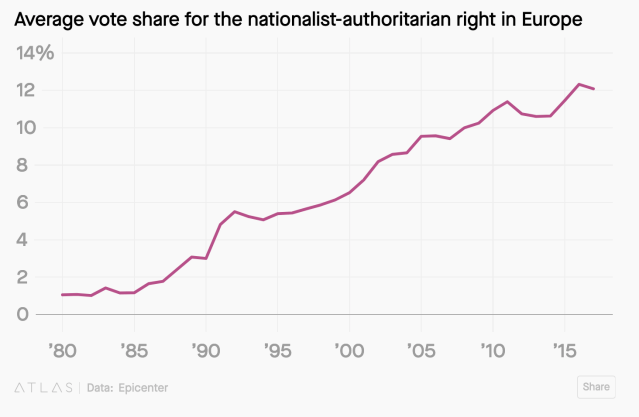
Across the globe there has been a sweep by nationalistic, right-wing and even far-right movements large enough to win elections, and form governments: Jair Bolsonaro in Brasil, Viktor Orbán in Hungary, Matteo Salvini in Italy, Andrzej Duda in Poland, Erdogan in Turkey, Boris Johnson (the Brexiteer) in the UK, Donald Trump in the USA, etc.
As of 2017 the rise in the percentage of voters supporting these authoritarians seemed inexorable: https://qz.com/1027518/populist-authoritarian-leaders-are-still-on-the-rise-across-europe/
I have Swiss roots. So I am naturally interested in electoral results from ‘back home’. Switzerland also has its xenophobic nationalistic party: the Swiss People’s Party (Volks Partei; SVP). Under Christophe Blocher the party gained popularity and now has 65/200 seats in the national council and is the largest party.
However, election results from this week indicate a major change:
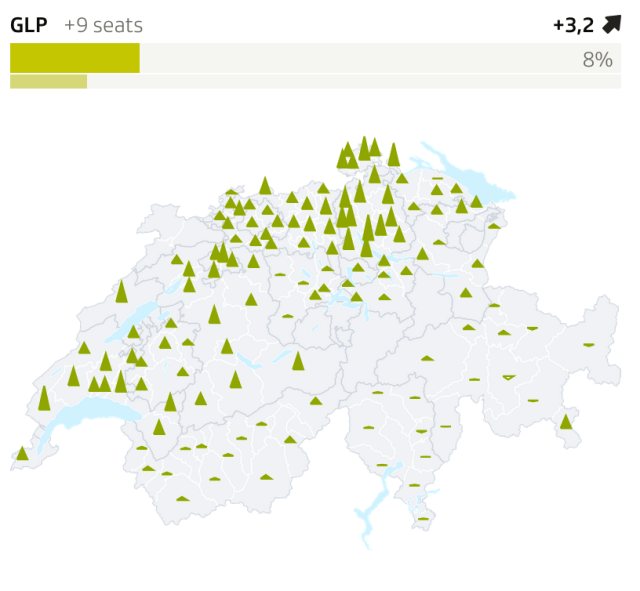
The historic gains made by the left-wing Greens exceeded expectations, turning the 2019 elections into a bellwether moment on climate change and environmental issues. The Greens gained 17 seats, overtaking the Christian Democrats, to become the fourth-largest party in parliament. This was the largest leap by a political party in Swiss politics since 1919. The centrist Liberal Greens gained nine seats. https://www.swissinfo.ch/eng/switzerland-election–2019-results-maps/45312474
I clearly needed a primer on the many Swiss political parties:
SP: is the Socialist Party or Social Democrats. (They lost)
The Greens: self-explanatory. (Gained big time)
GLP: Green liberal party, a split-off, more centrist than the Greens. (Gained)
CVP: Christian Democratic People’s Party. (Share of vote remains stable)
FDP: Radical Liberals, right of center, bourgeois party, a traditionalist. (They lost)
SVP: is the right-wing Swiss Volks Partei. (They lost big)
Here are some maps. The arrowheads pointing down represent a loss of votes. Those pointing up represent votes gained.


Is this the first election result from Europe showing a major left-ward shift and green shift? Possibly suggesting that voters are turning away from the far-right, populist and authoritarian politicians? As such it merits widespread attention.
Both Boris Johnson and Donald Trump are currently dealing with push back. And Greta Thunberg seems to be on fire. I wonder whether there is a theme here.
As reported by John Hooker in Switzerland:
The recent federal elections held in Switzerland last Sunday show that the Swiss are on the move! The average age of the elected officials is 49 and the representation by women has increased to 42%. And the young are demonstrating in the streets to demand that environmental studies be mandatory in all universities…!

From the East Hampton Star
October 13, 2019
Dear David:
For the first time in history, New Yorkers have a choice on when to vote. There are now nine days of early voting, from Oct. 26 through Nov. 3. They can also vote on Election Day, Nov. 5.
Early voting for East Hampton Town is in only one place:
It is handicapped accessible and parking is available. The voting hours vary so please check the times for the day on which you vote:
Now, East Hampton voters have 10 days to choose from to exercise their constitutional right to vote.All of this information is available online at suffolkcountyny.gov.
JERRY MULLIGAN
I should add the following excellent editorial also from the Star, in regard to the significance of early voting in East Hampton:
New York likes to think it is first in almost everything, but in adopting an early voting procedure, it ranks 38th among the states. Better late than never, as the cliché goes; however, early voting will be allowed this year for the first time.
This is an important step in improving the voter experience, but unfortunately it is not likely to boost the state’s dismal turnout. In Suffolk County, early voting will be held in a single location in each of the 10 towns for a week beginning on Oct. 26, with the polls open until 8 p.m. on Oct. 29 and Nov. 1. In East Hampton, the sole voting site is the Windmill Village Apartments on Accabonac Road. Southampton early vote polling will be in the gym at Stony Brook Southampton University.
A single place over seven days for all the town’s voters might seem stingy, but it is a start. Consider as well that staffing each polling place presents a challenge for the Suffolk County Board of Elections, which traditionally has focused on a massive, single-day mobilization and absentee ballot processing.
Logistical challenges aside, early voting is not expected to boost turnout nor shift expected election outcomes. Organizations that have looked into the relationship between so-called convenience voting and voters’ behavior have for the most part found that the option changed where and when people cast their ballots but had little effect on whether they vote or not. One clear benefit is shortening lines on Election Day, though that has never been much of an issue in most East End districts, given the generally paltry turnout.
What early voting can do is give local political parties more time to get their committed voters to the polls, rewarding candidates and committees with strong ground games. For a town with many seasonal and second-home owners like East Hampton, early voting will give weekenders a new way to be counted. Absentee ballots, until now the only option besides showing up on Election Day, can sometimes be problematic if there are even subtle discrepancies in the way signatures and addresses appear or if the ballots arrive too late to be counted. Early voting is a good way to make sure each voter matters.
But there is more to be done. New York ranks an embarrassing eighth from the bottom in voter turnout, even in presidential years. The next step in improving public participation in elections is same-day registration, that is, allowing people to vote the day they become eligible. Already, 21 states plus the District of Columbia allow this in some form or another, and in many places it has boosted turnout significantly.
In New York State, registration for the Nov. 5 election closed yesterday, about the time most people even begin thinking about politics. What is interesting is that same-day registration does not generally benefit any particular political party over another, but turnout can rise by 3 to 7 percent.
Thank you, New York, for early voting. Now, how about same-day registration?

I just saw a documentary on a Syrian underground hospital: The Cave. It should be compulsory viewing for everyone. INCLUDING Rep. Lee Zeldin. He too lived thru a period where his premature born twin girls where in the NICU. Might he identify with the story of a 30 year old pediatrician running an underground hospital in northern Syria under horrendous conditions and constant bombardment? I have spoken with Lee Zeldin, and he is aware of how lucky his family was.
Here is a review of The CAVE: https://www.thewrap.com/the-cave-film-review-syrian-documentary-goes-underground-to-find-a-new-face-of-tragedy/
And here is the trailer: https://www.firstshowing.net/2019/official-trailer-for-the-cave-doc-film-about-a-hidden-syrian-hospital/
If you have any doubt about the culprits, read more in the NY Times (Oct. 13). There is an 8 min video attached to the article and it contains ample proof of Russian planes specifically targeting hospitals. https://www.nytimes.com/2019/10/13/world/middleeast/russia-bombing-syrian-hospitals.html
In my book this is a crime against humanity. It should be prosecuted at The Hague. And the prime suspects/culprits are Syrian President Assad and Russian President Putin.
This all is relevant to our most recent national disaster in foreign policy: inviting Turkey to invade parts of northern Syria, where our previous allies, the Kurds, live. The bombs have started falling as reported today. The players are likely to have blood on their hands. Erdogan? Donald Trump? And Lee Zeldin ? He habitually supports Trump, irrespective of common sense.
|
Letter published in The Boston Globe
|

Lawmakers must hold a lawless president accountable.
In “GOP needs a soul cleansing” (Boston Globe, Ideas, Oct. 6), Michael A. Cohen expressed a basic solution to our problem. Lawmakers in the Senate must hold a lawless president accountable. America aspires to lofty goals that provide security and possibility. Somehow the negativity of “American carnage” has permeated the country’s spirit. Donald Trump claims that he alone can fix it. He has spent his time destroying our civility and trampling on the Constitution, but fortunately there is a solution, and it lies with Republican senators.
I was told many years ago by a US senator that he wanted to become a senator because it was the world’s most exclusive club. The membership should include having a backbone and not becoming a moral pygmy.
The civic lessons we learned in grammar school should be obvious to every legislator. The law requires that the Trump administration ends. The Founding Fathers saw him coming and provided a clear process to derail this runaway train.
It’s time to act in the name of justice. I studied hard to pass the bar exam. What was the point if our nation’s lawmakers ignore the high crimes and misdemeanors that are right in front of them?
Steven A. Ludsin, East Hampton, N.Y.