COVID-19 disease modelling

Excellent article in the NY Times:

Projections based on C.D.C. scenarios show a potentially vast toll. But those numbers don’t account for interventions now underway.

One of the CDC’s top disease modelers, Matthew Biggerstaff, presented four possible scenarios — A, B, C and D — based on characteristics of the virus, including estimates of how transmissible it is and the severity of the illness it can cause….  Highlights:
  • Between 160 million and 214 million people in the United States could be infected over the course of the epidemic, according to one projection….
  • The pandemic could last months or even over a year, …
  • As many as 200,000 to 1.7 million people could die worldwide…
  • 2.4 million to 21 million people in the United States could require hospitalization, potentially crushing the nation’s medical system, which has only about 925,000 staffed hospital beds. Fewer than a tenth of those are for people who are critically ill…
  • Studies of previous epidemics have shown that the longer officials waited to encourage people to distance and protect themselves, the less useful those measures were in saving lives and preventing infections.
  • Even severe flu seasons stress the nation’s hospitals to the point of setting up tents in parking lots and keeping people for days in emergency rooms. Coronavirus is likely to cause five to 10 times that burden of disease…
  • A preliminary study released on Wednesday by the Institute for Disease Modeling projected that in the Seattle area, enhancing social distancing — limiting contact with groups of people — by 75 percent could reduce deaths caused by infections acquired in the next month from 400 to 30 in the region.
  • A recent paper, cited by Dr. Fauci at a news briefing on Tuesday, concludes that the rapid and aggressive quarantine and social distancing measures applied by China in cities outside of the outbreak’s epicenter achieved success. “Most countries only attempt social distancing and hygiene interventions when widespread transmission is apparent. This gives the virus many weeks to spread,” …
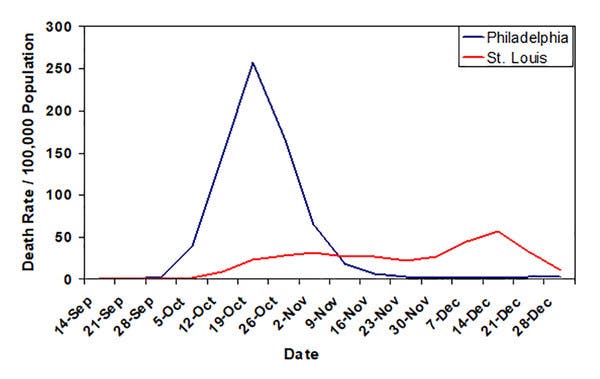
  • During the Spanish Flu pandemic a century ago, comparing the experiences of various cities, including what were then America’s third- and fourth-largest, Philadelphia and St Louis. In October of that year Dr. Rupert Blue, America’s surgeon general, urged local authorities to “close all public gathering places if their community is threatened with the epidemic,” such as schools, churches, and theaters. “There is no way to put a nationwide closing order into effect,” he wrote, “as this is a matter which is up to the individual communities.”  The mayor of St. Louis quickly took that advice, closing for several weeks “theaters, moving picture shows, schools, pool and billiard halls, Sunday schools, cabarets, lodges, societies, public funerals, open-air meetings, dance halls and conventions until further notice.” The death rate rose, but stayed relatively flat over that autumn.

By contrast, Philadelphia took none of those measures; the epidemic there had started before Dr. Blue’s warning. Its death rate skyrocketed.

Posted in Coronavirus, Health Care, Uncategorized | Tagged , | Comments Off on COVID-19 disease modelling

Still no COVID testing available?

A researcher at Hackensack Meridian Health Center for Discovery and Innovation in New Jersey works on developing testing for the novel coronavirus. (Kena Betancur/AFP/Getty Images)
March 12, 2020 at 6:24 p.m. EDT

Many Americans who are sick and seeking a coronavirus test continue to be turned away, creating a vexing problem for patients and health officials as the virus spreads. The problem persists, doctors and patients across the country say, despite increased production and distribution of the tests in recent days.

At a time when U.S. fatalities from the virus have risen, there remain limited numbers of tests and the capacity of laboratories is under strain.

The constraints are squeezing out patients who don’t meet rigid government eligibility criteria, even if their doctors want them tested, according to dozens of interviews with doctors and patients this week.

The gap between real-life obstacles to testing and President Trump’s sweeping assurances that “anybody that needs a test gets a test” has sown frustration, uncertainty and anxiety among patients who have symptoms consistent with covid-19, the disease caused by the virus, but have been unable to find out whether they are infected.

“It’s really been unbelievably infuriating,” said Remy Coeytaux, a North Carolina physician with a doctorate in epidemiology who tried to get tested for covid-19 but was turned down by the state public health department. He had not traveled abroad, was not sick enough to be hospitalized and had no known contact with an infected person.

At the time Coeytaux tried to get tested, there was only one confirmed case of covid-19 in the state. “It’s out there,” he said. “But we just haven’t been testing.”

The federal government’s handling of testing erupted as a political issue Thursday, with even members of the president’s party venting about not being able to get answers on when the nation would see more commercial tests, faster testing and more widely available tests.

Sen. James Lankford (R-Okla.) acknowledged that Trump’s recent statement about tests for anyone who wants them is “not consistent right now” with what is actually happening.

A U.S. Centers for Disease Control and Prevention laboratory test kit for the coronavirus. (CDC/AP)

As of Thursday evening, more than 1,600 people were infected in the United States, and more than 40 had died, according to researchers at Johns Hopkins University.

Since mid-January, the Centers for Disease Control and Prevention and other public health laboratories have tested about 11,000 specimens for the disease. The number of people who have been tested is likely far lower than that tally, however, because labs usually test at least two specimens per person, experts said. In contrast, South Korea has been running 10,000 tests per day.

“The system is not really geared to what we need right now, to what you are asking for. That is a failing,” Anthony S. Fauci, director of the National Institute of Allergy and Infectious Diseases and a member of Trump’s coronavirus task force, said Thursday, testifying before the House Oversight Committee. “The idea of anybody getting it easily the way people in other countries are doing it, we’re not set up for that. Do I think we should be? Yes.”

In an address from the Oval Office on Wednesday evening, Trump said his administration was responding “with great speed and professionalism.” “Testing and testing capability are expanding rapidly, day by day,” he said. “We are moving very quickly.”

States determine who is eligible for public covid-19 testing in accordance with CDC guidelines. In the early weeks of the outbreak, as the CDC struggled to roll out tests, the agency strictly limited testing to those most likely to be infected and most in need of acute care. Even a person with a fever and a cough who had traveled to a country with widespread community transmission — such as China, Iran or Italy — could not get tested unless they were sick enough to be hospitalized.

Amid mounting criticism, Vice President Pence declared last week that with a doctor’s orders, “any American can be tested.” Trump took that message a step further after a tour of the CDC last Friday, calling the tests “beautiful” and twice declaring anybody needing a test would get it.

The CDC loosened its rules, giving states and clinicians more discretion.

The number of medical professionals and patients who are denied access to tests is not tracked nationally. But in interviews, people from states as varied as Wisconsin, North Carolina, Washington, Indiana and New York said their doctors sought but were unable to get testing approval from local or state health officials.

Coeytaux, a 56-year-old family doctor and professor at Wake Forest School of Medicine in Winston-Salem, N.C., came down with a fever, shortness of breath, a dry cough and a deep ache in his lungs last Tuesday, he said. Two days later, he tested negative for flu and 15 other common respiratory viruses. He believed he was probably infected with the new coronavirus.

A county public health nurse agreed and called the state health department. She handed over her cellphone to Coeytaux, and he explained his situation. “They wouldn’t test me,” he said, because he didn’t meet the eligibility criteria.

Coeytaux said he wanted to get tested not only to protect his own patients, but also to protect his partner, who is a registered nurse, and her patients.

Kelly Haight Connor, a spokeswoman for the North Carolina Department of Health and Human Services, said the state is following CDC guidance and sent Web links to state documents that seemed to offer conflicting descriptions of who would be eligible for testing. She did not respond to a request for clarification.

“It’s very infuriating for us who work in this world,” said Amy Schabel, a public health worker in Milwaukee. “The messaging out there is completely inaccurate and inconsistent with what’s happening.”

Schabel, 32, returned last week from a vacation to Spain and northern Africa that included a trans-Mediterranean ferry ride with passengers who were noticeably ill, she said. Over the weekend, she developed a high fever, difficulty breathing and other symptoms consistent with the virus, she said.

On Monday morning, she went to an urgent-care center in downtown Milwaukee. Her flu test came back negative, and her doctor said he wanted her to get tested for covid-19. But after more than a half-hour of trying to reach city and state health officials to get approval, she said the doctor gave up.

“Unfortunately, he wasn’t able to get a response from them,” she said Tuesday, sick and self-quarantined in her home.

By Wednesday, her condition had deteriorated. She went back to the urgent-care center, and this time, she was able to get a test. It would take at least 24 hours to get a result, she was told, and still was waiting as of midday Thursday.

A spokeswoman for the Wisconsin Department of Health Services called the situation “unfortunate.” On the same day Schabel was turned away, the state instructed doctors they no longer needed government approval to order tests, Jennifer Miller said. A spokesman for the hospital did not respond to requests for comment.

Increasing pressure on labs

Experts say public health laboratories are generally not designed to do high-volume testing. Commercial and academic laboratories — which can test people who don’t meet CDC criteria — have begun processing samples only in the past few days and are still ramping up their capacity. The federal government does not have a way to count the tests that those labs are running, which means federal officials do not know how many Americans have been tested.

[Have you tried to get tested for coronavirus and been turned away? Share your experience with The Post.]

Limited testing in the early days of disease transmission not only increases the risk of the disease being spread by people who don’t realize they have it, but also affects the ability of public health officials and hospitals to plan for a prolonged outbreak.

“It’s difficult to predict the impact on the health-care system in the coming month because we don’t have any precision about the burden of disease around the country,” said Tom Inglesby, director of the Center for Health Security of the Johns Hopkins Bloomberg School of Public Health. “We’ve got to close that gap as quickly as we can.”


It is not just positive results that matter, but negative results, too. The negatives help researchers understand whether increasing numbers of covid-19 cases are a result of an epidemic or arise simply because testing expanded.

“When we monitor the flu, one of the indicators is the proportion of people who test positive versus negative. That positive proportion gives a very important number in terms of tracking how the epidemic is moving,” said Justin Lessler, an associate professor of epidemiology at Johns Hopkins and lead writer on a recent study estimating the incubation period of the coronavirus.


Administration officials have tried to reassure the public they’re rapidly expanding access to tests. Last Friday officials said they had shipped 1.1 million tests to labs across the country.

But nationwide, as of Wednesday, the nation’s public health, academic and commercial laboratories had the ability to process only about 16,530 patients per day, according to an estimate compiled by former Food and Drug Administration commissioner Scott Gottlieb and researchers at the American Enterprise Institute. That figure is growing as labs bolster efforts and is expected to reach 20,000 per day by the end of the week, according to Gottlieb.


In the meantime, some large research hospitals are trying to bypass the bureaucratic logjam.

“Our access to testing was entirely based on what the state would allow,” said Daniel Varga, chief physician executive at Hackensack Meridian Health in northern New Jersey.

Researchers at the hospital began developing an in-house test several weeks ago. The hospital planned to start using it this week.

Varga estimated that “a handful” of patients exhibiting signs of the virus had been turned down for testing by the state because they did not meet the criteria.

In Indiana, an emergency-room doctor at a community hospital said she had tried to get three patients tested, two of those after the CDC liberalized its guidelines.

Both patients had flu-like symptoms and CT scans that showed lung problems consistent with covid-19, and both were in severe enough distress that they needed to be admitted to the hospital. Both also tested negative for a panel of 20 common respiratory viruses.

But neither had a history of travel or been in contact with a confirmed infected person. In the two cases after the loosened guidelines, when the doctor called the state health department to request testing, the request still was denied.

“Since I watched all three cases get denied, it made me realize that they weren’t testing anyone,” said the doctor, who spoke on the condition of anonymity because she did not have permission from her employer to speak to a reporter.

Sick and chasing a test

In early March, Marcy Klein of New Rochelle, N.Y., came down with a fever and a dry cough, just as a coronavirus cluster transformed her Westchester County town into the nation’s first containment zone.

A week later, still hacking and taking Tylenol to keep her temperature down, she sought a test for the coronavirus. Though her symptoms were mild, the ­64-year-old worried about her husband, a 71-year-old physician with diabetes.

On Wednesday, a hospital nurse told her she didn’t meet the testing criteria: She hadn’t traveled outside the country recently and she hadn’t had any known contact with someone who tested positive.

The uncertainty has left Klein feeling paralyzed.

“I don’t want to feel like I’m giving the virus to anybody,” she said.”

A spokeswoman from Westchester County declined to comment on Klein’s experience.

A spokeswoman for Montefiore Health System, Laura Ruocco, said the hospital has had to prioritize patients given the limited access to testing.

In Washington, D.C., doctors repeatedly declined to test a woman who got sick after spending three days with a delegation visiting from her company’s home office in northern Italy.

“I realize health care is an imperfect process, but this is just kind of ridiculous,” said David Johnson, whose wife has been sick for 1½ weeks with symptoms akin to covid-19.

He spoke on the condition that his wife, an Italian living in Washington, not be identified to avoid complicating her application for a green card.

On March 2, days after the visit, his wife came down with a fever, body aches, congestion and a cough. Since then, she has gone three times to an emergency room at MedStar Georgetown University Hospital. She has been unable to persuade anyone there to test her for the virus because she had not traveled to Italy and could not confirm she had been in close contact with anyone who had tested positive, her husband said — though she later learned that an unidentified person from the home office had.

She tested positive for a trace amount of the H1N1 virus — a form of flu. But when the couple asked whether that meant she could not have covid-19, they said they did not get an answer.

Told of the woman’s attempts, a MedStar Georgetown spokeswoman, Debbie Asrate, said Thursday that the facility “has been working closely” with the CDC and the District’s health department and following their guidelines.

In the District, people can be tested by the public health laboratory when they are showing symptoms and have a known exposure to a laboratory-confirmed case of covid-19, or have traveled to one of several countries with widespread transmission, or are living in long-term care facilities, said D.C. Health Director LaQuandra Nesbitt at a news conference Wednesday. She said health-care providers can get other people tested by sending their samples to commercial labs.

“From an epidemiological risk perspective, she absolutely should have been tested,” said Jeanne Marrazzo, director of the Division of Infectious Diseases at the University of Alabama at Birmingham. “She was in close contact with visitors from the epicenter of the epidemic.”

On Wednesday, 10 days after she fell ill, she was finally able to get tested at a D.C. urgent-care clinic. She was told it would take about four days to learn the results.

Andrew Ba Tran and Fenit Nirappil contributed to this report.

Posted in Coronavirus, Health Care, Trump, Uncategorized | Tagged , , | Comments Off on Still no COVID testing available?

Trump’s Incompetence

Published as Letter to the Editor in The East Hampton Star, March 12 edition

Shocked
East Hampton
March 9, 2020

Dear David:

During an impromptu press conference at the Centers for Disease Control and Prevention on Friday, President Trump: maintained that anyone who wants to get tested for coronavirus can (not true); said he preferred the cruise ship off the coast of San Francisco stay offshore because “I don’t need the numbers to double because of one ship;” asked about the ratings he got on a Fox News town hall the night before (“I’ve been told the ratings were record-breaking”); and repeatedly talked about how shocked he was to find out that the flu kills people.

Trump’s incompetence is on display nearly every time he speaks, but watching an entire press conference (or reading a transcript) lays bare the full extent of his rambling incoherence, breathtaking ignorance, and vicious pettiness. November can’t come soon enough.

Sincerely,

CAROL DEISTLER

Posted in 2020 elections, Coronavirus, GOP, Trump, Uncategorized | Comments Off on Trump’s Incompetence

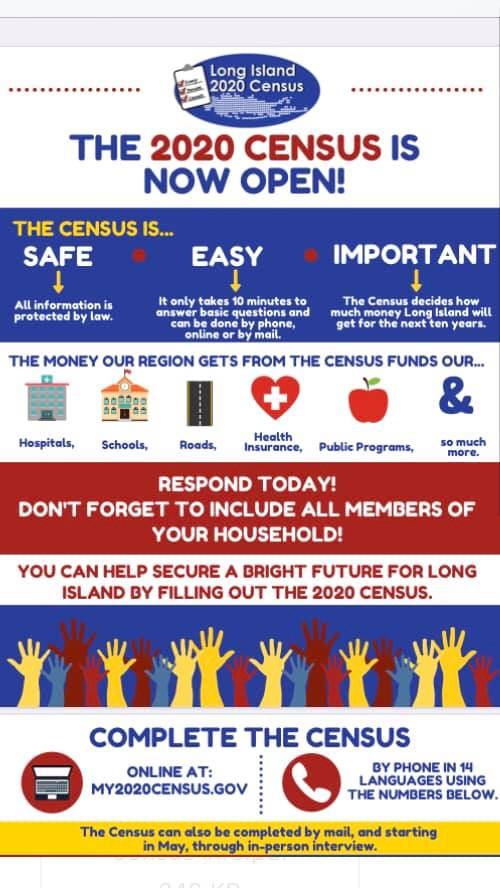
Census 2020

Via Dr. Eve Krief on Facebook.

#Census2020
The Census starts arriving in mailboxes today! Complete by mail, online or by phone . Our responses will determine the allocation of crucial federal funding our communities rely on!

https://2020census.gov/en.html

89238823_820630401754178_1068699888876781568_n

Note:

Vox:
“It looks like Trump is trying to trick people into filling out “census” forms online”

Fight back, >>


Trump cronies have found yet another scheme to manipulate redistricting:

➢ The RNC is sending out political mailers that look like official census documents. (The state of Montana even warned voters about the scam.)

➢ The Trump campaign ran deceptive Facebook ads to trick people into filling out fake “census” forms.

We’re going to have to fight harder than ever to ensure fairness in the face of these shady practices. Can you pitch in to help?

Let’s review all the ways Trump and Republicans have attempted to manipulate the 2020 Census in order to supercharge their gerrymandering:

➢ They tried to add a discriminatory citizenship question to depress census participation among immigrant communities and communities of color. If they’d been successful, Republicans would have gotten more seats than they were due in Congress and state legislatures.

➢ When the Supreme Court shot down their plan, they started compiling other types of data to try to diminish minority voices during redistricting.

➢ And now they’re using misleading mailers and online ads that look like official census documents which could depress census participation.

There’s no limit to how low they’re willing to stoop, David. But we’re committed to fighting them tooth and nail until we achieve a fair census and fair elections.

Time is running out before voters go to the polls for the last time before redistricting. Will you rush a donation NOW?

Posted in census, long island, Uncategorized, Zeldin | Tagged , , | Comments Off on Census 2020

Why do many British people not like Donald Trump?

Nate White’s stunning answer to the question: Why do many British people not like Donald Trump?

It was a question asked on Quora February 12, 2019: Why do many British people not like Donald Trump?

Nate White is a London-based copy writer, an advertising guy. His Quora profile says, “Drinks coffee. Writes copy.” Nate took a swing at answering the question.

The 90 year-old Queen is forced to go around our idiot President,
who doesn’t even know how to walk properly.” (The Wow Report)

Sadly, for some reason the thread has been deleted from Quora (threats from Trump’s side?) Several people were inspired to preserve it on blogs and in other forms. Ronald Lebow (@RonaldLebow) posted the piece in a series of Tweets, a thread.


Here is Nate White’s answer to the question, “Why do some British people not like Donald Trump.”

A few things spring to mind…

Trump lacks certain qualities which the British traditionally esteem.

For instance, he has no class, no charm, no coolness, no credibility, no compassion, no wit, no warmth, no wisdom, no subtlety, no sensitivity, no self-awareness, no humility, no honour and no grace – all qualities, funnily enough, with which his predecessor Mr. Obama was generously blessed.

So for us, the stark contrast does rather throw Trump’s limitations into embarrassingly sharp relief.

Plus, we like a laugh. And while Trump may be laughable, he has never once said anything wry, witty or even faintly amusing – not once, ever.

I don’t say that rhetorically, I mean it quite literally: not once, not ever. And that fact is particularly disturbing to the British sensibility – for us, to lack humour is almost inhuman.

But with Trump, it’s a fact. He doesn’t even seem to understand what a joke is – his idea of a joke is a crass comment, an illiterate insult, a casual act of cruelty.

Trump is a troll.

And like all trolls, he is never funny and he never laughs; he only crows or jeers.

And scarily, he doesn’t just talk in crude, witless insults – he actually thinks in them. His mind is a simple bot-like algorithm of petty prejudices and knee-jerk nastiness.

There is never any under-layer of irony, complexity, nuance or depth. It’s all surface.

Some Americans might see this as refreshingly upfront.

Well, we don’t. We see it as having no inner world, no soul.

And in Britain we traditionally side with David, not Goliath. All our heroes are plucky underdogs: Robin Hood, Dick Whittington, Oliver Twist.

Trump is neither plucky, nor an underdog. He is the exact opposite of that.

He’s not even a spoiled rich-boy, or a greedy fat-cat.

He’s more a fat white slug. A Jabba the Hutt of privilege.

And worse, he is that most unforgivable of all things to the British: a bully.

That is, except when he is among bullies; then he suddenly transforms into a snivelling sidekick instead.

There are unspoken rules to this stuff – the Queensberry rules of basic decency – and he breaks them all. He punches downwards – which a gentleman should, would, could never do – and every blow he aims is below the belt. He particularly likes to kick the vulnerable or voiceless – and he kicks them when they are down.

So the fact that a significant minority – perhaps a third – of Americans look at what he does, listen to what he says, and then think

‘Yeah, he seems like my kind of guy’

is a matter of some confusion and no little distress to British people, given that:

Americans are supposed to be nicer than us, and mostly are.

You don’t need a particularly keen eye for detail to spot a few flaws in the man.

This last point is what especially confuses and dismays British people, and many other people too; his faults seem pretty bloody hard to miss.

After all, it’s impossible to read a single tweet, or hear him speak a sentence or two, without staring deep into the abyss. He turns being artless into an art form;

He is a Picasso of pettiness; a Shakespeare of shit.

His faults are fractal: even his flaws have flaws, and so on ad infinitum.

God knows there have always been stupid people in the world, and plenty of nasty people too. But rarely has stupidity been so nasty, or nastiness so stupid.

He makes Nixon look trustworthy and George W look smart.

In fact, if Frankenstein decided to make a monster assembled entirely from human flaws – he would make a Trump.

And a remorseful Doctor Frankenstein would clutch out big clumpfuls of hair and scream in anguish:

‘My God… what… have… I… created?’

If being a twat was a TV show, Trump would be the boxed set.

Posted in Trump, Uncategorized, Zeldin | Tagged , , , , , , | Comments Off on Why do many British people not like Donald Trump?

COVID-19 is here!

We now have a confirmed case admitted at Southampton Hospital.  It is time to reassess.   Although there is but a single patient confirmed on the South Fork of Long Island, suspicion is running high. (update 3/11: 6 cases in Suffolk county including one in the retirement home PECONIC LANDING).  A local physician tells me that patients with potential COVID-19 symptoms are examined in the parking lot, in their cars, by the physician (wearing protective gear).  This is in order to avoid transmission to critical medical staff in the office.  Healthcare professionals are a known risk group for contacting COVID-19. But physicians on the South Fork are still struggling to get testing for their patients.

Delays in testing

A few days ago I called the Suffolk County Department of Health to inquire about getting COVID-19 tests done on people that had recently returned from international travel to countries with now well-documented outbreaks.  These persons also had flu-like symptoms.  The county officials thought this did not meet CDC criteria for testing (no high fever and no acute respiratory distress) and they recommended self-isolation.  I know first hand how unreliable self-isolation can be!  A recent news report confirmed my suspicions when a Missouri patient’s family broke quarantine to attend a school dance!

The problems seem to have been threefold — the Centers for Disease Control did not move quickly enough to manufacture test kits at scale (either because of lack of funding or political will) nor did it open up testing options to other institutions that could have worked to develop tests — and because of the limited availability of tests, the CDC rationed how many tests were performed. Those issues were compounded by the initial release of faulty tests by the CDC in early February.

As former U.S. Food and Drug Administration official Scott Gottlieb wrote on Twitter in early February, “Since CDC and FDA haven’t authorized public health or hospital labs to run the tests, right now #CDC is the only place that can.

Also, the CDC has somewhat arbitrary criteria (?) for placing countries on the list of places that will increase your risk of having contracted COVID-19.  Here is a list of countries with documented cases as a percentage of the population size.  Level 3 Travel Health Advisory (CDC) applies only to the top 4 on the list.  Note that  Bahrain with 5.42 documented cases/100,000 inhabitants does not make the list while China with 5.79 does! Neither does Switzerland with 3.96 cases, where many cases have been tourists from its southern neighbor, Italy.

Screen Shot 2020-03-09 at 1.22.27 PM

The above graph comes from a local Swiss Newspaper (NZZ) – test your German skills!

By January there was a test available.  It was offered worldwide by Roche, Inc. FOR FREE and to any country in the world!  The US declined the offer.  Read more about these early missteps here.
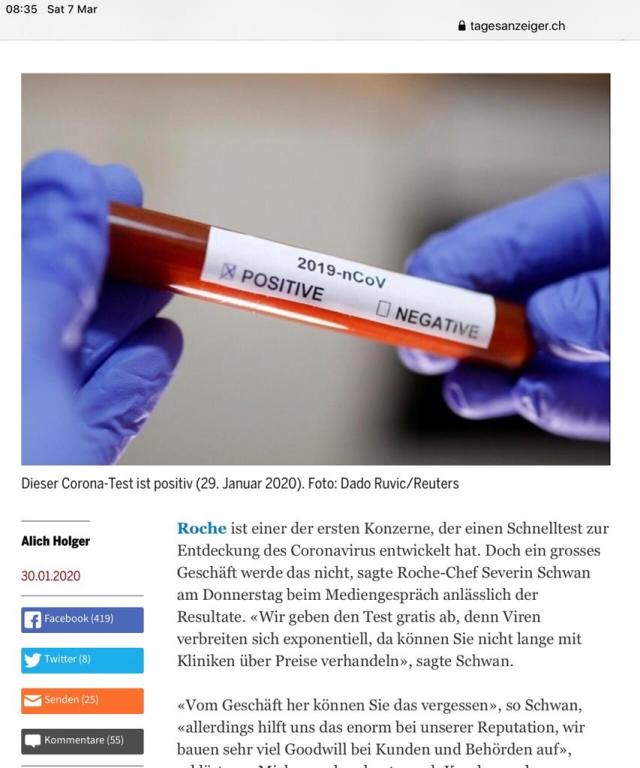
PHOTO-2020-03-07-04-54-04

The above report is from a Zurich Newspaper: note the date on the sample is Jan 29th 2020.

Note also, patients that took the test were billed about $200 (SFR 180) for labor of administering the test.  That was their entire cost.

At the time an astute observer commented: “It’s very difficult to understand that countries like the US didn’t seize the opportunity to get the test for free. Perhaps some US companies wanted to make money by developing their own tests?”

Thermo Fisher Scientific corporation provides the COVID-19 test in the US currently. According to the Associated Press, Donald Trump, has listed investments in Thermo Fisher Scientific Corporation (TMO), which moved jobs out of the U.S. in high profile outsourcing deals. Apparently, Donald Trump stands to profit from medical testing of coronavirus that will now take place in the United States.

The response by the administration

The reason that COVID-19 cases are low in the USA is most likely because it has been difficult to get patients tested.

For instance,  a recent CDC conference gave us a glimpse into Trump’s view of the coronavirus as a political rather than health issue.  Trump said he would rather have the passengers of the Grand Princess, a cruise ship docked in San Francisco with 21 confirmed cases on board, stay on the ship than move to land — all because doing so would raise the number of total Covid-19 cases in the US:

“I would rather because I like the numbers being where they are,” Trump said. “I don’t need to have the numbers double because of one ship that wasn’t our fault.”

It is unclear how many people have been infected by the virus due simply to a delay in testing, but it has become increasingly clear in recent days that there are Americans infected with the virus across the country.  It is naive to think that one can suppress the numbers.

Trump fears the fall out on the economy and indirectly on his political chances in November. But his actions are likely to make things worse for himself.

The coronavirus outbreak has U.S. companies starting to shutter offices and send workers home through layoffs, furloughs or directives to telecommute until health risks from the spreading virus recede.  Even if that’s helpful to guard against further spread of the disease, it’s triggering widespread uncertainty and the biggest threat to the labor market since the financial crisis almost a dozen years ago.

The evidence is expected to show up through lost consumer spending.
“If workers can’t work … production and income go down,” Georgetown University economist Harry Holzer said. “That becomes a demand problem if workers lose income and stop spending.”  When that happens, “odds of recession can go way up.”

Eleven states, including California, Massachusetts and New York, require employers to offer workers paid leave, as does the District of Columbia. But none of these jurisdictions explicitly guarantee the benefit to healthy workers on leave because a virus outbreak sent everybody home.

Fourteen Democratic senators last week wrote to leaders of the Business Roundtable, the Chamber of Commerce and the National Association of Manufacturers to urge their member companies not to penalize workers for going home during the outbreak.
Paid sick days are particularly rare for low-income workers. Ninety-three percent of workers in the top tenth of the income distribution get paid sick leave, compared with only 30 percent of those in the bottom tenth, according to the Economic Policy Institute, a left-leaning think tank.

Our Healthcare system can not handle a pandemic efficiently

Finally, let’s consider our health care system and how it is ill-suited to handle a pandemic: America’s Health System Will Likely Make the Coronavirus Outbreak Worse
Out-of-network costs, high deductibles, and confusing coverage options may keep people from getting tested or receiving care (Abigail Abrams)

Deductibles, networks, and a complicated insurance bureaucracy—that already make it tough for many Americans to afford medical care under normal conditions will likely make the outbreak worse.

First, people must actually choose to get tested—a potentially expensive prospect for millions of Americans. While the government will cover the cost of testing for Medicaid and Medicare patients, and for tests administered at federal, state and local public health labs, it’s unclear how much patients will be charged for testing at academic or commercial facilities, or whether those facilities must be in patients’ insurance networks. Just recently, a Miami man received a $3,270.75 bill after going to the hospital feeling sick following a work trip to China. (He tested positive for the seasonal flu, so did not have the new coronavirus, and was sent home to recover.)

Those who test positive for COVID-19 possibly face an even more financially harrowing path forward. Seeking out appropriate medical care or submitting to quarantines—critical in preventing the virus from spreading further—both come with potentially astronomical price tags in the U.S. Last month, a Pennsylvania man received $3,918 in bills after being released from a mandatory U.S. government quarantine after he and his daughter were evacuated from China. (Both the Miami and Pennsylvania patients saw their bills decrease after journalists reported on them, but they still owe thousands.)

In 2019, 82% of workers with health insurance through their employer had an annual deductible, up from 63% a decade ago, according to a report from the Kaiser Family Foundation. The average deductible for a single person with employer insurance has increased from $533 in 2009 to $1,396 last year.  The timing of the new coronavirus at the beginning of the year makes the outlook even worse: because most deductibles reset each January, millions of Americans will be paying thousands out of pocket before their insurance companies pay a cent.

Many patients may simply decide not to go to the doctor, which is “exactly the opposite of what we want to happen in this type of situation.”

Public health experts and Democrats have also criticized the Trump administration’s decision to allow people to sidestep the Affordable Care Act’s rules and buy limited, short-term health insurance coverage. Such “junk plans,” are not required to cover diagnostic tests or vaccines.

A large group of health, law and other experts released a letter this week urging policymakers to “ensure comprehensive and affordable access to testing, including for the uninsured.”

The Trump Administration is considering using a national disaster recovery program to reimburse hospitals and doctors for treating uninsured COVID-19 patients. And even Republicans, who have traditionally opposed health care paid for by the government, are warming to the idea. “You can look at it as socialized medicine,” Florida Rep. Ted Yoho, who has vocally opposed the Affordable Care Act, told HuffPost this week. “But in the face of an outbreak, a pandemic, what’s your options?”



Posted in Coronavirus, East Hampton, Health Care, long island, Medicaid, medicare, Trump, trumpcare, Uncategorized | Tagged , , , , | Comments Off on COVID-19 is here!

Sanders’ Vaporware

Published as an LTE in the East Hampton Star.

Vaporware
Springs, February 24, 2020

Why doesn’t Bernie Sanders level with voters as to how he plans to pay for his flagship “Medicare for All” plan? The answer is simple: He can’t.

Take a look at Sanders’s official campaign website and take a look at his program for Medicare for All. If as Senator Warren says Pete Buttigieg’s plan is nothing more than a “Post-it,” the Sanders plan is more like a postage stamp. Nowhere does his campaign site include a plan for paying for his pie-in-the-sky program. After spending seven-plus years of foisting this plan on voters, one would think he would be able to explain it to us. He can’t, because it is unworkably expensive.

In short, it is nothing but political vaporware. What is vaporware? When the term was in vogue it described efforts by software companies to promise a non-existent product to deceptively discourage customers from buying an existing competitive product (or discourage competitors from developing one). So what Sanders is doing is deceptively attracting voters to a Medicare for All plan that promises everything but will deliver nothing.

And what’s even worse is that there is proof of his plan’s nonviability from an actual attempt to launch a similar plan. And guess where that plan was tried? Vermont (Bernie’s home state)! In 2011, then-Governor Pete Shumlin euphorically promised a single-payer plan, dubbed Green Mountain Care. Backed by advocates bordering on the “theological,” Green Mountain Care (encouraged by Senator Sanders) promised a system of health care for all that would save money, even though no one knew what it would cost when it passed in 2014.

That belief proved hopelessly naïve. As the Green Mountain plan moved into implementation, it became clear that the plan would double Vermont’s budget, would require raising state income taxes by up to 9.5 percent, and imposing an 11.5-percent payroll tax on employers.

The Green Mountain Plan crashed in flames in 2014, after the governor realized that the only economically viable plan would offer Vermonters less protection than they already had.

So there is every reason for Senator Sanders to avoid discussing how his Medicare for All plan would be financed (other than in the broadest of generalities, like “taxes would go up.” (Yes, but how much?) There is an equally obvious reason why he fails to even mention the failed Vermont plan, and a mysterious absence of any explanation of how his plan would correct the deficiencies of the Vermont plan he touted at the time.

Given Senator Sanders’s evasions, it is incumbent upon voters (and his competitors) to put his feet to the fire and force him to explain in detail, with data, how his plan would be paid for and why it would behoove 150 million Americans to vote for a candidate who would deprive them of their existing health care for an unknown product. Until he comes clean, it’s vaporware, and voters should beware of being duped. Taking him on faith could not be more dangerous.

Sincerely,  BRUCE COLBATH

Posted in Health Care, Medicaid, medicare, Uncategorized | Tagged , , , , | Comments Off on Sanders’ Vaporware

Exposing Lee Zeldin’s Record on Healthcare

the-republican-healthcare-bill-would-bring-close-to-unprecedented-chaos-in-the-health-systemRemember the Graham Cassidy bill?


By Perry Gershon

Representative Lee Zeldin (R-NY1) is a master at telling half-truths. He goes to great lengths to tell his constituents that he supports healthcare coverage for people with pre-existing conditions and lowering prescription drug prices, but his voting record says differently. Zeldin voted against coverage for pre-existing conditions, and just recently shot down a bill for prescription drug coverage reform and prescription drug coverage reform. He even has the audacity to take credit for programs he voted against. A quick look at his record, however, is quite revealing.

Lee Zeldin voted to repeal the Affordable Care Act (ACA). He has cast several such votes in his three terms in office, most recently May 2017 (and he openly urges the courts to overturn the ACA now). The federal requirement to provide coverage for people with pre-existing conditions comes directly from the ACA, so Zeldin’s opposition to coverage for pre-existing conditions is right there in his votes! Zeldin and Trump claim to offer ACA-replacement legislation that provides for pre-existing condition coverage, but these bills do not protect consumers, especially those with pre-existing conditions. They provide no requirement that these individuals will not be penalized in pricing and availability of coverage.

When Congress, in December 2019, passed its bill to make prescription drugs more affordable, Lee Zeldin voted against the bill (HR-3). His position on this critical issue is again demonstrated by his vote. The only effective way to control the cost of prescription drugs is to let Medicare, the largest consumer, negotiate drug prices directly with the manufacturers. It’s no surprise that Zeldin continues to prohibit Medicare from negotiating because much of his campaign contributions come from drug makers and their affiliates. This isn’t me saying this, it’s right there in his campaign finance reports that he is legally obligated to file with the Federal Election Commission. Given Zeldin’s benefactors, it’s no wonder he opposes true prescription price reforms.

Zeldin takes credit for funding medical research at Stony Brook. His most recent February “newsletter” stated that he secured $3 million of new NIH grants to Stony Brook for medical research, and he cites a bi-partisan letter he signed requesting a budget increase specifically for NIH research. What Zeldin does not tell you is that when the actual budget came to a vote on July 25, 2019, he voted against it. His own voting record proves that Zeldin did not vote to increase NIH appropriations or increased funding for Stony Brook.

But Zeldin’s biggest deception of all is that he is has listened and knows what his constituents need for their healthcare. Again, the facts belie that. Zeldin’s last public town hall was in April 2017, before his vote to repeal the ACA. He has not held one since then. He has no idea what his constituents want or need!

Town halls are meant to be open to ALL constituents who want to attend. There should be no prescreening of questions or questioners (to exclude critics) or else it is not really a true town hall. I know this from first-hand experience.

I have held five open town halls since last September and I will hold five more before the end of June. I take questions from Democrats, Republicans – whoever attends and wants to ask a question. As a matter of fact, I take each and every question asked of me and I give truthful fact-based answers. There is no pre-screening and no spin at my town halls.

People on Long Island deserve a representative who will listen to them when they speak out about healthcare. I want to see universal healthcare for everyone – and I believe we can do it with the ACA supercharged with a public option. We need to allow Medicare to negotiate drug prices to achieve true pricing reforms. This November, we have a chance to give NY-1 a representative who will fight for us in Washington and tell us the truth here at home.

Originally published in the Village Times Herald

Posted in drug costs, Health Care, Medicaid, medicare, perry gershon, Trump, Uncategorized, Zeldin | Tagged , | Comments Off on Exposing Lee Zeldin’s Record on Healthcare

COVID-19: just a bad flu?

Last night Pres. Trump spoke to the nation about the Corona virus epidemic.

Quotes: “I am shocked by the number of people who die from the common flu annually. ” The gist being this cannot be much worse than the flu.

Said “he did not think the virus’s spread was “inevitable.””  The intent: calm the jittery markets.  Attack Dems and free Press for raising alarms. I thought health care is about saving lives, not saving the stock market!

So I thought it was time to do some research (to satisfy my wife who asked) isn’t this just a bad flu?

How about death rates?

Influenza:

For 2017/2018 season  – the over all death rate/number of cases was 61,000/45,000,000 = 0.136 %

(Yes DT there are many thousands of cases every year)

MERS (a coronavirus)

Since September 2012,  2,494 confirmed cases (WHO)

MERS-CoV associated deaths since September 2012:  858

the overall death rate was 858/2494 = 34.4 %

For more: MERS Situation Updates


SARS (a coronavirus)

The sample’s overall case-fatality rate was 2.3%

but that depends a lot on the sample group: https://www.marketwatch.com/story/coronavirus-fatality-rates-vary-wildly-depending-on-age-gender-and-medical-history-some-patients-fare-much-worse-than-others-2020-02-26


COVID19

Overall cases 72,000 (as of this writing); overall death rate is 2.3%

But the death rate is much higher in the critically ill and elderly:  49%

http://www.cidrap.umn.edu/news-perspective/2020/02/study-72000-covid-19-patients-finds-23-death-rate


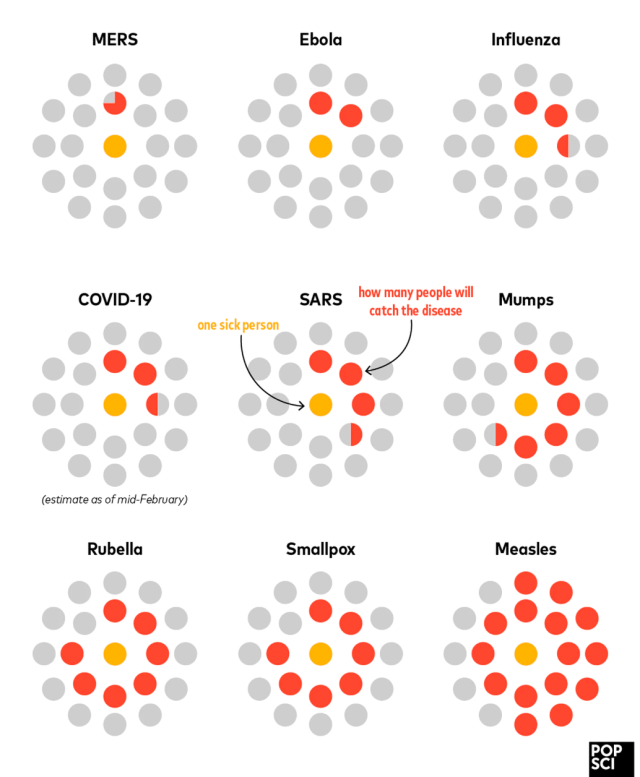
How infectious are these viruses compared to one another:

https://www.popsci.com/story/health/how-diseases-spread/

Screen Shot 2020-02-27 at 4.38.27 PM


I.e.  how many uninfected people (red) will one COVID-19 infected patient (yellow) infect?  Hope this helps.

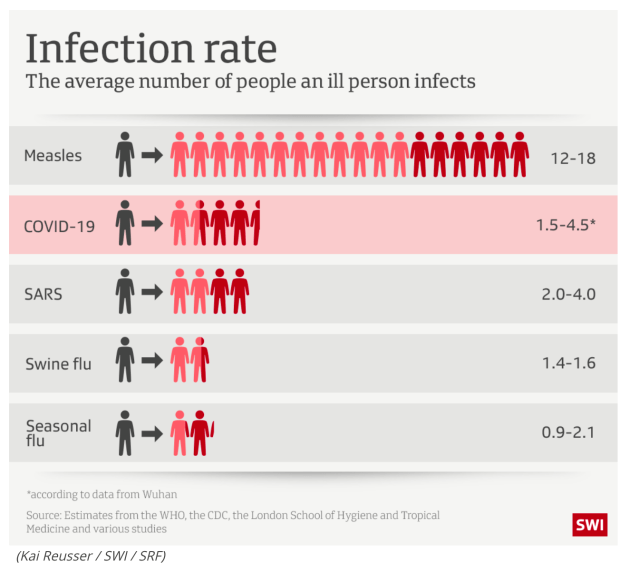
MORE on the infection rate from a different source (probably more accurate):

Screen Shot 2020-03-06 at 3.36.47 PM

Posted in Health Care, Trump, Uncategorized, Zeldin | Comments Off on COVID-19: just a bad flu?

Septic Taxation: The Zeldin Tax?

Unknown-2


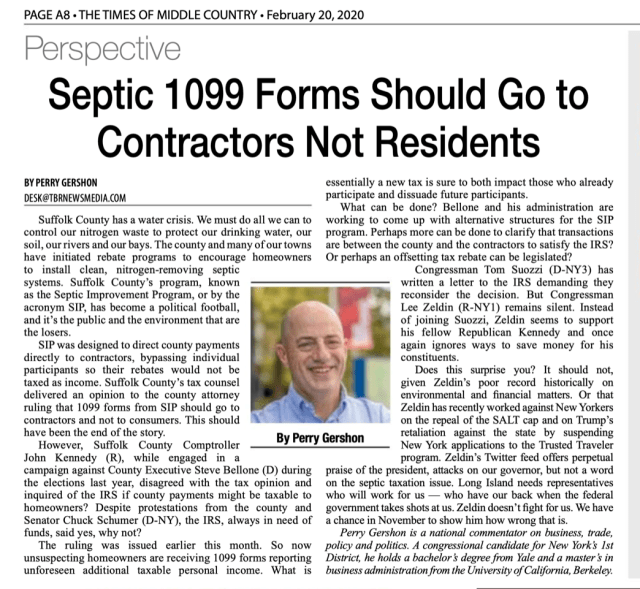
Posted in Trump, Uncategorized, water quality, Zeldin | Tagged , | Comments Off on Septic Taxation: The Zeldin Tax?